
Culture · 2026-10-13
Beyond Switzerland: the creative independence of Belgian watchmaking
An in-depth look at Belgium’s surprisingly diverse independent watch scene, from Ressence’s mechanical interfaces and L’Artisan’s remarkable stone dials to Raidillon’s racing heritage.
Save this watch to revisit later.
Share this article
By Chronolume digest · Original English summary · Based on Ressence; L’Artisan; Raidillon; manufacturer sources
What to know
Belgium is not usually the first country named when watch collectors describe the geography of fine horology. Switzerland commands the industrial mythology, Germany has Glashütte, and Japan has developed a language of precision and finishing all its own. Yet Belgian independent makers offer something unusually compelling: a scene that has less interest in imitating a national tradition than in testing what a watch might be. From a dial that moves like a small mechanical planetarium to stone cut and finished at a workbench in West Flanders, Belgian watchmaking is defined less by one aesthetic than by a willingness to make individual decisions.
That difference matters. The word independent can describe very different businesses: a designer who commissions Swiss movements and concentrates on the complete product, a tiny atelier that finishes its dials and assembles watches by hand, or a specialist making a mechanically radical timepiece with the support of industrial partners. Independence does not automatically mean that every screw is manufactured locally. A more useful question is who takes responsibility for the concept, the design and the result—and how clearly that work is explained to the buyer.
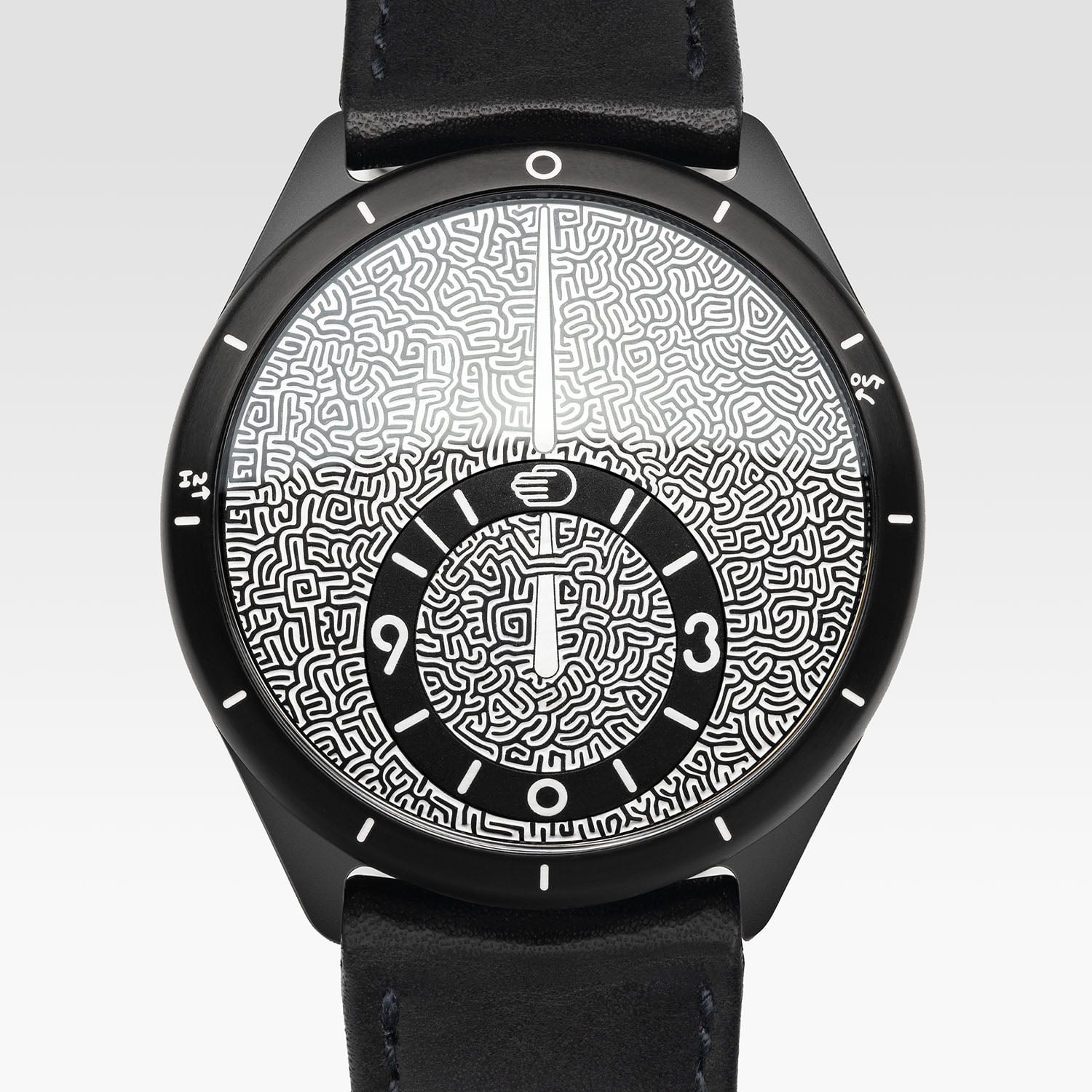
Perhaps the clearest expression of Belgian design-led watchmaking is Ressence. Founded by industrial designer Benoît Mintiens in 2010, the brand begins with an almost deceptively simple provocation: why must an analogue wristwatch use conventional hands? Its Orbital Convex System, usually shortened to ROCS, distributes indications across discs that continuously orbit the dial. What might have seemed like a digital-interface experiment is achieved through mechanical engineering. The display reads as one surface in motion rather than separate hands moving over a static background.
The design philosophy is more important than the novelty alone. On a conventional watch, the owner learns to identify a central hand, a date aperture and perhaps a subdial. A Ressence asks the owner to learn a new grammar. Its rounded surfaces, disciplined typography and unconventional use of colour come from treating the dial as a designed information system. The best examples are strange only for the first few minutes; afterwards their geometry begins to feel inevitable.
In 2026 the company made a particularly significant move with the Type 11 and its Ressence Werk RW-01. The new movement was developed specifically to drive the orbital display rather than relying on the earlier approach of adapting a base movement. A power-reserve indication using small coloured ceramic balls makes the state of the watch visible in an unusually tactile way. For a design-led company, this is an important maturation: the mechanical architecture begins to follow the requirements of the interface from the start.
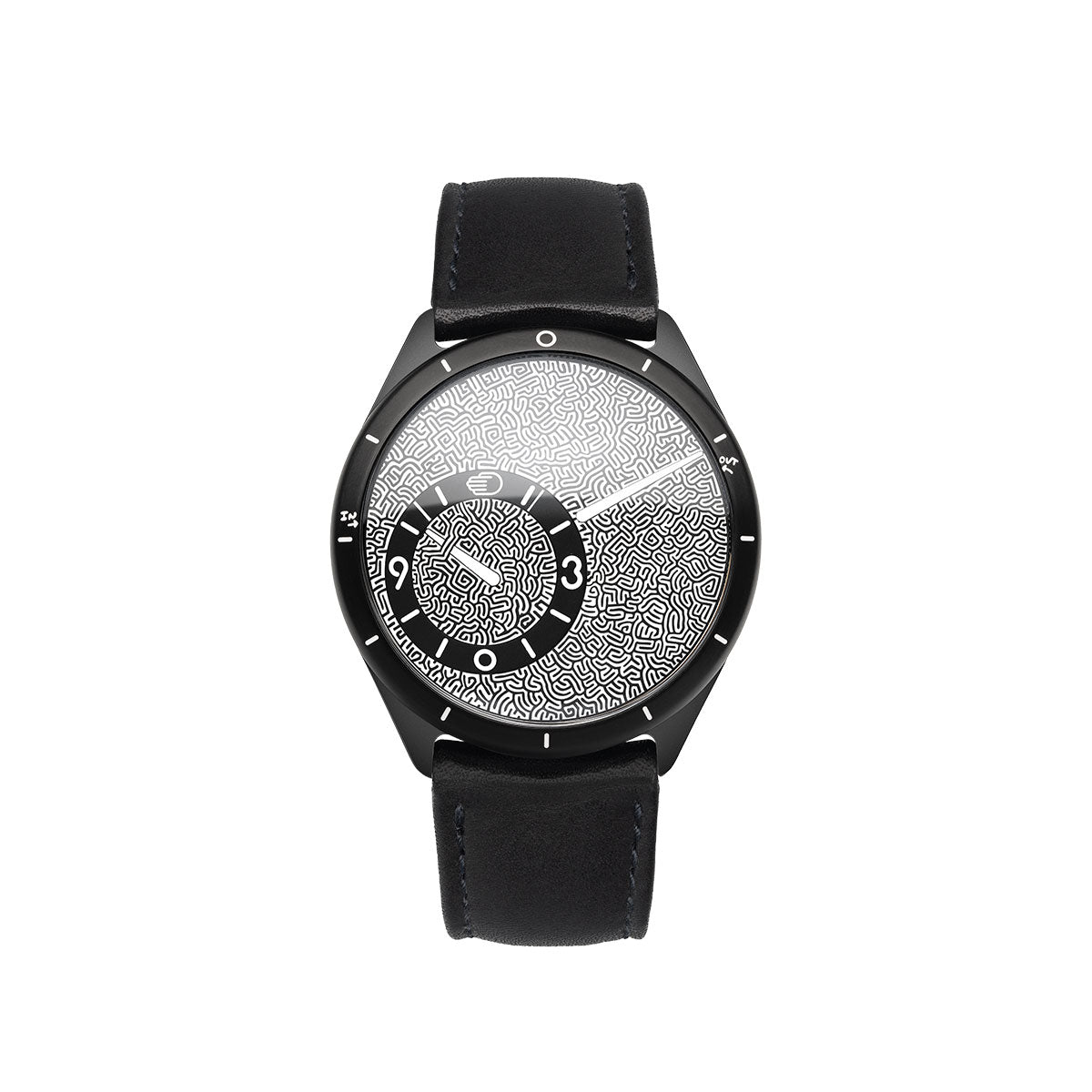
Ressence also reveals why Belgian watchmaking can intersect naturally with contemporary art. Its Type 9 collaboration with Belgian artist Jules Wittock places a hand-drawn labyrinth across the moving display. The engraving changes as the dial rotates, and its hidden path only resolves at particular moments of the day. The collaboration does not merely print a signature on an existing dial. Time itself changes the artwork, making the watch's mechanical system a medium for the artist.
At the other end of the scale sits L’Artisan, the atelier built by Arnaud in Menen. The story here is not about reinventing the indication of time; it is about changing what the surface of a watch can contain. The maker began young and largely self-taught, learning finishing, assembly and dial production through experimentation. Rather than build a brand around a familiar vintage silhouette alone, the workshop has increasingly focused on rare, difficult dial materials: stone, fossil, enamel and mosaic mother-of-pearl.
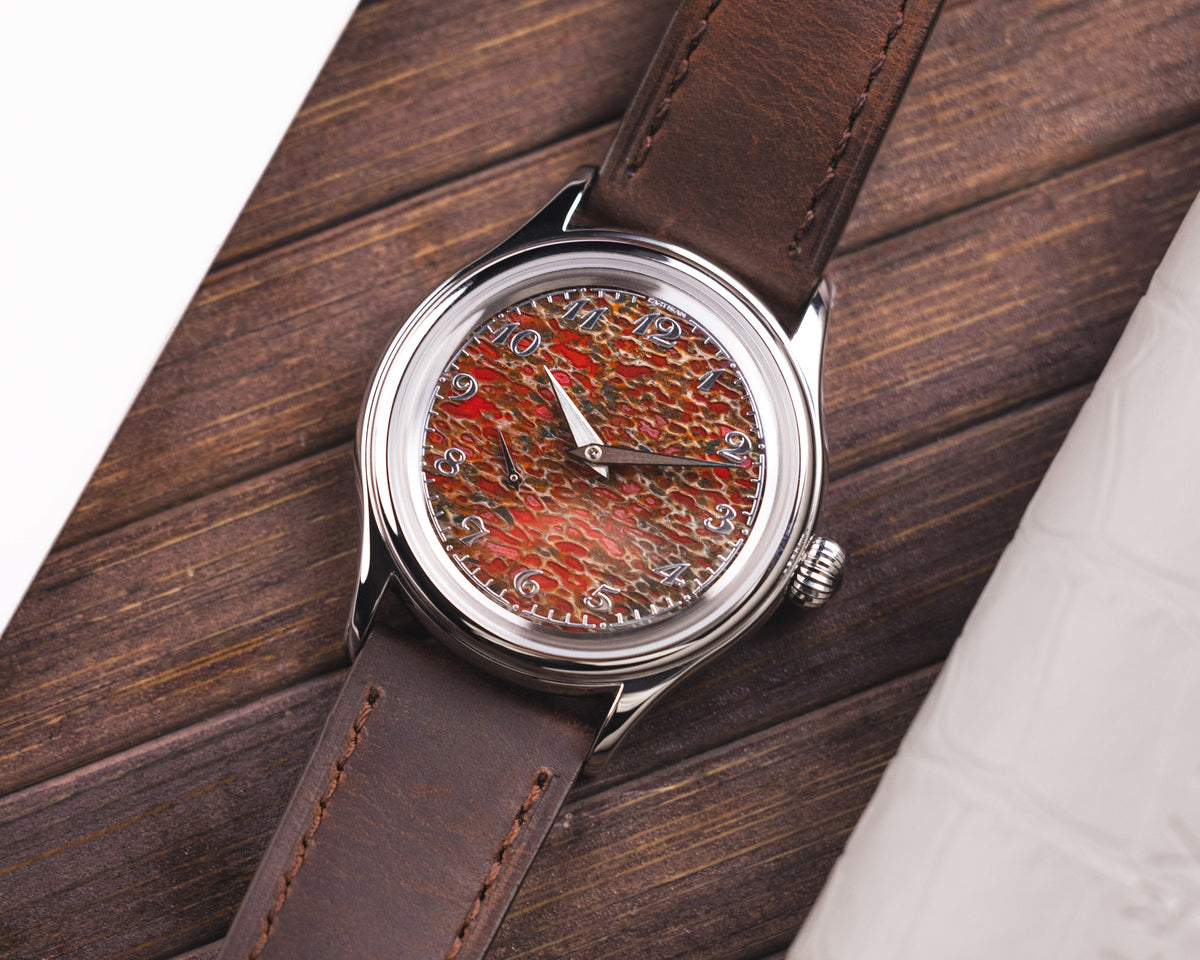
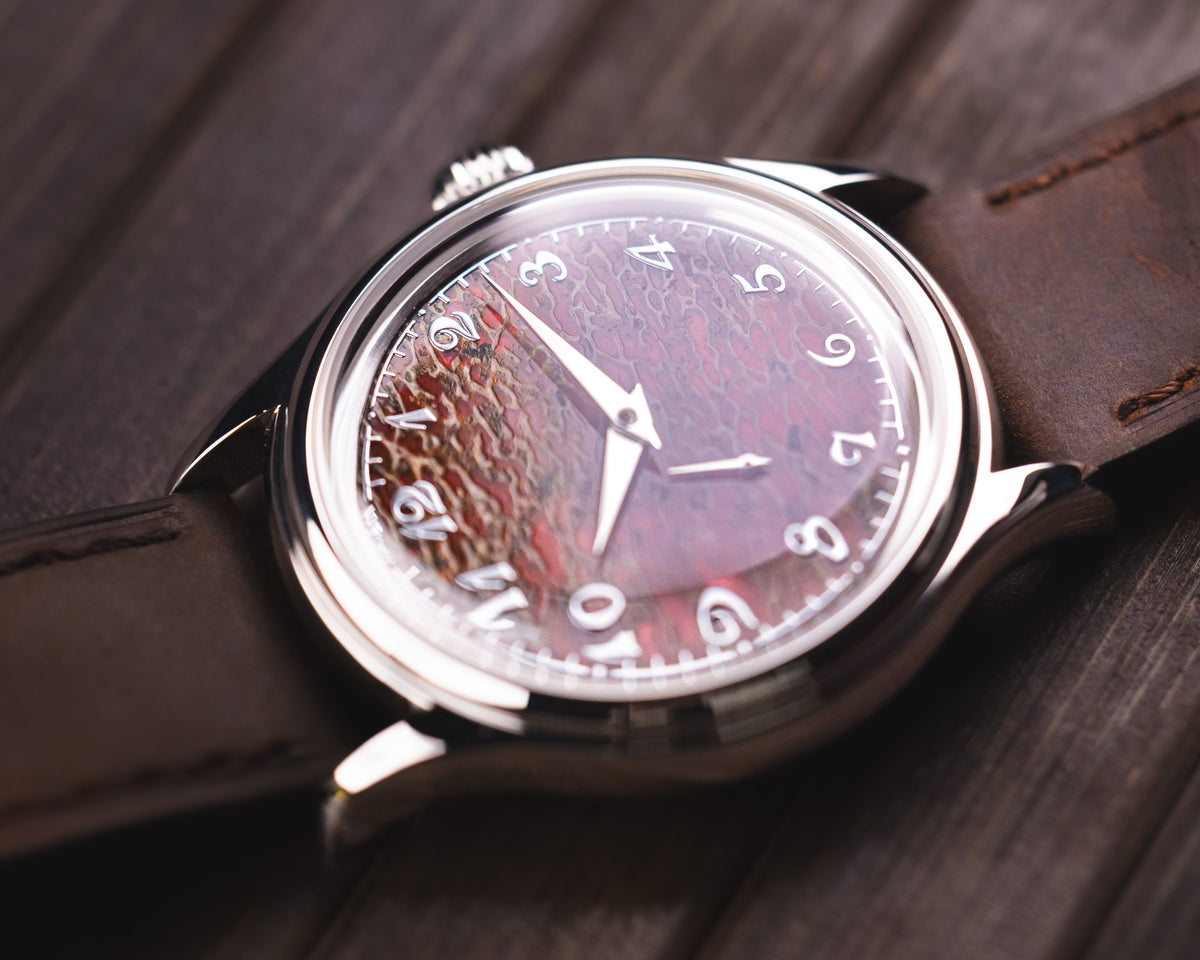
The Jurassic watch, built around fossilised dinosaur bone, is an attention-grabbing example. The fascination is not only the age of the material. Fossil is awkward, inconsistent and unforgiving compared with an ordinary industrial dial blank. Working it into something thin, even and aesthetically coherent requires the maker to reconcile geology with watchmaking tolerances. Every dial is different because the source material is different. Imperfection and variation become part of the promise, provided the work remains durable and technically sound.
The new Pietersite edition extends that idea. Often nicknamed Tempest Stone for its moving blue-and-gold appearance, pietersite has an internal fibrous structure that can produce dramatic optical effects as light changes. L’Artisan sources the material and finishes the stones in Belgium, applying classical Breguet-style numerals and a minute track above the natural pattern. The design tension is productive: an orderly, almost historical graphic language floats over a restless mineral surface.
This approach also makes Belgian independent watchmaking accessible at very different price points. A hand-finished stone-dial microbrand and a Ressence with its proprietary mechanism are not competitors in a conventional product comparison. One sells the intimacy and unpredictability of making; the other sells a fundamentally different experience of mechanical time. Their coexistence is what makes the local story interesting. It resists the idea that independent horology must occupy one narrow luxury category.
Motorsport provides a third identity. Raidillon takes its name from a famous part of the Spa-Francorchamps racing circuit and uses the visual vocabulary of competition: contrasting subdials, rally straps, bright accents and limited numbered production. Its 2026 anniversary chronographs show how watch design can use local cultural geography without relying on national flags. The shape of a racing stripe or the colour of a helmet can connect the object to Belgian sport more convincingly than a printed slogan.
Yet the scene is not automatically cohesive. These makers differ in price, production scale, origin of components and even the meaning they attach to Belgian manufacture. Calling something Belgian-made without explaining what happens in Belgium can conceal more than it reveals. Collectors benefit from precise attribution: where is the movement sourced, who finishes the dial, where is assembly completed and which aspects of design are proprietary? Transparency makes the story stronger, not weaker.
There is also a practical challenge in remaining independent. Small editions create excitement, but scarcity alone is not a design achievement. Serviceability, spare parts, continuity of the workshop and the ease of repairing a distinctive mechanism may matter far more over a twenty-year relationship with a watch. A collector buying an ambitious independent piece is also choosing a maker's capacity to care for it. For the smallest ateliers, after-sales service is part of their long-term cultural credibility.
Belgium's wider design culture helps explain why this field feels natural here. Graphic design, industrial design, fashion and craft have a long history of crossing boundaries in Antwerp, Brussels and beyond. Ressence approaches the watch as an interface; L’Artisan approaches the dial as a material experiment; Raidillon approaches the chronograph as an object of racing memory. These are distinct starting points, but each gives the wearer a reason to care about more than the movement specification.
For readers new to Belgian independent watches, the best entry point is not a ranking by price or complexity. Look for a piece whose central idea makes sense to you. Does the Ressence dial change how you understand time? Does a stone-dial L’Artisan make you more attentive to texture and light? Does a Raidillon connect to a circuit, driver or personal memory? Such questions lead to more interesting collections than simply chasing edition numbers.
Belgian independent watchmaking is still a small, varied and sometimes fragile landscape. That is precisely its attraction. It is a place where the definition of a watch remains negotiable, where a designer can challenge the placement of hands, a craftsperson can put geology on the wrist, and a racing enthusiast can translate a local sporting legacy into a mechanical object. The defining feature is not that all these watches look Belgian. It is that they do not have to look alike.
Source & attribution
Ressence; L’Artisan; Raidillon; manufacturer sources · Published 2026-10-13 ↗
Related perspectives
The best watch collaborations leave fingerprints on the design ↗