
Design · 2026-10-19
Built to Survive: 43 Years of G-SHOCK Industrial Design
From Kikuo Ibe's shock-resistant 1983 square to Carbon Core Guard, full-metal engineering, MR-G craftsmanship and experimental gold, the design ideas that made Casio G-SHOCK an icon.
Save this watch to revisit later.
Share this article
By Chronolume digest · Original English summary · Based on Casio G-SHOCK official history, technology, product and philosophy archives

What to know
INTRODUCTION — THE WATCH DESIGNED TO SURVIVE. Most watches are designed around the delicate act of keeping time. G-SHOCK was designed around what happens when timekeeping goes wrong: the fall, collision, vibration, water and dirt that can destroy a conventional instrument. Since 1983, that simple inversion has produced one of the most recognisable families in industrial design. More than a rugged electronic watch, G-SHOCK is a design language: protective shoulders, proud bezels, functional typography, layered colour and a case that visibly communicates its purpose.
1. THE QUESTION THAT STARTED EVERYTHING. Casio engineer Kikuo Ibe had a single objective after a treasured watch was broken in a fall: make a watch that would not break when dropped. In 1981 he organised Project Team Tough. Casio describes more than 200 prototypes and roughly two years of development before the first production watch appeared in 1983. The decisive idea came from observing a bouncing rubber ball. Instead of making every part impossibly hard, the team could protect the timekeeping module by allowing it to sit supported and cushioned inside a protective outer shell.
2. THE DW-5000C: WHY THE ORIGINAL SQUARE LOOKS THE WAY IT DOES. The 1983 DW-5000C was not designed as a style exercise. Its raised urethane outer bezel protected the crystal, while its surrounding structure sheltered the operating buttons. The protected digital display was legible at a glance; the broad case and molded strap formed a visual continuity from watch head to wrist. The famous near-square perimeter was the outward expression of a hollow protective structure. What eventually became a timeless silhouette originally looked unusually large and tough.

3. THE UNSEEN ARCHITECTURE. A G-SHOCK does not simply put a conventional watch inside a thick plastic case. The basic approach uses a protective frame, carefully located supports and materials that absorb and redirect energy. Casio's hollow-case concept positions the inner module away from the most direct path of impact, while the raised bezel and strategically designed buttons act as external guards. Shock tolerance is therefore an interaction between geometry, materials and movement design, rather than a single protective coating.
4. FORTY YEARS OF THE SQUARE. The DW-5600 family maintained the original model's rectangular LCD, guarded buttons and recognisable red-and-black graphic framing, even as the case materials and modules changed. The 1987 DW-5600C shows how quickly an engineering experiment became a durable template. Repeatability is a key part of great industrial design: the same archetype can be refined across generations without losing its identity.

5. FROM WORK GEAR TO STREET CULTURE. G-SHOCK's commercial story also changed its aesthetic meaning. Casio's accounts describe the watches gaining traction among American skateboarders and surfers before becoming fashion objects in 1990s Japan. The round DW-6900, released in 1995, proved the brand did not need to remain square. Its three circular upper indicators, large frontal light button and bold resin housing made it a natural canvas for colours, graphics and collaborations. The design became part instrument, part visual shorthand for urban youth culture.

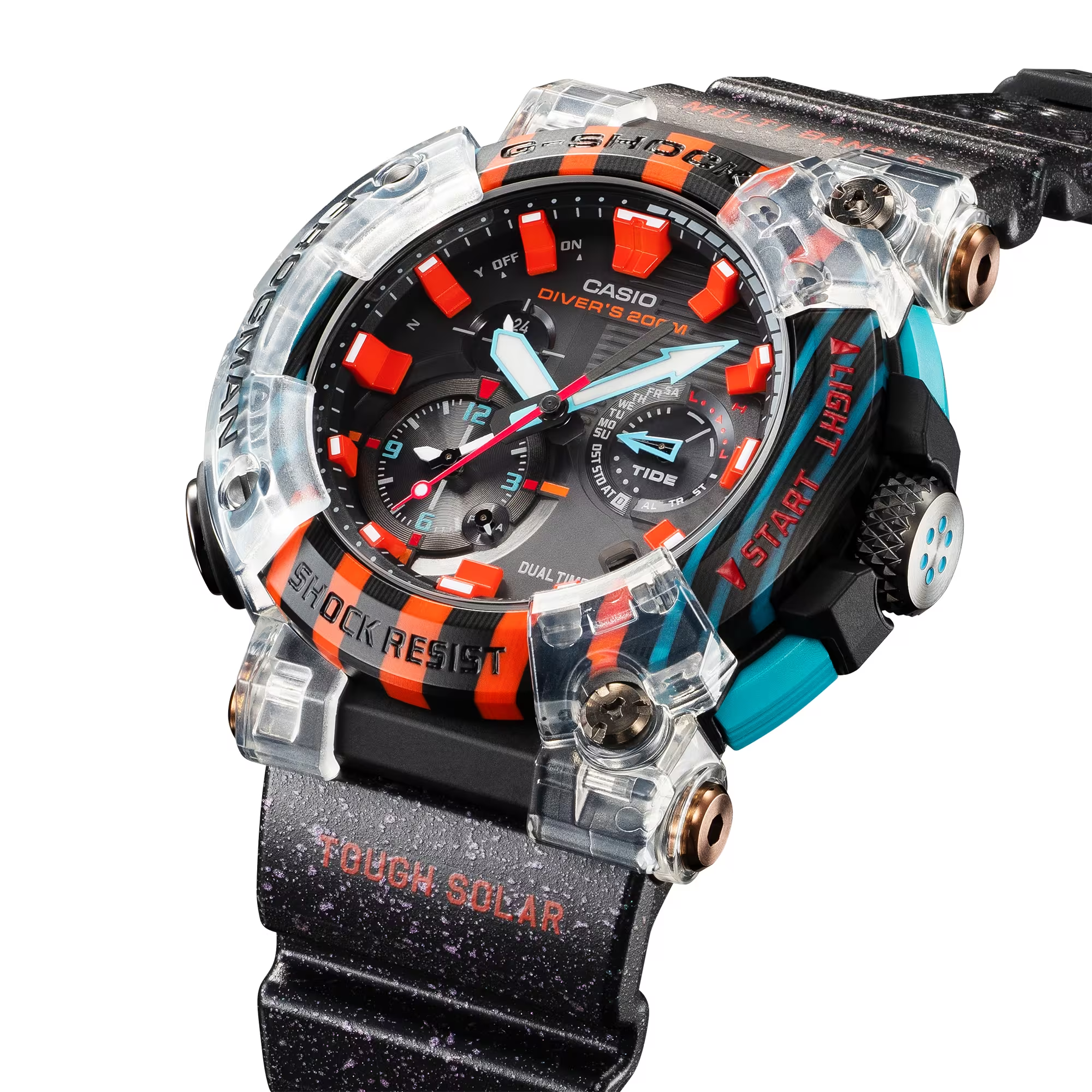
6. THE TOOL WATCH BECOMES A TOOLKIT. The G-SHOCK concept extended from impact protection into specialist tasks. The FROGMAN series, introduced with the asymmetric DW-6300 in 1993, was built for diving with ISO-rated 200-metre water resistance and a case arranged to preserve wrist movement. Rangeman models took another route: the GW-9400 combined resistance to hard use with compass, barometer/altimeter and thermometer functions. These watches reveal G-SHOCK at its most literal: a product shaped by a user's operating environment.

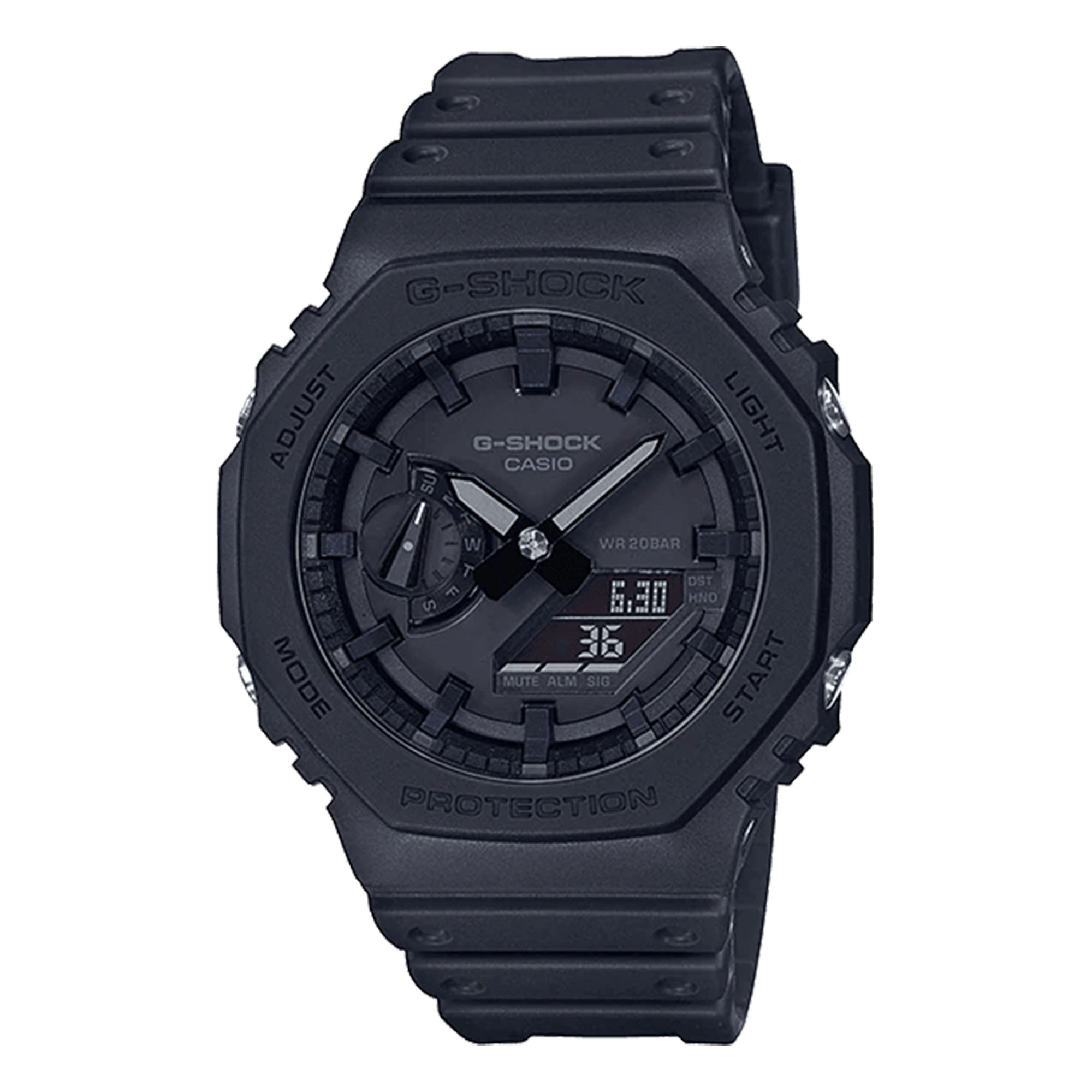
7. CARBON CORE GUARD: WHEN STRENGTH ENABLES SLIMNESS. The 2019 GA-2100 is a pivotal redesign because it made a shock-resistant G-SHOCK look slimmer and more restrained. Its carbon-fibre-reinforced resin inner case allowed an 11.8 mm profile, while the octagonal bezel referenced the early square family. The result looks almost like an analogue sports watch, yet its real story is structural. Carbon Core Guard illustrates a familiar industrial-design principle: smarter load paths and material selection can replace brute bulk.
8. THE FULL-METAL REVOLUTION. A steel G-SHOCK cannot merely be a resin square recast in heavier material. Metal transmits shock differently, so Casio redesigned the system for the 2018 GMW-B5000 series. Fine-resin buffers separate its steel exterior from the inner case; a redesigned bracelet connection spreads forces, and the screw-lock back adds solidity. Forging, precise machining, hairline brushing and polished bevels make every protective contour more visible. The GMW-B5000D-1 is the key reference: industrial protection translated into metal craftsmanship.

9. THE DESIGNER'S PLAYGROUND: RESIN, STEEL AND TITANIUM. Once the brand developed a dependable protective architecture, it could experiment with the visible shell. The titanium GMW-B5000TVA Virtual Armour takes cues from science-fiction equipment, with marked apertures and intentionally technical surface graphics. It is an extension of the same square but communicates a different idea: protection as futuristic body armour. Shape, finishing and printed information now become storytelling tools.

10. TRANSPARENCY AS A MATERIAL EXPERIMENT. The clear DW-5040RX anniversary watch exposes the physical object behind the iconic silhouette. Translucent elements show that resin is not merely cheap material hiding complicated parts; it is an engineering medium whose colour, translucency and texture can become a design feature. Visible structure encourages the wearer to understand how the object is assembled rather than treating the case as a sealed black box.

11. BIOLOGY, COLOUR AND THE FROGMAN. The Poison Dart Frog FROGMAN is an especially strong example of functional design becoming expressive design. Its intense spotted colour and layered translucent exterior borrow from amphibian warning patterns, while the underlying G-SHOCK architecture remains purpose-built for diving. This is not decoration pasted onto a generic product: the organic theme sits alongside an already amphibian-inspired asymmetric dive-watch identity.
12. JAPANESE CRAFT AND THE MR-G IDEA. At the premium end, MR-G demonstrates that the same fundamental toughness can coexist with labor-intensive finishing. The MR-G × Gassan limited edition draws on Japanese swordmaking, titanium working and surface decoration. The engineering brief is still protection, but the intended audience is also looking for workmanship, material subtlety and cultural meaning. G-SHOCK's range is therefore not best understood as a ladder from inexpensive to expensive: it is a set of different answers to the same structural challenge.

13. WHERE ARTIFICIAL INTELLIGENCE MEETS CAST GOLD. The one-off G-D001 'Dream Project' in 18-karat gold pushes the experimental logic to an extreme. Casio worked with AI-assisted structural ideation on a complex, gold-toned, highly sculptural watch. It is an exercise in manufacturing possibility, not a conventional mainstream product. What makes the experiment interesting is the continuity: decades after Project Team Tough, Casio was still exploring how a tough watch might be shaped from first principles.

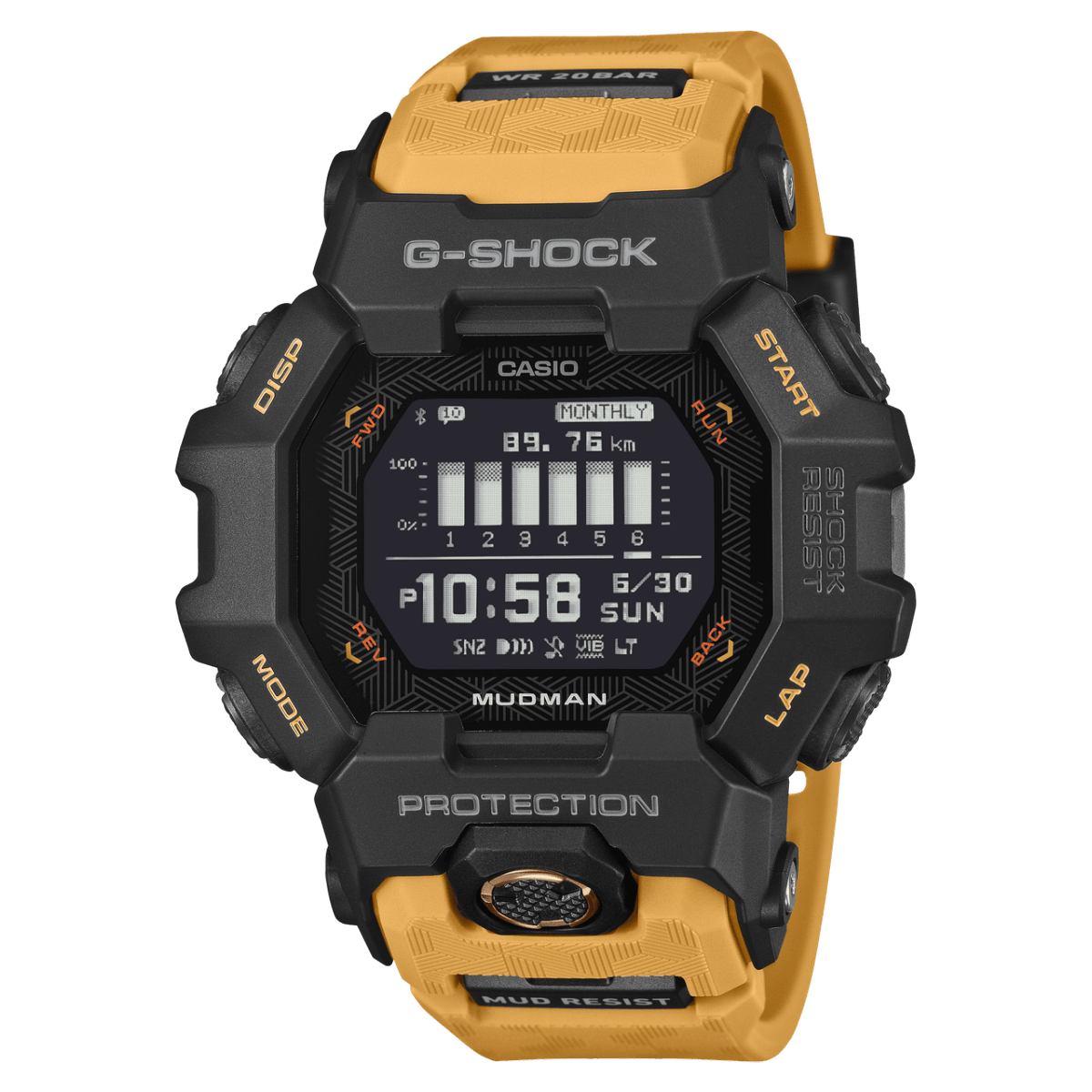
14. THE CONTEMPORARY TOOL: MUDMAN AND OUTDOOR READABILITY. Modern digital G-SHOCKs such as the GDG-B100 MUDMAN maintain the oversized protected controls and aggressive case language, but new displays and material choices keep evolving. These elements can look theatrical in studio photography; their purpose becomes obvious when gloves, mud, poor light and wet conditions enter the picture. Good rugged design is ultimately about legibility and control under imperfect circumstances.
15. THE BRIGHT METAL FUTURE. The blue-sapphire MR-G experiments show how dramatically new materials can change the emotional reading of a tough watch. Sapphire's lustre and precision manufacturing turn a watch associated with impact absorption into an object of jewel-like surface interest. The contrast may seem paradoxical, but it reflects G-SHOCK's enduring design tension: technical toughness can produce expressive beauty.

16. MORE THAN TIMEKEEPING TECHNOLOGY. Casio added solar-powered circuits, radio calibration, Bluetooth connectivity, GPS reception on selected models, LED lighting and specialised sensors. Tough Solar turns ambient light into stored energy; Multi Band 6 uses radio time signals where reception is available; connected models can simplify configuration through a phone. None of these applies to every G-SHOCK. What links them is usability: a watch meant to survive use should also reduce the effort required to keep it operating accurately.
17. WHY G-SHOCK LOOKS LIKE G-SHOCK. A G-SHOCK is recognizable even when its logo is hidden. Raised bezel edges, layered casings, protected pushers, high-contrast information, bold colour separations and visible fastening details all indicate that function precedes delicacy. The repeated shapes have become a visual vocabulary in the same way that exposed bolts or an industrial knurl signal engineering in other product categories. Its aesthetic is not always minimalist; it is deliberately expressive about the job it was built to do.
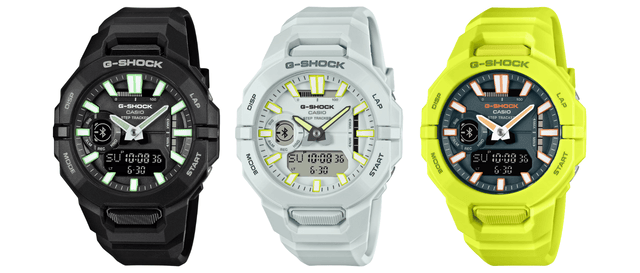
18. AN OBJECT FOR COLLECTORS AND EVERYDAY WEARERS. A resin square and a handcrafted MR-G can have little in common in price or finishing, yet they belong together because their identity is structural rather than merely decorative. The best G-SHOCK designs balance utility, recognisable forms and experiment. Some are tools meant to be scratched. Others are objects meant to be studied. Both are authentic expressions of the same original idea.
CONCLUSION — TOUGHNESS IS A DESIGN LANGUAGE. From the 1983 DW-5000C to carbon-core octagons, full-metal squares and titanium showpieces, G-SHOCK has evolved without abandoning its central premise. It made protective geometry visible, turned practical engineering into cultural symbolism, and offered an unusually coherent identity at vastly different prices. Forty-three years on, the enduring achievement is not a watch that can withstand a fall. It is an entire vocabulary of watch design created from the desire to survive one.
Explore the watches
Casio casio-gshock-dw5000c-1983-original · DW-5000C-1A ↗
Casio casio-gshock-dw5600c-1987-original · DW-5600C-1 ↗
Casio casio-gshock-dw6900-1995-triple-graph · DW-6900-1V ↗
Casio casio-gshock-rangeman-gw9400-2013 · GW-9400-1 ↗
Casio casio-gshock-ga2100-2019-carbon-core · GA-2100-1A1 ↗
Casio GMW-B5000D-1 · GMW-B5000D-1 ↗
Casio casio-gshock-gmw-b5000tva-1-virtual-armour-2021 · GMW-B5000TVA-1 ↗
Casio casio-gshock-dw-5040rx-7-clear-remix-2023 · DW-5040RX-7 ↗
Casio casio-gshock-gwf-a1000apf-poison-dart-frog-2023 · GWF-A1000APF-1A ↗
Casio casio-gshock-mrg-b2000ga-gassan-2023 · MRG-B2000GA-1A ↗
Casio G-SHOCK MUDMAN GDG-B100-1A5 · G-SHOCK MUDMAN GDG-B100-1A5 ↗
Source & attribution
Casio G-SHOCK official history, technology, product and philosophy archives · Published 2026-10-19 ↗
Related perspectives
Casio G-SHOCK GMW-B5000D-1: the 1983 square rebuilt in full metal ↗
Casio G-SHOCK DW-5000C: the original shock-resistant watch from 1983 ↗
Casio G-SHOCK DW-5600C: the 1987 square that shaped four decades ↗