
Design · 2026-11-04
Roger Dubuis and the Architecture of Excess: when a watch becomes a world
From the Excalibur biretrograde calendar to Merlin's sculpted knights and Kabuto Legacy, how Roger Dubuis turns mechanical timekeeping into architectural storytelling.
Chronolume · Source-based analysis · Research checked 2026-11-04

Save this watch to revisit later.
Desk-based formal analysis, compared official maker histories and the three existing model articles and their manufacturer photographs. No hands-on testing, interviews, measurements or independent movement verification.
The analysis
Most mechanical watches make a promise of restraint: a circle, a few hands, a controlled amount of decoration. Roger Dubuis makes a more radical proposition. What if the watch were a piece of architecture, a miniature theatre, or even an object of narrative art? The recent Excalibur Biretrograde Perpetual Calendar, Knights of the Round Table Metamorph Merlin and Kabuto Legacy show three very different answers. Together they reveal a coherent design system that has little interest in disappearing discreetly beneath a cuff.
That language did not arrive out of nowhere. Founded in Geneva in 1995, the manufacture began with technically ambitious watchmaking and unconventional displays. The Hommage and Sympathie families gave early form to the founder’s fascination with retrograde hands; the Excalibur collection, introduced in 2005, established the large round case, fluted bezel and distinctive triple lugs. Those elements became a recognizable framework rather than a single fixed aesthetic. The important continuity is not maximalism for its own sake, but an appetite for making mechanical information and craft visibly expressive.
Look closely at the architecture of an Excalibur case. The bezel is a strongly articulated edge, not a neutral ring. The lugs do not simply attach a strap; they continue the structure outward. On many versions, the movement and dial have a star-like or radiating organization. This strong perimeter lets Roger Dubuis vary what happens inside it—open-worked mechanics, calendar instruments, jeweled surfaces or sculptural scenes—without losing the identity of the object.
The 40mm Excalibur Biretrograde Perpetual Calendar is the clearest case for a more disciplined version of that philosophy. The two retrograde indications describe arcs rather than complete subdials, while a moon-phase display anchors the lower half. Instead of spreading complications across a symmetrical collection of small circles, the design uses movement and directional lines to guide the eye. Layers of structure and blue-toned surfaces give the calendar physical depth.

There is an important functional question here: do two arcing indications genuinely make a perpetual calendar easier to read? The arcs are intuitively expressive, and their reset is a distinctive mechanical event. Yet the various levels, colors and decorated elements still compete for attention. From an interface-design perspective, the watch favors richness of discovery over instantaneous scanning. That can be a conscious choice, not a failure, provided the owner understands what kind of watch this is.
The Metamorph Merlin pushes in a completely different direction. Here, twelve micro-sculpted knights circle a layered green dial in which the environment is as important as the time indication. The figures supply a rhythm analogous to hour markers, while their dimensionality gives the dial an extraordinary sense of stage depth. Instead of a traditional graphic language of numerals and indices, the watch depends on silhouette, material and shadows.
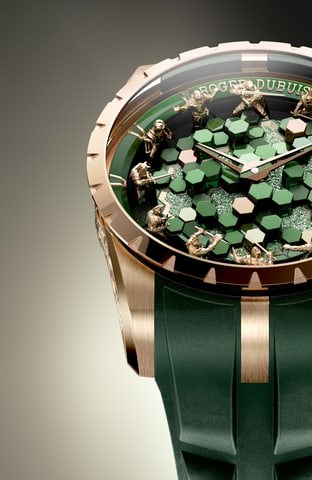
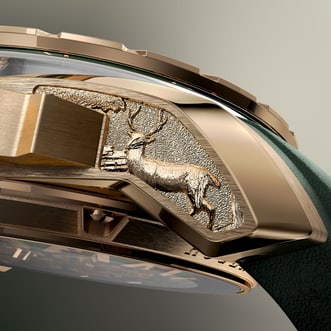
Merlin also shows how the brand avoids treating a decoration as a picture merely laid over a movement. The watch’s sculpted surfaces extend outward to its case engraving and wider narrative. A miniature stag and forest references make the exterior participate in the same composition. The result is immersive, perhaps excessive, but internally consistent. That consistency is what distinguishes a designed world from an ornamented product.
The Kabuto Legacy makes the same principle visible through a different cultural lens. Twelve miniature helmets form a perimeter around Edo Castle. The central architecture sets up a visual hierarchy and the helmets make a circular procession. The watch’s materials, colors and depth are there to help the miniature scene register at wristwatch scale. It is better understood as a small sculptural tableau with a mechanical clock inside than as an everyday readability exercise.

Such watches also raise a legitimate design criticism. Historical references and cultural imagery can become spectacle if they are treated only as exotic motifs. Kabuto Legacy is at its strongest when the arrangement of architectural forms and helmets creates a studied composition, rather than merely multiplying decorative details. For the viewer, the question is whether the craftsmanship communicates something specific about the chosen subject—and whether the watch has enough visual hierarchy to carry it.

Across these models, Roger Dubuis relies on a few repeatable moves: a recognizable case silhouette, multiple planes of depth, material contrasts, radial organization and a willingness to let the dial become an object rather than a flat surface. The Geneva Seal and in-house mechanisms are not substitutes for design; they give technical substance to a visual language that otherwise risks being dismissed as theatre. Craft and spectacle remain separate claims, and both deserve scrutiny.
The trade-offs are real. A 45mm narrative watch will not serve the same role as an understated 36mm dress watch. Sculpted figures compete with the display. High-detail dial treatments challenge quick legibility, while large cases make a strong physical and social statement. But it would miss the point to evaluate these pieces solely by the standards of discreet tool watches. Roger Dubuis is selling a particular experience of looking, exploring and wearing something conspicuously made.
Ultimately, the most compelling argument for Roger Dubuis is not that more decoration is better. It is that mechanical watch design need not remain confined to two-dimensional dial graphics. At its best, the brand treats time, structure and storytelling as materials that can be sculpted together. The question for collectors is less 'Would I wear this every day?' than 'Does this object say something that a quieter watch could not?'
Share this article
Sources & research
Research checked 2026-11-04. Specifications are manufacturer figures; interpretation and calculations are identified in the text.
- https://www.rogerdubuis.com/ng-en/our-maison/maison-roger-dubuis/founder-and-history
- https://www.rogerdubuis.com/eg-en/our-maison/maison-roger-dubuis/our-heritage
- https://www.rogerdubuis.com/watches/excalibur/biretrograde-perpetual-calendar-40mm-rddbex1178
- https://www.rogerdubuis.com/watches/knights-of-the-round-table/the-metamorph-merlin-45mm-rddbex1118
- https://www.rogerdubuis.com/watches/excalibur/the-kabuto-legacy-45mm-rddbex1139
