
Design · 2026-09-15
How the Tissot PRX turned a 1978 shape into a modern design language
From a slim Seastar ancestor to today’s many-sized PRX family, the collection’s history is a study in proportion, continuity and intelligent revival.
Save this watch to revisit later.
Share this article
By Chronolume digest · Original English summary · Based on Tissot archives; Tissot; Monochrome; Fratello
What to know
The story of the Tissot PRX begins before the name appeared on a modern dial. In 1978, Tissot introduced a slim watch within its Seastar family whose case and bracelet read as one continuous object. Its broad, tonneau-like body, raised round bezel and sharply articulated first links belonged to the integrated-bracelet mood of the late 1970s, but the watch was conceived as an accessible daily instrument. Tissot’s archive describes a stainless-steel construction designed to resist dust, shocks and humidity, protected by mineral glass and supported by the company’s longer history of antimagnetic and water-resistant watches.
The initials supplied the practical promise. Tissot has used PR to mean “Particularly Robust” as well as “Precision and Resistance”; the X represents the Roman numeral ten and points to water resistance of 10 bar, or 100 metres. That combination of graphic name and functional claim neatly explains the watch. Its appeal has never depended on a complicated mechanism. The PRX idea is an everyday Swiss watch whose resilience is expressed through an unusually coherent industrial form.
When Tissot revived the design in 2021, the critical decision was restraint. The new PRX did not imitate every vintage detail. It preserved the ingredients that mattered: a thin angular case, a separate circular bezel, a wide horizontal dial opening and a bracelet that seems to flow directly from the case. Alternating brushed planes and narrow polished facets make those surfaces react differently to light. The bracelet’s broad links then taper toward the clasp, giving the watch visual momentum instead of the abrupt stop produced by conventional lugs.
Quartz came first, which was historically appropriate and kept the price accessible. The Powermatic 80 automatic version followed, adding a textured dial and a display back while preserving the silhouette. Its movement’s long reserve gave the collection an easy mechanical proposition: a watch could be set down for much of a weekend and still be running when picked up again. In 2022, the family expanded in two revealing directions. A 35mm model restored something close to the compact scale of the 1978 inspiration, while a 42mm automatic chronograph stretched the architecture into a heavier, more overtly sporting watch.
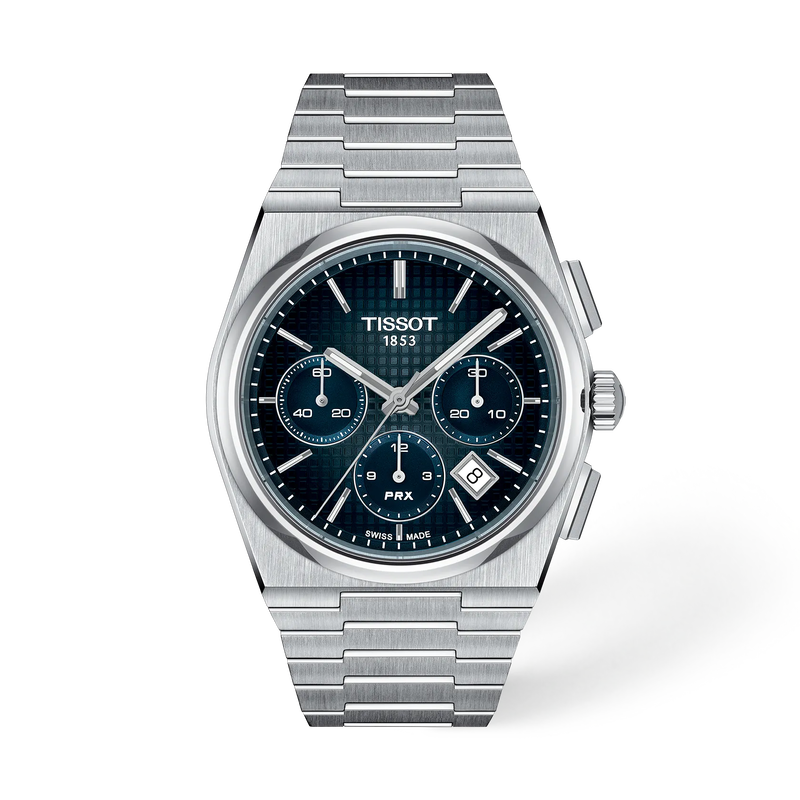
Subsequent variations tested how flexible the formula could be. Smaller 25mm references treated the PRX almost as jewellery; digital models introduced in 2023 connected the integrated case to another strand of late-1970s watch culture. Forged carbon, titanium, Damascus steel, gold details, mother-of-pearl and an expanding palette of bright or gradient dials altered the material and emotional character without erasing the recognisable outline. The current blue titanium 38mm PRX shows the idea at its lightest, while the blue-gradient automatic chronograph demonstrates how far the case can be enlarged before it becomes an entirely different kind of watch.

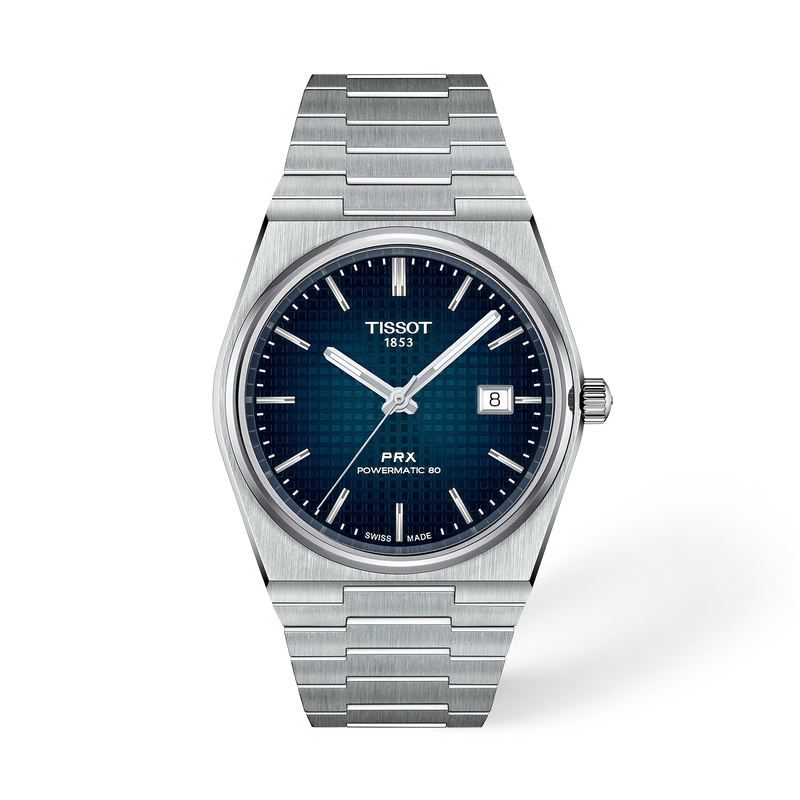
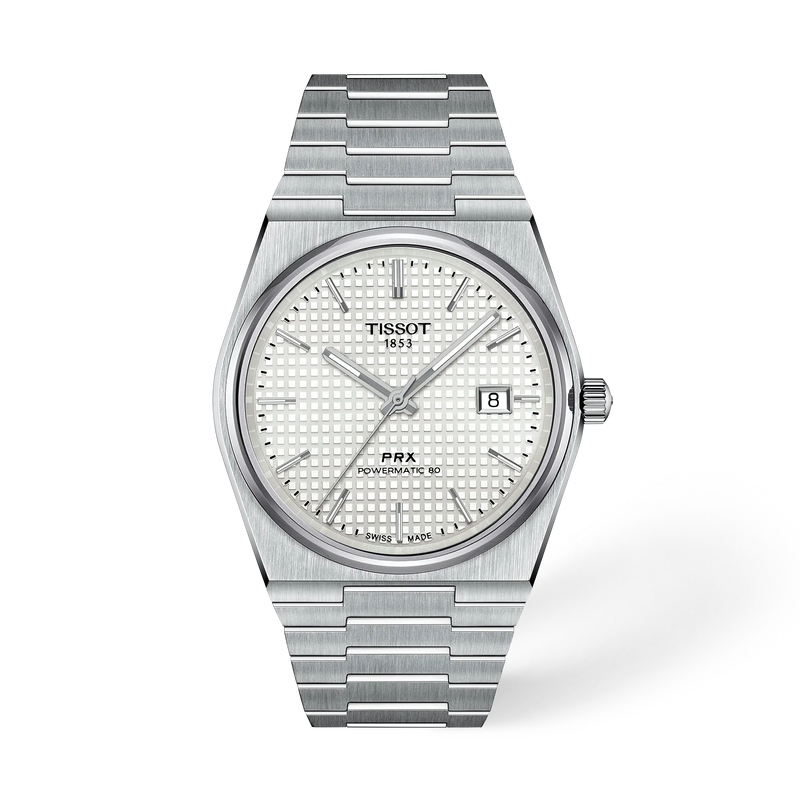
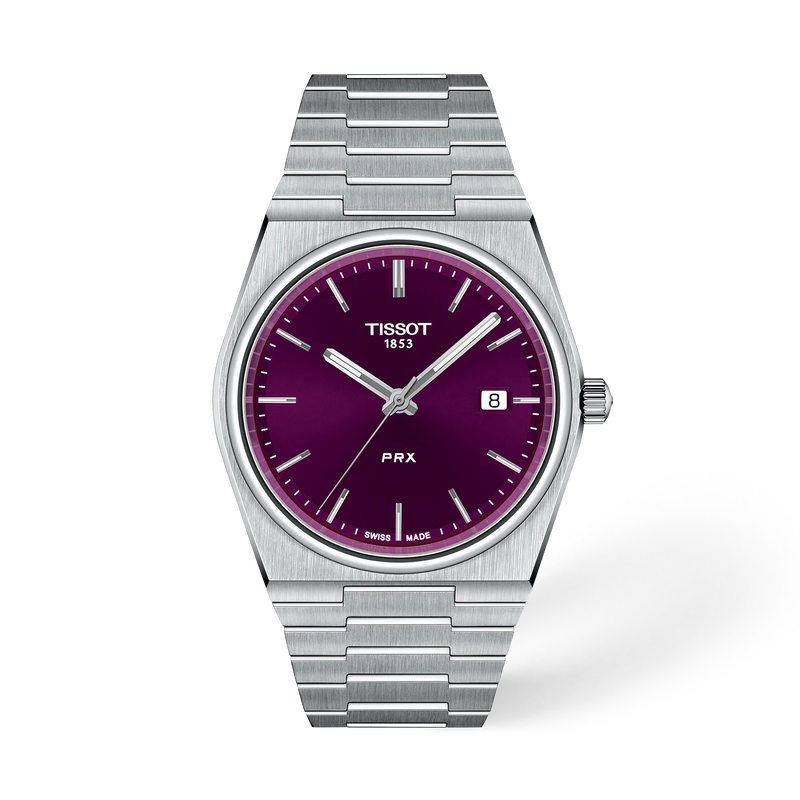
Colour has become another design tool rather than decoration applied after the fact. The purple 40mm PRX Quartz lets a single saturated surface animate the simplest version of the watch. The mother-of-pearl Powermatic 80 replaces a strict geometric texture with naturally variable light, while the blue-gradient US-exclusive Powermatic 80 uses a dark perimeter to emphasise the strong bezel and compact the dial visually.
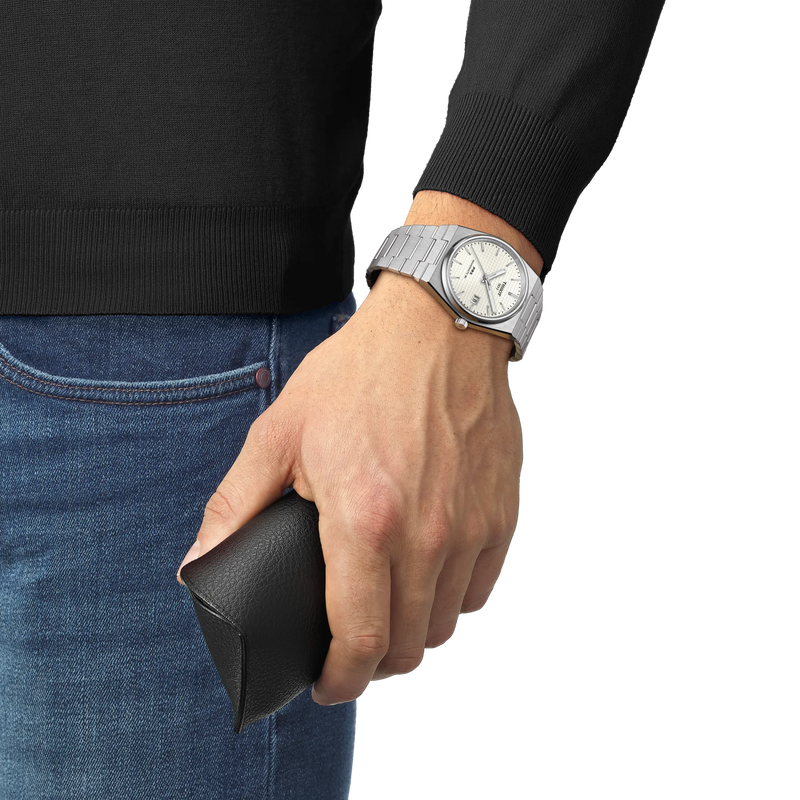
The PRX revival works because the design is specific without being fragile. Remove the logo and its case-to-bracelet transition remains identifiable; change the movement, size or dial and the basic architecture still holds. It also arrives at a useful point in the market. Integrated-bracelet sports watches carry powerful luxury associations, yet the PRX offers the visual logic in a broadly attainable Swiss-made watch. That accessibility is not a side effect. It continues the purpose of the 1978 model: modern-looking, robust timekeeping meant to be worn rather than preserved.
Today’s PRX is less a single watch than a controlled design system. The quartz three-hander, Powermatic 80, digital display and two forms of chronograph each place different demands on the same silhouette. The best versions are those that respect proportion: enough bezel to frame the dial, enough taper to keep the bracelet fluid, and enough contrast between brushed and polished surfaces to reveal the geometry. Nearly five decades after the original Seastar-era shape, the PRX endures because Tissot understood what to change—and, more importantly, what to leave alone.
Explore the watches
Tissot PRX Powermatic 80 T137.407.11.041.03 · PRX Powermatic 80 T137.407.11.041.03 ↗
Tissot PRX Automatic Chronograph T137.427.11.041.01 · PRX Automatic Chronograph T137.427.11.041.01 ↗
Tissot PRX Powermatic 80 T137.407.11.111.00 · PRX Powermatic 80 T137.407.11.111.00 ↗
Tissot PRX Quartz T137.410.11.401.00 · PRX Quartz T137.410.11.401.00 ↗
Tissot PRX Powermatic 80 T137.807.44.041.00 · PRX Powermatic 80 T137.807.44.041.00 ↗
Source & attribution
Tissot archives; Tissot; Monochrome; Fratello · Published 2026-09-15 ↗
Related perspectives
Built to Survive: 43 Years of G-SHOCK Industrial Design ↗
Casio G-SHOCK GMW-B5000D-1: the 1983 square rebuilt in full metal ↗