Design · 2026-10-21
The Quiet Genius of the Orient Bambino: A Design Classic Hiding in Plain Sight
A long illustrated design essay about the Japanese Bambino's domed crystal, dial typography, case proportions, 2010s evolution, and five very different 2025–2026 watches.
By Chronolume digest · Original English summary · Based on Chronolume original longform analysis with official Orient/Epson 2025–2026 product references and launch materials

Save this watch to revisit later.
What to know
The Orient Bambino has spent more than a decade doing something that is increasingly rare in watch design: being elegant without demanding attention. It has no famous octagonal bezel, no superfluous armoured surfaces and no promise to survive the deepest part of the ocean. Its strengths are modest and recognisable: a curved crystal, slender lugs, polished steel, leather, and a dial that values rhythm over spectacle. None of those ideas belongs exclusively to Orient. What makes the Bambino interesting is how consistently the Japanese brand has brought them together at a comparatively accessible price. New no-date, graduated-colour, solar and Sun & Moon references reveal a surprisingly flexible design system.
THE ROOTS — Orient was established in 1950, and its history is deeply connected to mass-produced mechanical timekeeping. The Bambino emerged as an enthusiast favourite in the early 2010s, when affordable mechanical dress watches were often crowded with awkward details. Orient's answer was restrained rather than radical. The earliest versions combined a curved face, a substantial domed crystal and conventional round steel cases. Subsequent generations changed the dial typography, hands and applied indices but kept that central visual identity. The Bambino looked familiar without being an exact replica of one celebrated luxury reference. It could be an introduction to mechanical watches and still reward a more knowledgeable collector.
THE GLASS — The defining Bambino feature is not its movement or dial colour. It is the way the domed mineral crystal changes the appearance of the entire watch. A flat glass surface makes a dial read almost like a printed graphic. The Bambino's curved glass instead pulls light around the edges, creating reflections, magnification and a sense of depth. The dial beneath is gently shaped to strengthen that impression. From the side, the crystal recalls the high acrylic domes seen on mid-century watches; from above, it turns very simple indices into a more tactile composition. Mineral glass is more vulnerable to scratching than sapphire, but here its shape is an essential part of the product's character.

DIALS — The first familiar Bambino configurations explored several separate languages of classic watch typography. Roman numerals and railway-minute tracks suggested old European dress watches; baton-heavy versions looked closer to mid-century modernism, and other variants used dauphine hands or a more relaxed contemporary layout. The differences might look small in a catalogue, but they change how the watch feels. Narrow markers create air around the centre; Roman numerals give a dial rhythm and ornament; a date aperture provides convenience but can interrupt symmetry. Because the case design stays comparatively consistent, each typographic variation becomes an experiment in how a very small composition conveys formality.
SIZE AND PROPORTION — The Bambino also demonstrates that diameter alone cannot describe how a watch wears. An original-style 40.5mm dress watch can feel relatively large when its narrow bezel gives almost the entire face to the dial. Later 38.4mm cases restored more vintage-like proportions. The 2026 green Bambino 38 measures 44mm from lug to lug, yet its domed construction still makes it 12.5mm thick. Both measurements matter. The Sun & Moon grows to 41.5mm across and 14.2mm tall to accommodate its displays. The solar-powered 38 uses a different movement and a shallower case. Across the family, geometry is not merely a matter of fashion; it follows function.
THE NEW MINIMALISM — Orient Bambino 38 No Date RA-BB0001E. In February 2026, Orient introduced a simpler three-hand Bambino with no date indication, powered by the newly adapted automatic F6524. Our selected green model pairs copper-tone hands and alternating Roman numerals and bars with a dark-green dial. The absence of a three-o'clock window allows an uninterrupted ring of indices, and the compact case makes this look especially convincing. This is a reminder that subtracting a feature can make a design feel more complete. The functional cost is small; the compositional benefit is substantial.

COLOUR AS STRUCTURE — Bambino Purple Gradient RA-AC0032V. The 2026 purple-gradient reference does the opposite of the no-date 38: it invites colour to become the main event. The centre glows violet, and the dial darkens towards its perimeter. Under the dome, that optical gradient has another level of apparent depth. The polished silver markers, narrow date opening and restrained brown leather strap prevent the colour from taking over the whole watch. Compared with the green 38, the 40.5mm diameter gives this dial more breathing room. It is a modern mood contained within a recognisably classical case.

COPPER AND SCARCITY — Bambino Copper RA-AC0034Y. Orient produced only 130 examples of this copper-gradient release for 2026, of which 50 were allocated to Japan. The dial moves between salmon and warm copper as the light changes. Rather than relying on a new case or complication, the designers change the temperature of the existing composition. This reveals how the Bambino's shape is sufficiently established to support very different personalities. A warm metallic face makes the steel case and polished markers look almost like jewellery; a small serial-numbered run adds collecting interest, but the design's appeal is not dependent on scarcity.

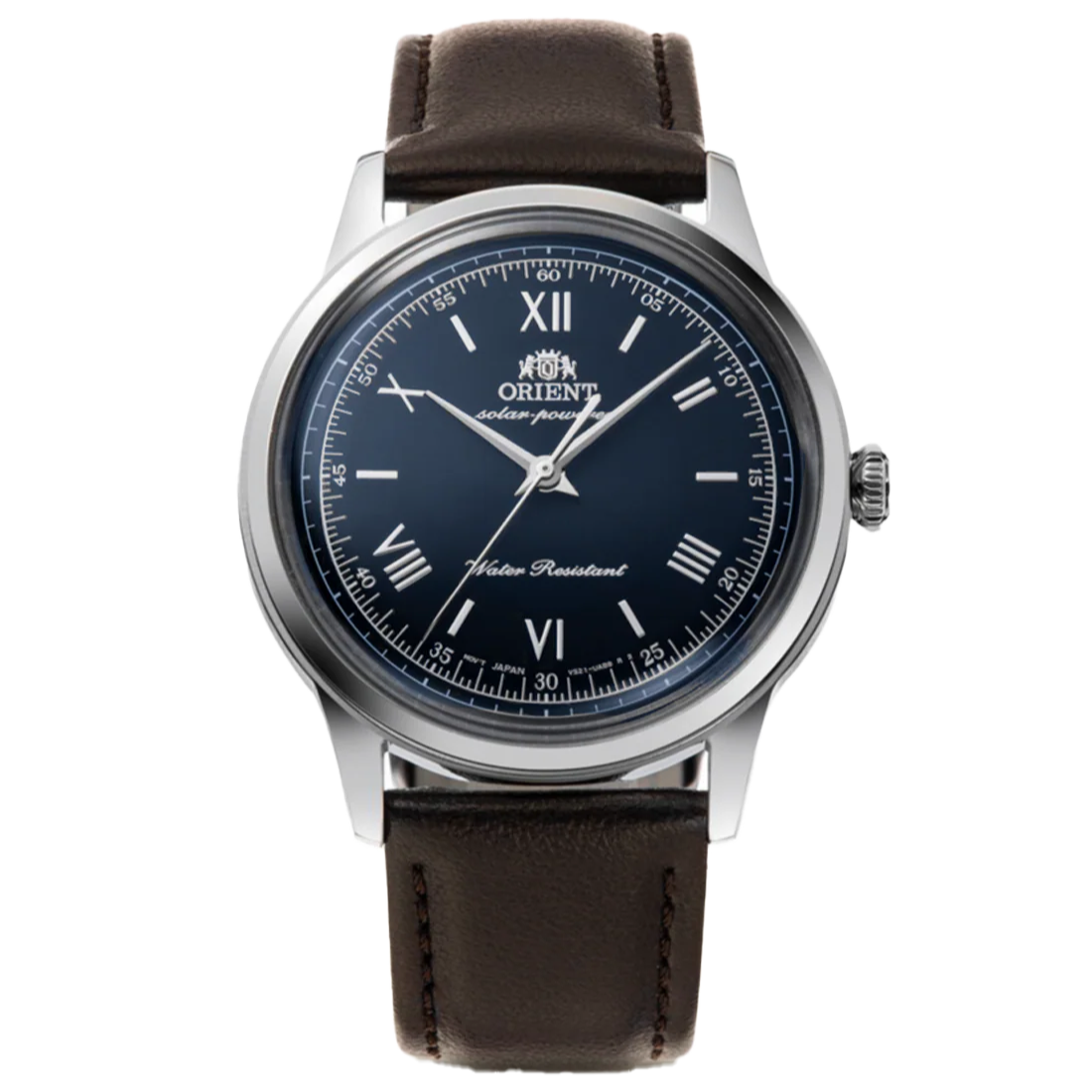
SOLAR AS A DESIGN TEST — Bambino 38 Solar RA-WK0004L. Traditionally the Bambino's appeal included a mechanical movement visible through an exhibition back. The 2025 Solar version asks whether the visual formula can survive without one. Its navy dial, Roman numerals, slim lugs, domed mineral crystal and brown apple-derived strap carry the familiar personality, but a VS213 solar quartz movement replaces the automatic. Six months of running after a full charge make it easier to own for somebody who wears formal watches only occasionally. The closed caseback tells the engineering truth. The Bambino still looks like a Bambino, which is good evidence of a robust design identity.
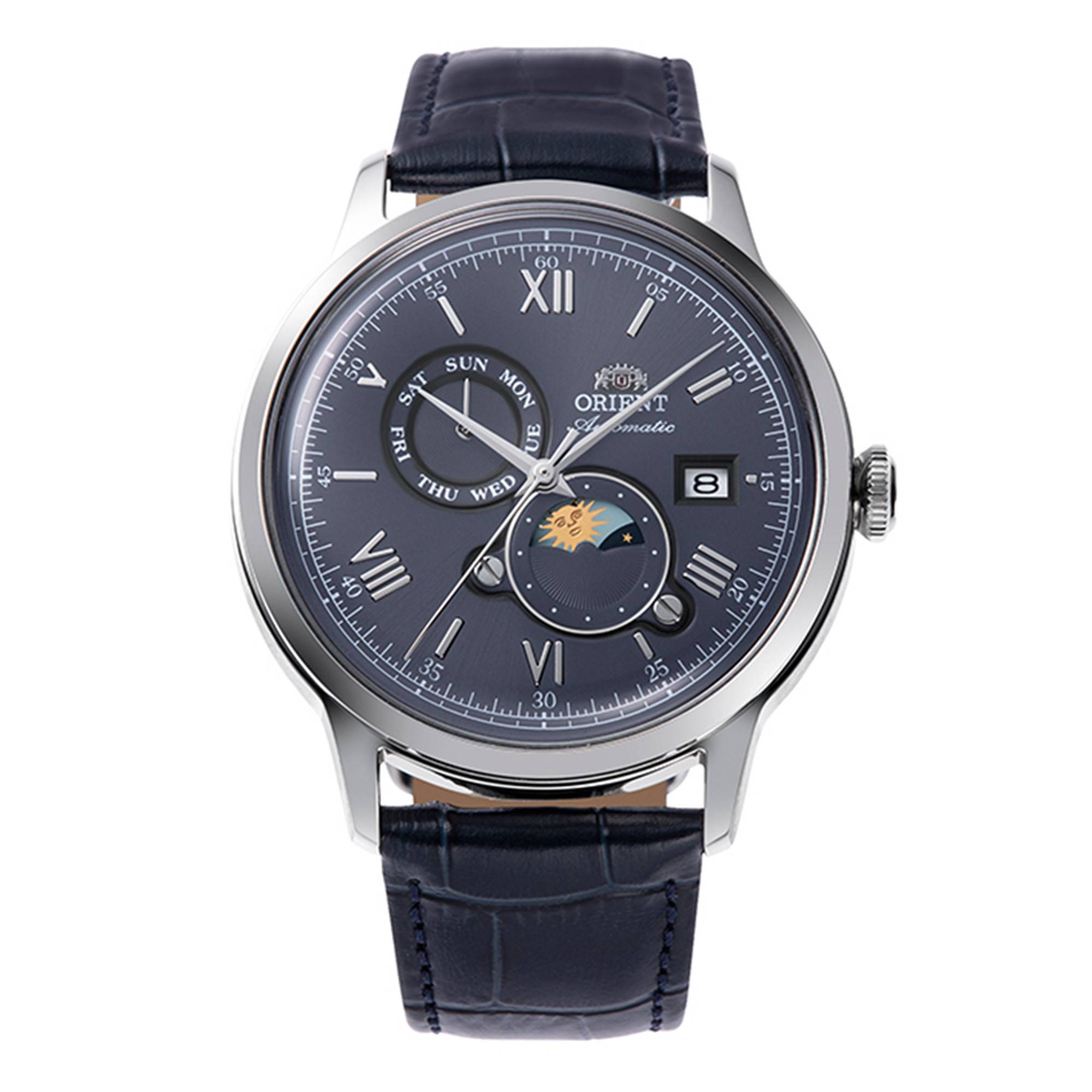
TIME AS THEATRE — Bambino Sun & Moon RA-AK0806L. This 2025 navy model takes an almost opposite approach. A rotating disc at six shows a sun and moon motif to indicate day and night, while a circular weekday subdial and date window fill the upper and right portions of the face. It is easy to describe it as a moon-phase watch, but that would be wrong: the disc illustrates the daily cycle, not the changing lunar phase across a month. The F6B24 automatic calibre supports this extra display. The crowded yet carefully balanced dial transforms a quiet dress watch into an animated mechanical object.

THREE WAYS TO MOVE THE HANDS — In the current family, movement design has become one of Orient's important sources of variation. The 2026 F6524 three-hander removes the calendar assembly to suit a no-date dial; the F6724 in purple and copper references retains the date and the familiar combination of automatic winding, hand winding and seconds hacking. Both promise around 40 hours of reserve. The solar VS213 instead stores energy electrically, providing roughly six months of operation when fully charged. The F6B24 adds weekday and day/night mechanisms to an automatic foundation. None should be confused with haute horlogerie. The merit is that several distinct watchmaking experiences share a comprehensible visual language.

WHAT THE PRICE DOES NOT BUY — The Bambino is not a luxury-specification competition winner. Most of these variants use mineral instead of sapphire glass. Their nominal water resistance is 30m, appropriate for ordinary splashes rather than swimming; mechanical accuracy specifications are a much wider range than those of certified chronometers. A synthetic or modestly finished leather strap might be the first component a collector replaces. The movement finishing is functional rather than lavish. These compromises are worth naming precisely, because the Bambino's value is easier to appreciate when it is judged as a thoughtful dress watch instead of a universal tool watch. Its visible design receives the attention that matters to this category.
WHY THE STRAP MATTERS — Dress-watch design does not end where the lugs meet the leather. The 38mm Bambinos generally use a 20mm strap; many 40.5mm versions use 21mm, which reduces off-the-shelf replacement choices slightly. Recent easy-exchange systems allow a leather strap to be replaced without tools. A brown strap amplifies copper and gold-tone dials, while navy can cool down the look; black leather gives a green or purple Bambino greater formality. A change in strap texture may be enough to move the watch from office to evening wear. The humble strap is one of the easiest ways to experience the Bambino as a versatile design rather than a static catalogue reference.
WHICH ONE MAKES SENSE? — Choose the green 38 No Date if you admire symmetrical dial layouts and compact proportions. Choose the purple-gradient 40.5 if you want a more expressive everyday dress watch. Choose the copper edition for its warmer material impression and small run, remembering that availability may be limited. Choose the solar navy if convenience matters more than seeing a rotor in motion. Choose the Sun & Moon if you want a miniature mechanical performance every time you check the hour. No single one is objectively best: the collection's strength is the way it makes meaningful design distinctions available without demanding a luxury budget.
THE QUIET GENIUS — The best industrial designs tend to establish a rule and then demonstrate how many sensible variations that rule can accommodate. The Bambino's rule is exceptionally simple: a warm, generously curved crystal over a carefully composed classical dial, enclosed in a compact polished case. The rules survive a smaller diameter, an uninterrupted dial, an unexpected purple or copper hue, a solar quartz movement and even an animated day/night display. That is why the Bambino belongs in a serious conversation about watch design. It is not famous because it shouts about innovation. It is loved because it finds an accessible way to make ordinary timekeeping feel considered.
At a glance
| Article | Long-form design essay |
|---|---|
| Featured references | RA-BB0001E, RA-AC0032V, RA-AC0034Y, RA-WK0004L, RA-AK0806L |
| Periods covered | Bambino development from early 2010s to 2026 |
| Movement comparisons | F6524 no-date automatic; F6724 automatic; VS213 solar quartz; F6B24 day/night automatic |
| Themes | Industrial design, domed crystal, case proportions, dial typography, colour and collecting |
| Complication note | Sun & Moon is a day/night indicator, not an astronomical moon phase |
| Linked watch articles | 5 |
Explore the watches
Orient Bambino RA-BB0001E · RA-BB0001E ↗
Orient Bambino RA-AC0032V · RA-AC0032V ↗
Orient Bambino RA-AC0034Y · RA-AC0034Y / RN-AC0034Y Japan ↗
Share this article