
Design · 2026-10-13
Beautifully bizarre: the automatic watches that refuse to look normal
A long-form look at the automatic watches breaking conventional design rules—from Ressence and MB&F to URWERK, Freak, Isotope and Zenith.
Save this watch to revisit later.
Share this article
By Chronolume digest · Original English summary · Based on ChronoLume design analysis using official technical documentation from MB&F, Ressence, URWERK, Ulysse Nardin, Isotope, Zenith and Rado

What to know
The dial of a wristwatch seems like an obvious invention: a circle, two or three hands and twelve positions around the edge. But that arrangement is a design convention, not a law of nature. Once you recognise it as a convention, watchmaking becomes much more interesting. What if the whole dial rotated? What if the winding rotor became the star of the show? What if the movement replaced the hands entirely? The strangest automatic watches invite us to ask these questions and turn traditional horology into kinetic design.
Automatic is a technical description, not a style. A self-winding mechanical movement captures the motion of the wearer through an oscillating weight and stores energy in a mainspring. A watch can be wildly futuristic and still operate without a battery, screen or charging cable. Conversely, an extraordinary-looking mechanical creation can be hand-wound. This essay focuses on genuinely automatic watches and on a particular design achievement: using a mechanical timekeeper to rethink the appearance, motion or shape of an everyday object.
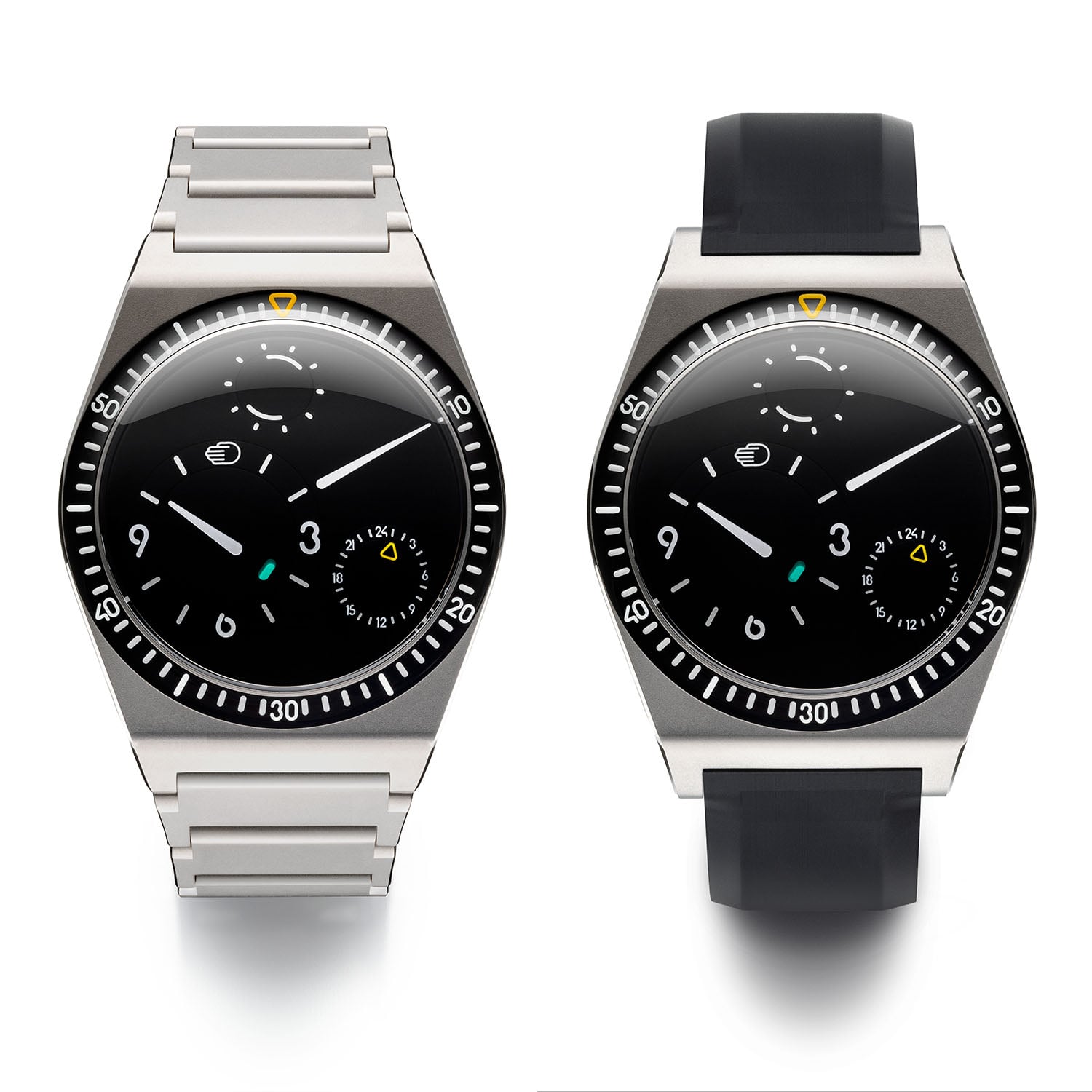
Ressence offers an elegant place to begin. Its Type 9 replaces ordinary hands with an orbital display made from rotating surfaces. The entire convex dial moves, accompanied by an eccentric hour disc that revolves as time passes. Your eye does not follow a single hand over fixed markers; it learns to interpret a miniature choreography. The system is powered by a self-winding base calibre driving the patented Ressence Orbital Convex System. Setting the time through the caseback, rather than a protruding crown, completes the impression of a smooth instrument from somewhere slightly ahead of our time.
The limited Type 9 IKE, created with Japanese artist Terumasa Ikeda, adds an extraordinary layer to the concept. Lacquer and thin mother-of-pearl inlay produce an abstract composition suggestive of signals, or perhaps star maps. The elements are not placed on a static canvas: they were designed for a face that keeps moving. Patterns align and separate as hours pass, making the artwork an event rather than an image. The watch still has to communicate hours and minutes, but the interface also tells a parallel visual story. This is the difference between eccentric decoration and design that transforms its own mechanism.
Ressence's Type 7 changes something even more fundamental: the optical relationship between dial and crystal. Its upper chamber contains oil, almost eliminating the refraction that usually makes a watch dial appear set back beneath glass. Information seems to float just under the crystal surface, like the graphics on a digital screen. Yet the watch is an automatic mechanical GMT with rotating satellite indications. Magnetic transmission allows the oil-filled display to communicate with the movement in a separate, dry chamber. The strange visual effect follows a coherent engineering logic, even though the result appears almost impossibly flat.
MB&F's M.A.D.Editions make the opposite choice: reveal the motion that conventional watchmakers conceal. On the M.A.D.1S, an inverted automatic La Joux-Perret G101 and modified rotor occupy the most prominent viewing position. The rotor spins in plain sight where a normal watch would present a quiet dial. Hours and minutes are read from a cylinder at the case edge. Viewed straight on, it looks like a playful machine; viewed from the side, it becomes a timepiece. Every movement of the wrist gives the design an unexpected response. The 42 mm case and single-cylinder display make mechanical winding a form of entertainment.
The M.A.D.2 shifts inspiration from machines to music. Designer Eric Giroud references DJ turntables, vinyl grooves and the stroboscopic ring of a record player. Its rotating element is not theatrical imitation: the visible platter is part of the automatic winding system. Meanwhile, a jumping-hour module changes the way time appears near the centre of the dial. Behind the playful form is a Swiss-made La Joux-Perret G101 base movement. The result illustrates an underrated principle of design: functional interfaces may borrow emotional associations from entirely different objects without becoming meaningless decoration.
URWERK approaches the concept as a moving map. In the UR-100V, a satellite assembly carries hour indicators past a minute scale. As they leave the ordinary time-reading zone, pointers reappear in displays referring to the Earth's rotation and its movement around the Sun. It is an unusual way to make a philosophical argument with gears: measuring time is inseparable from motion through space. The 41 mm titanium variant uses a self-winding calibre with turbine-regulated winding and a stated 48-hour reserve. Its cockpit-like casing and orbital architecture could be science-fiction props, yet their purpose is the oldest one in watchmaking.
Ulysse Nardin's Freak ONE tackles the conventional dial more aggressively. There are no normal hands, no conventional dial and no crown. A flying carousel of mechanical components rotates to indicate time; the watch is adjusted through its external interfaces. The UN-240 is self-winding, with the manufacturer's Grinder winding system and a claimed 90-hour reserve. The Freak does not conceal the calibre behind an expressive design. It makes the calibre the expressive design. The resulting watch looks complicated because the mechanism is the visual language, not because extra decoration has been layered onto a familiar face.
Not every weird automatic is about replacing hands. The Isotope Flyway Coral has a conventional way of telling time, but its physical shape refuses convention. Wing-like extensions give the 36 mm case a surprising silhouette, the bezel carries a dense geometric texture, and the sapphire crystal forms a distinctive saddle-shaped surface. A coral-toned patterned dial brings an organic counterpoint to the sharp geometry. Isotope offers self-winding Swiss movement choices, so the watch is mechanically familiar beneath its unusual exterior. It demonstrates that case architecture and optical curvature can create as much surprise as a complicated calibre.

Zenith's DEFY Extreme Ultraviolet argues for visual intensity rather than minimalism. Angular case facets, transparent violet elements, openworked architecture and high-contrast mechanical layers crowd the display. Inside, the automatic El Primero 9004 separates the timekeeping escapement from the faster chronograph escapement used to measure hundredths of a second. There is a risk that this density becomes noise, but the repeated angles and deliberately limited palette give the watch a coherent visual rhythm. It resembles an instrument designed to show off complexity, and it makes no apology for doing so.

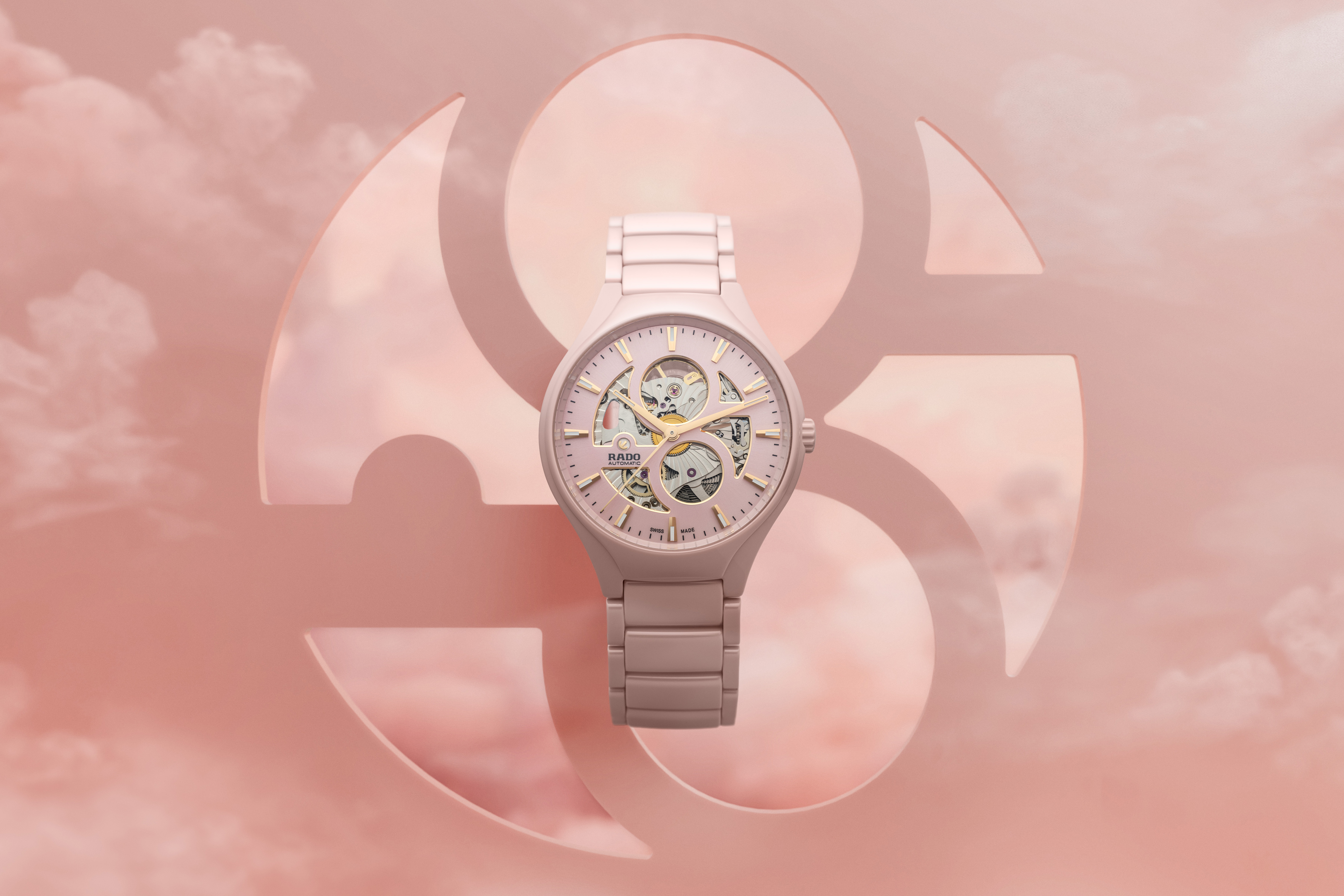
Rado's True Round Open Heart Limited Edition presents a quieter kind of strangeness. Its pale-rose ceramic case is relatively conventional in outline, while the open-heart dial provides a glimpse of the automatic movement. The unusual element is a photochromic surface that changes toward vivid magenta in ultraviolet light. That response is not caused by the movement, yet it alters the personality of the watch throughout the day. Two systems coexist: a mechanical device responding to motion and a material responding to light. Unconventional watch design can be a conversation between disciplines rather than a competition of complications.
These examples share no single look. Ressence turns the face into an orbital composition; MB&F celebrates the winding mechanism; URWERK rearranges hours as satellites; Ulysse Nardin removes the familiar hands altogether; Isotope reshapes the surrounding architecture; Zenith exposes technical intensity; Rado lets the environment change colour. Each maker chooses a rule to break and accepts a trade-off. Some watches require practice to read. Others become unusually thick, costly to maintain or difficult to wear discreetly. Their eccentricity succeeds when the departure from convention serves a recognizable idea.
The most enduring lesson is that automatic watchmaking is not limited to nostalgic design. Its energy source—the ordinary movement of a human wrist—can power interfaces that look more like moving sculpture, typography experiments or futuristic instruments. You do not have to want one of these on your wrist to appreciate what they achieve. A genuinely unusual automatic watch makes you notice a mechanism, rethink a familiar visual pattern and rediscover something surprising about an object you thought you already understood.
Source & attribution
Related perspectives
October 2026: Our Complete Selection of Watches Under €1,000 ↗
Beyond the colour: how great watch dials are actually made ↗
The Rolex design language: why evolution beats reinvention ↗