Design · 2026-10-22
Designing with shadows: inside Otsuka Lotec’s mechanical architecture
Jiro Katayama treats a watch as a small machine to be constructed in three dimensions. His Otsuka Lotec No. 6 reveals how mechanisms, shadows and exposed assembly can become a coherent design language.
By Chronolume digest · Original English summary · Based on MONOCHROME interview with Jiro Katayama; Otsuka Lotec official design and model documentation

Save this watch to revisit later.
What to know
Most watches begin with a familiar diagram: a round dial, hands turning from the centre and a case built to contain the movement. Otsuka Lotec begins somewhere else. Founder Jiro Katayama treats the watch as a compact machine whose structure deserves to be seen. Screws, layered plates, windows and indicators become the design rather than details to be hidden behind a conventional face.

Katayama arrived at watchmaking through automotive and product design. Around 2008, after buying a small lathe, he chose a watch case as a manageable object on which to learn metalworking. He had no established supplier network or traditional apprenticeship. Early experiments were made at home from readily available materials, and the process grew through observation, research, dismantling ideas and repeated prototyping.
That background helps explain the unusual unity of his work. Katayama does not draw a shell and later ask engineers to fit a mechanism inside it. He develops the case, display and mechanical arrangement together in three-dimensional CAD. Overlapping components are positioned for the shadows they cast; adjacent surfaces receive different textures so the construction remains legible; a technical solution is judged partly by the form it produces.
The No. 6 is the clearest example. Hours and minutes share a coaxial retrograde display beneath a fan-shaped crystal, snapping back at the end of their respective scales. A rotating seconds disc occupies the centre, while a date window sits to the right. The layout recalls an analogue industrial gauge, but it is not a literal miniature of any one instrument. Familiar visual cues have been reorganised around a wristwatch mechanism.
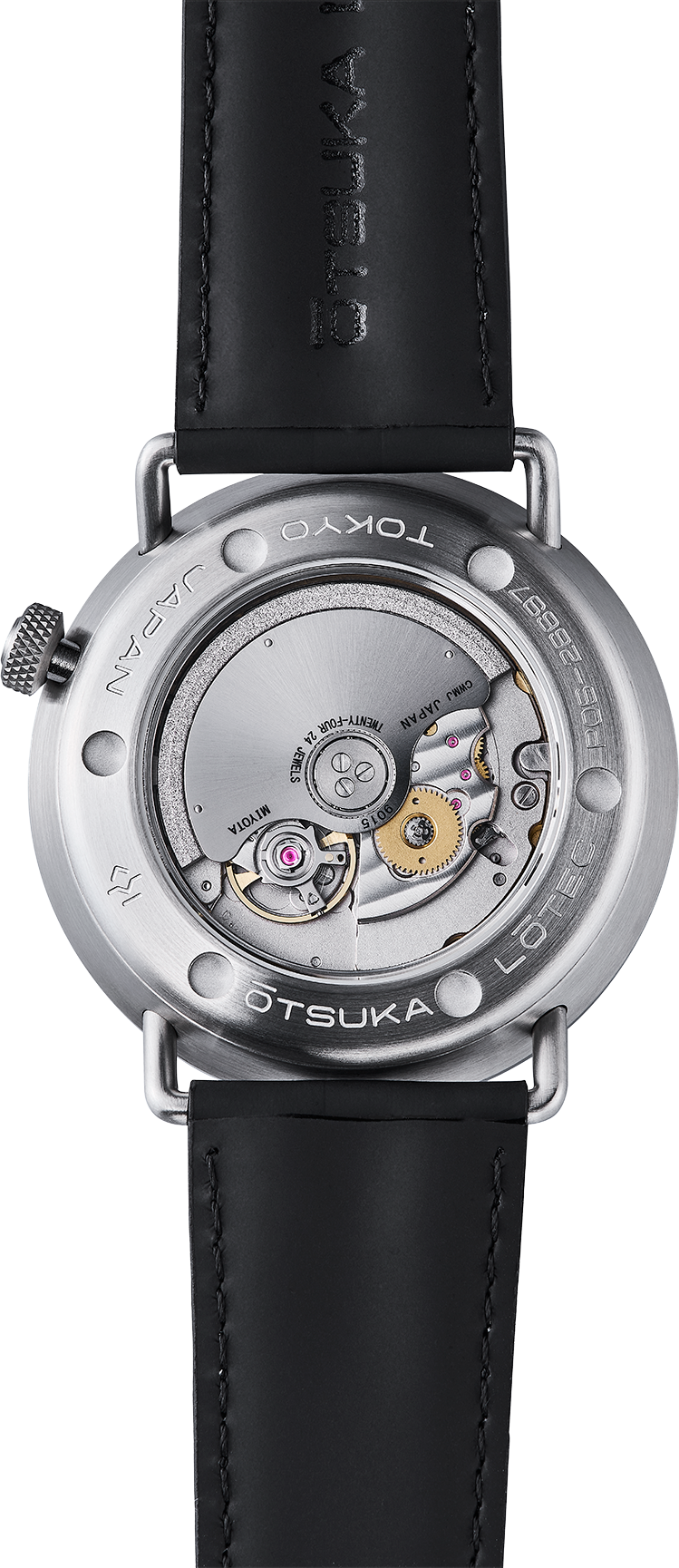
Depth is carefully controlled. The hour-and-minute unit sits low in the case to reduce overall thickness, while the dial is screwed directly to the movement so that the dial and bezel can meet on a closely aligned plane. The visible fasteners do real visual work: they establish rhythm, communicate assembly and give the object the directness of equipment built to be opened and understood.

Later revisions demonstrate that this appearance is not frozen nostalgia. Otsuka Lotec changed the case from SUS303 to 316L steel, moved from mineral glass to sapphire crystal and revised how the lugs attach. The hands and screw heads gained bevelled edges, improving both durability and the way light travels across the front. Engineering refinement strengthens the original character instead of smoothing it away.
Katayama’s references include old cameras, gauges, metal housings and tools assembled from plates, cast parts and screws. What attracts him is the visible personality of the maker: an era when one engineer’s decisions could remain apparent in the finished object. That interest distinguishes the watches from generic retro-futurism. They do not decorate a standard watch with industrial motifs; they rebuild the display according to an industrial way of thinking.
His use of shadow is particularly instructive. Watch photography often treats shadow as something to eliminate, yet physical products need it to explain depth. Recesses make an indicator feel separate from its plate. A polished bevel catches a narrow line of light. A screw head creates a small interruption that confirms one component sits above another. The No. 6 becomes readable because its surfaces respond differently as the wrist moves.
Independent watchmaking is often discussed through hand-finishing, complications or production volume. Otsuka Lotec offers another definition: independence as authorship. Katayama continues to direct design, engineering and prototyping, while a small production structure helps improve quality and output. The result carries the consistency of a single point of view even as the execution becomes more sophisticated.
The lesson reaches beyond one Japanese atelier. A distinctive watch need not begin with a decorative theme or an exotic material. It can emerge from deciding how parts meet, which mechanism should remain visible and where light should be allowed to collect. Otsuka Lotec’s strongest designs feel less like styled objects than machines whose construction has found its own visual voice.
Explore the watches
Share this article