
Culture · 2026-10-13
When watches become movie stars: the timepieces that defined cinema
From Steve McQueen’s Monaco to Bond’s Seamaster, Interstellar’s Murph, Marty McFly’s Casio and Ripley’s Seiko: six watches that became characters of their own.
Save this watch to revisit later.
Share this article
By Chronolume digest · Original English summary · Based on ChronoLume original editorial; TAG Heuer, Hamilton, Seiko and Casio archival sources plus original movie-watch references
What to know
Some watches become famous because their makers achieve extraordinary technical breakthroughs. Others become famous because a filmmaker puts one on precisely the right wrist. The difference is important. Cinema can transform a modest quartz watch into a generational symbol, a distinctive chronograph into the uniform of a racing legend, or a simple field watch into an object loaded with emotional meaning. Across decades of film history, watches have done far more than tell characters what time it is. They help tell audiences who those characters are.
A movie watch occupies an unusual position between costume, prop and product design. Unlike a fictional gadget built solely for the screen, it often begins as a real object with a history, price and purpose outside the story. It might be chosen because it looks believable in a character's world, because its movement suits the period, or because a director recognises its graphic impact. Audiences see the watch for a few seconds; collectors can return to the object for years. That delayed effect is one of cinema’s quietest forms of cultural influence.
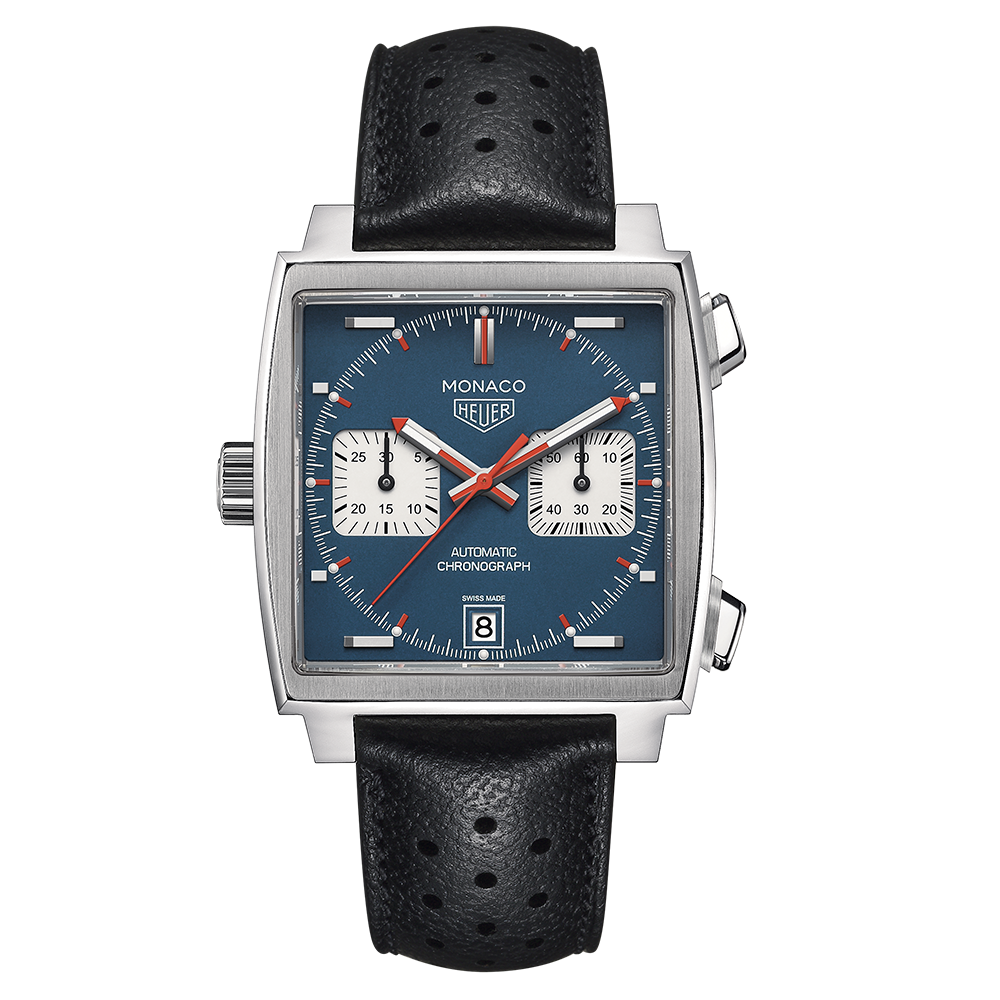
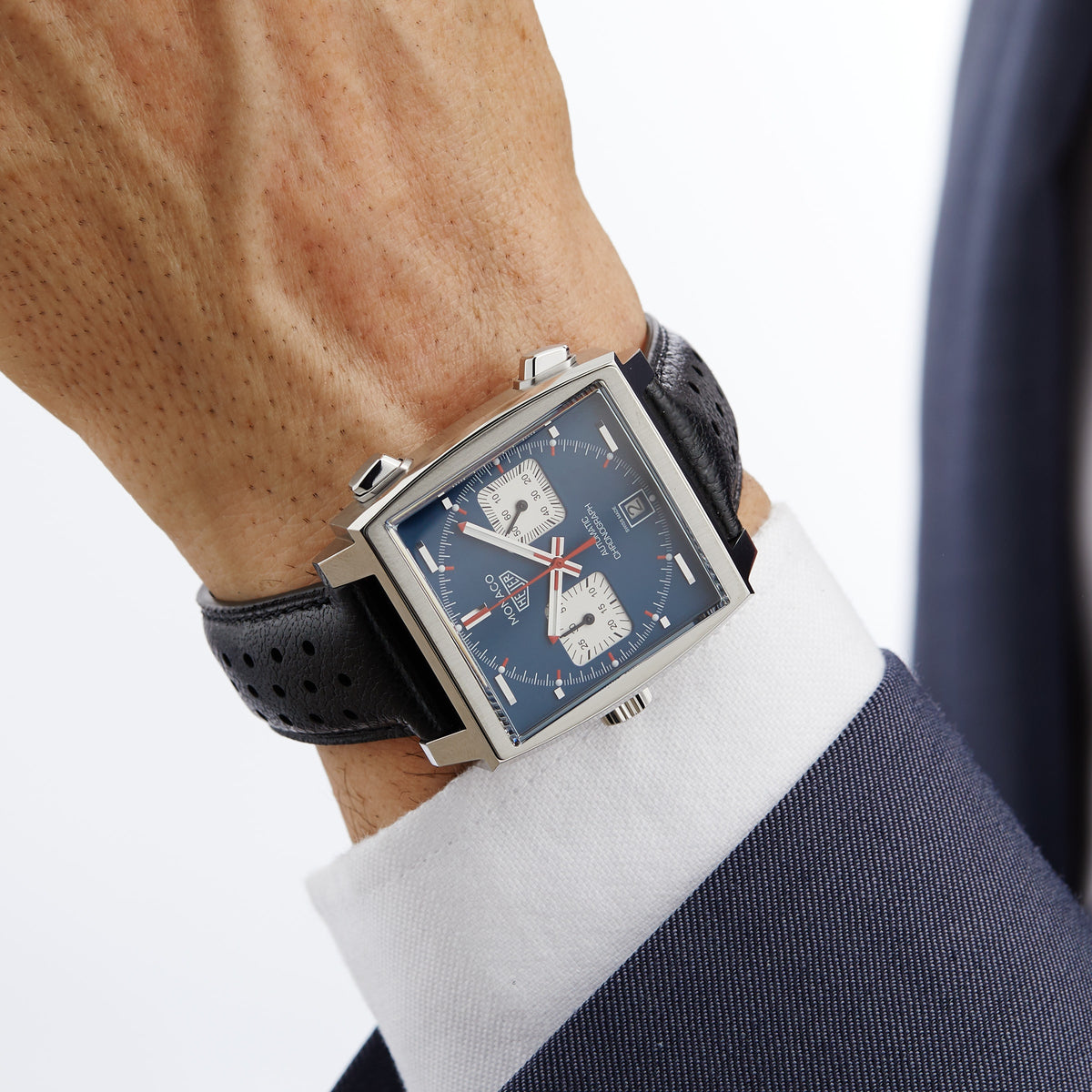
**The Monaco: when a racing film made a square watch inevitable.** Few partnerships of watch and character are as visually complete as Steve McQueen and the Heuer Monaco in Le Mans (1971). The original reference 1133B was already daring when introduced in 1969: square, water resistant, fitted with an early automatic chronograph movement, and marked by a crown positioned on the left. On paper it seems an unusual choice for someone who spends the film surrounded by engines and speed. On screen, its uncompromising geometry looks exactly right.
McQueen plays driver Michael Delaney with a remarkably restrained physical performance. Racing suits, helmets, glances and mechanical noises communicate more than lengthy dialogue. The vivid blue watch face becomes one of the few small, repeatable points of colour within that visual universe. The Monaco does not need a close-up that explains its calibre. It acts as a graphic signature. The watch is recognisable in a fraction of a second, which is precisely what successful costume design often needs to accomplish.
The version pictured in this feature is a later TAG Heuer Monaco Calibre 11 CAW211P, not McQueen’s exact screen-worn 1133B. Its steel square case, blue dial, white counters and perforated black strap deliberately preserve the older watch’s identity. TAG Heuer now lists that modern reference as discontinued. The distinction between original and tribute matters to collectors, but it also reveals the enduring power of a film: fifty years later, the same visual formula still communicates the same attitude.
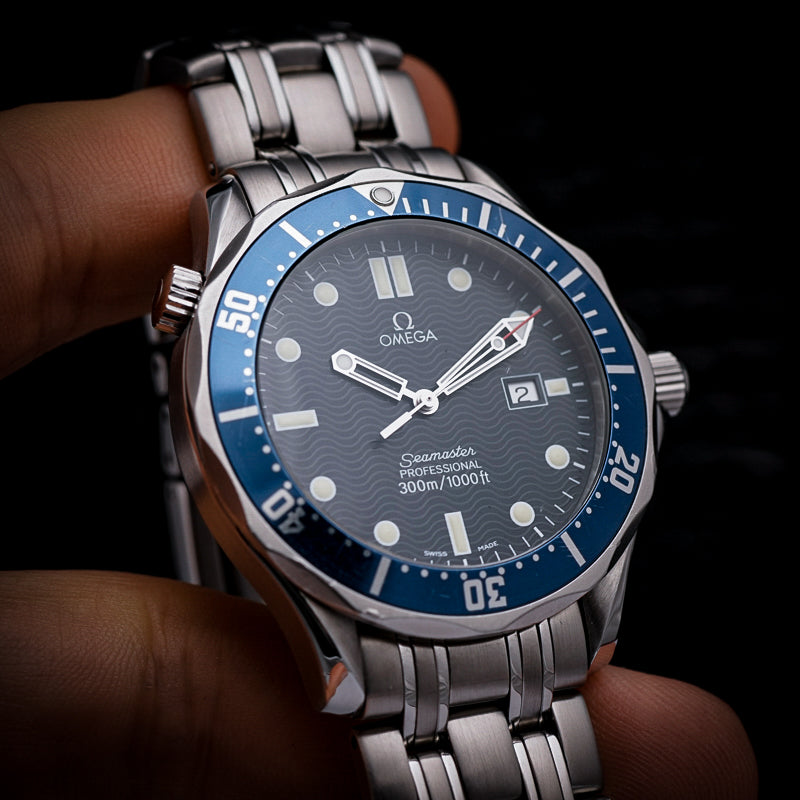
**The Bond Seamaster: a blue dial becomes the language of a new 007.** Omega’s relationship with James Bond began a new chapter with GoldenEye in 1995. Pierce Brosnan’s version of the character moved away from the Rolex watches associated with earlier eras and into an Omega Seamaster Professional 300M. Its blue wave-pattern dial, skeleton-shaped hands, scalloped bezel and steel bracelet formed a recognisable new ensemble. Compared with the severe black dive-watch aesthetic familiar to many viewers, this Seamaster felt slightly more polished and visibly contemporary.
An easily overlooked detail is the movement: Bond’s first blue Seamaster was the battery-powered quartz reference 2541.80, not the automatic Seamaster often substituted in retrospective photographs. The 41 mm steel watch offered 300 metres of water resistance and a date display. Later Brosnan films used automatic models, and subsequent Bonds wore different Seamasters, Planet Oceans and other Omega references. The entire franchise should not be collapsed into one ‘Bond watch.’ The distinction allows the 1995 model to retain its own historical personality.
The Bond partnership illustrates how a fictional identity can be transferred to a very real watch collection. The same blue bezel that looks elegant in a shop window becomes, in a film, a shorthand for resourcefulness and danger. Q’s cinematic modifications are fantasy, of course. But Omega’s physical watch remains a proper diver, which gives those invented functions a plausible visual foundation. Our profile of the original GoldenEye Seamaster explains why its quartz calibre is not a footnote to be erased.
**Interstellar’s Murph: when a watch becomes the plot.** Christopher Nolan’s Interstellar (2014) turns a familiar object into something close to a narrative character. The Hamilton watch that Cooper leaves with his daughter Murphy is not just wardrobe. It is part of the emotional connection between them, and later the mechanism through which crucial information reaches her across time. Without giving the entire plot away, it is enough to say that the ticking seconds hand does a job no ordinary prop could do as effectively.
The film’s central idea gives the watch symbolic weight. A wristwatch measures time in tidy units, while the story places people in situations where time passes at dramatically different rates. The object remains intimate despite the enormous scale of the narrative. It was created specifically for the film, then brought into Hamilton’s collection in 2019 as the 42 mm Khaki Field Murph. The resulting product is an unusual case of fans asking for a fictional prop to become something they could actually wear.
The Hamilton Murph H70605731 preserves the black field-style dial, warm numerals, cathedral-shaped hands and black leather strap. Its H-10 automatic movement provides approximately 80 hours of reserve; the 42 mm model’s seconds hand hides the word 'Eureka' in Morse code. Hamilton later made 38 mm versions and other colourways. ChronoLume has also covered a more recent blue Murph variant, showing how one emotional film appearance can sustain an evolving product family.

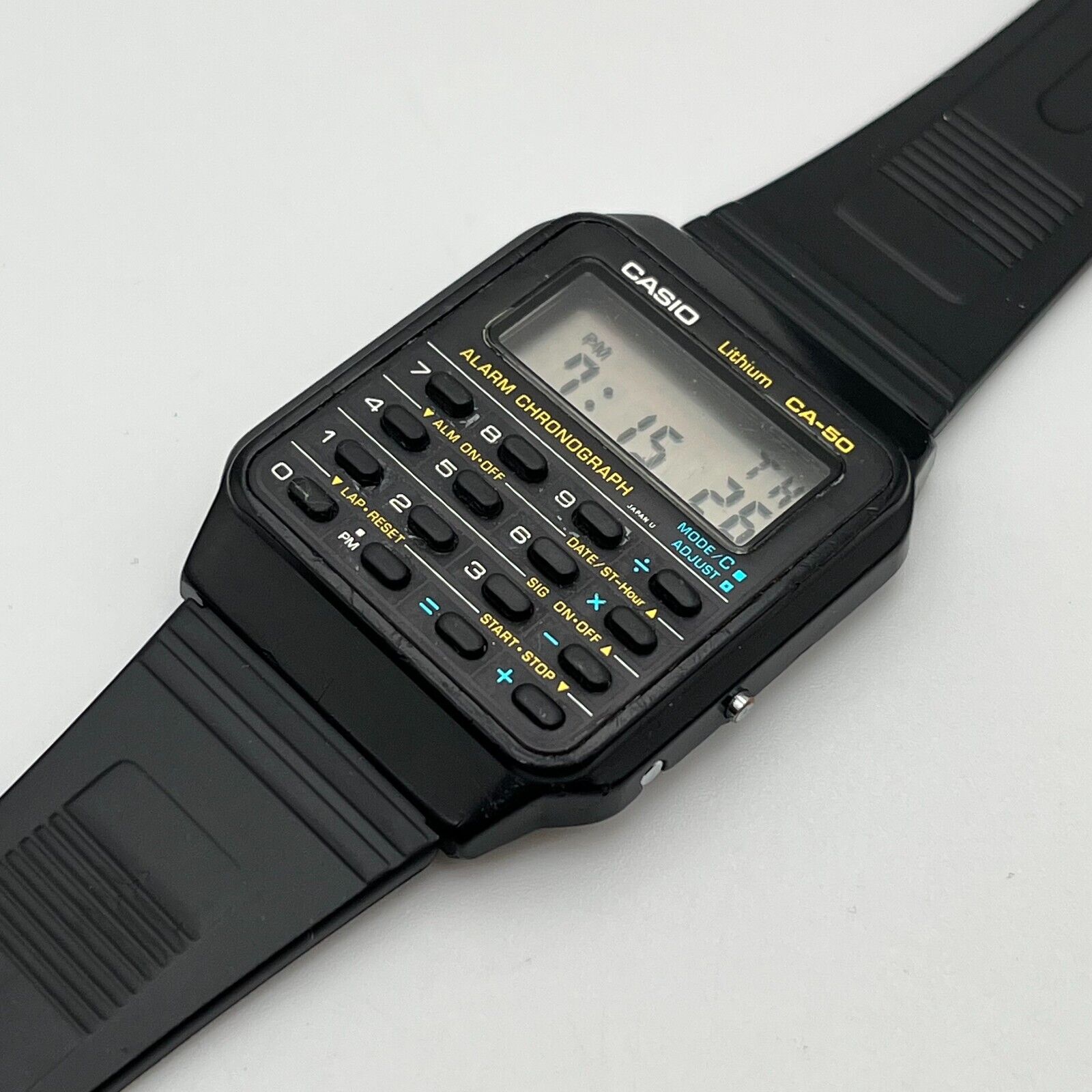
**Back to the Future: the affordable watch with the biggest personality.** Marty McFly does not need a luxury chronograph. He is an imaginative teenager with a skateboard, a guitar and a fascination with gadgets. The small Casio calculator watch he wears in the 1985 film belongs to precisely that character. A rectangular LCD display sits above a tiny grid of numerical buttons, giving Marty a miniature piece of consumer electronics on the wrist. The watch looks futuristic to the characters of the past and charmingly obsolete to us.
The original film is associated with the Casio CA-50. The visually similar CA-53W is linked to the later Back to the Future films and became the better-known long-lived model. Even Casio’s anniversary campaigns celebrate the family resemblance, which can blur that distinction. Both models belong to the history of affordable digital watchmaking, but they should not be described as if their references were identical. The CA-50 story on ChronoLume explains the watch’s practical calculator functions and the charm of its original design.
The Casio is arguably the strongest evidence that cinema does not require a prestigious price tag to create desire. The CA-50’s black resin case and digital movement were ordinary technology in the mid-1980s. Seeing it on Marty’s wrist attached that ordinariness to an adventure millions of viewers wanted to inhabit. When collectors now seek original CA-50s or modern successors, they are not necessarily pursuing mechanical complexity. They are buying a small, tangible connection to a story and to the experience of having watched it.
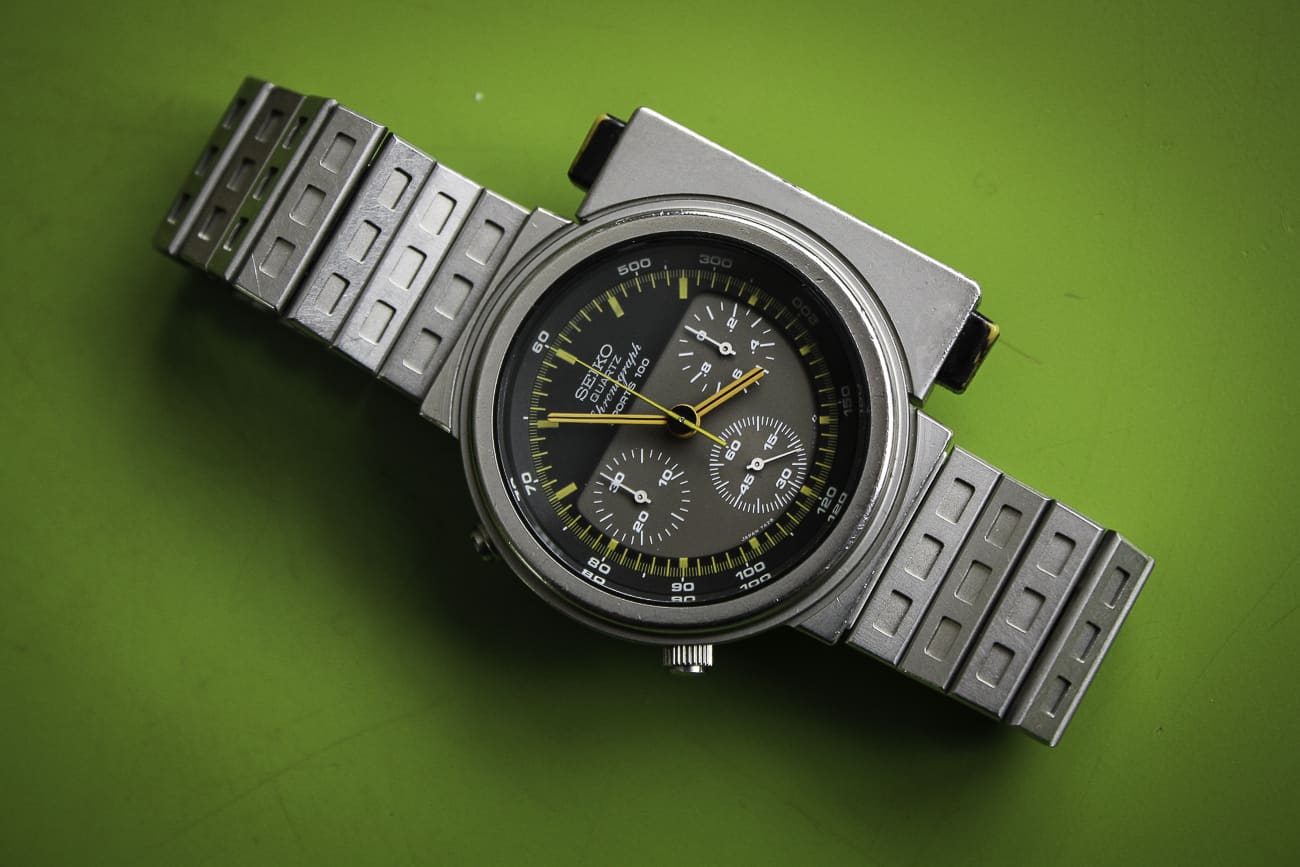
**Aliens: a car designer invents the future before cinema needs it.** Ellen Ripley’s Seiko in Aliens (1986) seems built to survive a hostile industrial spaceship. The circular chronograph dial sits inside an asymmetrical metal structure, and its unusual pusher placement resembles a component from machinery rather than traditional jewellery. The design comes from Giorgetto Giugiaro, whose career includes some of the most influential cars of the twentieth century. It was developed as a real Seiko chronograph in the early 1980s, before James Cameron put it on screen.
The 7A28 series is important beyond the costume department: Seiko’s 7A28 was a landmark analogue quartz chronograph calibre. The movie-associated 7A28-7000 turns those functions into a striking visual instrument, with bold timing markers and a case that feels ergonomic in a technical rather than decorative way. Its dramatic asymmetry might once have limited mainstream popularity. On Ripley, it becomes convincing, practically inevitable. The watch feels at home in the future because the film’s imagined industrial world and the real object’s design language reinforce one another.
Modern collectors sometimes encounter later Seiko Giugiaro reissues before seeing an original 1980s example. Those reissues are legitimate interpretations, but they are different references. ChronoLume’s Seiko Giugiaro profile looks at the original and its film context. The lesson is wider than one watch: a great prop does not always need to be invented by the film. Sometimes a production designer finds an overlooked real-world object that already looks as though it belongs in an invented world.
**Hamilton’s ordinary field watch: the art of not stealing the scene.** Hamilton has one of the most extensive screen histories of any watchmaker. The brand documents appearances stretching back to Shanghai Express in 1932 and describes involvement in hundreds of films and television productions. The unusual Ventura became part of Elvis Presley’s on-screen style, while bespoke or carefully selected Hamiltons later appeared in science-fiction adventures, historical dramas and action films. But perhaps the clearest lesson comes from a watch that is not trying to become iconic.
In Sonic the Hedgehog (2020), Sheriff Tom Wachowski wears a Hamilton Khaki Field Mechanical, reference H69439931. Its 38 mm brushed steel case, black dial and olive textile strap are sensible choices for a practical character. The H-50 movement is hand-wound, not automatic, and offers an 80-hour power reserve. Nothing about the object demands attention from the camera. That is precisely why it works: wardrobe can tell the truth about a character even when nobody in the audience notices a brand name.
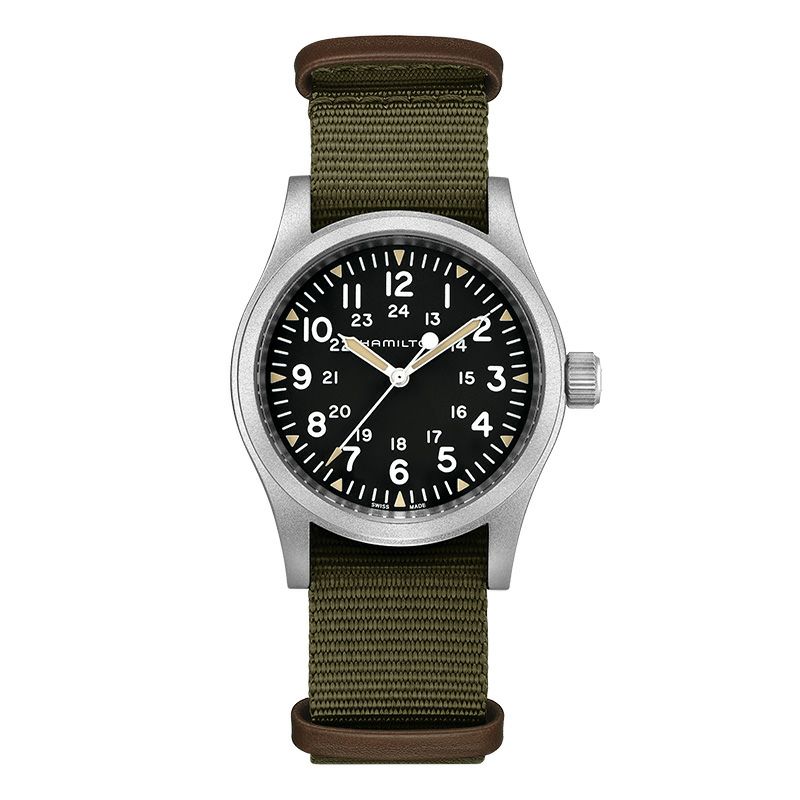
Hamilton’s other film collaborations reveal the opposite possibility. The company has used watches to make period details convincing in Pearl Harbor, to support the science-fiction world of The Martian, and to participate directly in the narrative machinery of Interstellar. Its later Khaki Field Auto The Odyssey shows how the relationship with director Christopher Nolan continues beyond the Murph. Across these examples, the watches are not all the same product or even the same kind of film prop, but they support the same principle: useful objects can make imagined people feel real.
**Why movies change the market without changing the mechanism.** Most collectors know that watch specifications can be compared. Case diameter, reserve, accuracy, materials and servicing costs are tangible. Movie associations resist comparison because they belong to memory. A Monaco is not technically better because McQueen wore one. The Casio’s digital functions are not more advanced because Marty McFly used them. The Murph’s mechanical movement is not more precise because it transmits an emotional message in a screenplay. Yet those connections make the objects different to people who love the films.
The effect is not automatically positive. Film references can encourage manufacturers to produce endless anniversaries, artificial scarcity or packaging that overwhelms the underlying watch. Collectors should ask whether a modern tribute has the same dimensions, movement type and details as a screen-worn original before assuming the two are equivalent. Vintage examples also need independent authentication; marketing images and attractive nicknames are not substitutes for checking references and condition. The most thoughtful collecting separates affection for a film from honest evaluation of a watch.
These six watches span a surprising range: an automatic Swiss racing chronograph, a quartz diver, an automatic field watch, an inexpensive calculator, an angular quartz chronograph and a manually wound military-inspired three-hander. They do not share a luxury segment, movement type or design language. What they share is visibility at the right dramatic moment. Cinema transforms objects into part of a character’s identity, then allows viewers to carry that identity into ordinary life. The greatest movie watches do more than remind us of famous scenes. They make the invisible link between memory and material feel wearable.
Source & attribution
Related perspectives
October 2026: Our Complete Selection of Watches Under €1,000 ↗
Beautifully bizarre: the automatic watches that refuse to look normal ↗
Beyond the colour: how great watch dials are actually made ↗