
Design · 2026-10-13
A Watch Within a Watch: The Industrial Design of Inner Rotating Rings
An original design essay on the architecture, geometry and interaction of internal rotating bezel watches, with 2025–26 examples.
Save this watch to revisit later.
Share this article
By Chronolume digest · Original English summary · Based on Chronolume original design editorial with sources from Seiko, Mido, Briston and Junghans
What to know
A watch with an internal rotating bezel seems simple until you study its layers. The hands remain in the centre, yet a numbered ring moves around them beneath the glass. What would normally be an external physical border becomes a second functional plane within the dial. This is one of watchmaking’s most satisfying examples of arranging a mechanical user interface around a tiny object.
### The shell and the instrument An external bezel adds visual weight around the case, often with a rough edge designed for grip. Relocating its markings under the crystal lets the outside become smooth, faceted, or sculptural. The centre of the watch can still carry timing information without the hard outline usually associated with a sports diver. This split between an expressive shell and an instrument-like interior is the key to the aesthetic.
### Depth as a design material The printed scale is not only a tool. Seen through the crystal, it can wrap around the dial like an architectural gallery. A sloping chapter ring pulls the eye down toward the hands. Changes in colour and finish set up a hierarchy: bold hours in the middle, quiet calibrated minutes at the edge. The best designers balance this extra density rather than simply adding more numbers.
### The crown becomes a controller Most examples use one crown for time-setting and another for manipulating the inner ring. This gives the case a memorable silhouette and makes the user aware of a second mechanical interaction. Single-crown approaches exist as well, showing that this familiar double-crown layout is a design convention, not a physical law.
### A note on compressor history Twin crowns and internal timing rings often evoke the Super Compressor cases of the mid-twentieth century. Historically, that term described a particular pressure-responsive case construction, not merely the number of crowns. Many modern watches are inspired by its appearance without reproducing its engineering. Clear terminology makes the heritage more interesting, not less.
### Seiko, 2025: everyday countdown The Seiko Prospex Speedtimer SPB513 uses its ring to count down, operated from the 4 o’clock crown. It has a compact 39.5mm steel case and automatic 6R55 movement. The pale face with dark minute scale and carefully placed orange accents looks more like a piece of 1970s industrial instrumentation than an overt dive-watch pastiche.

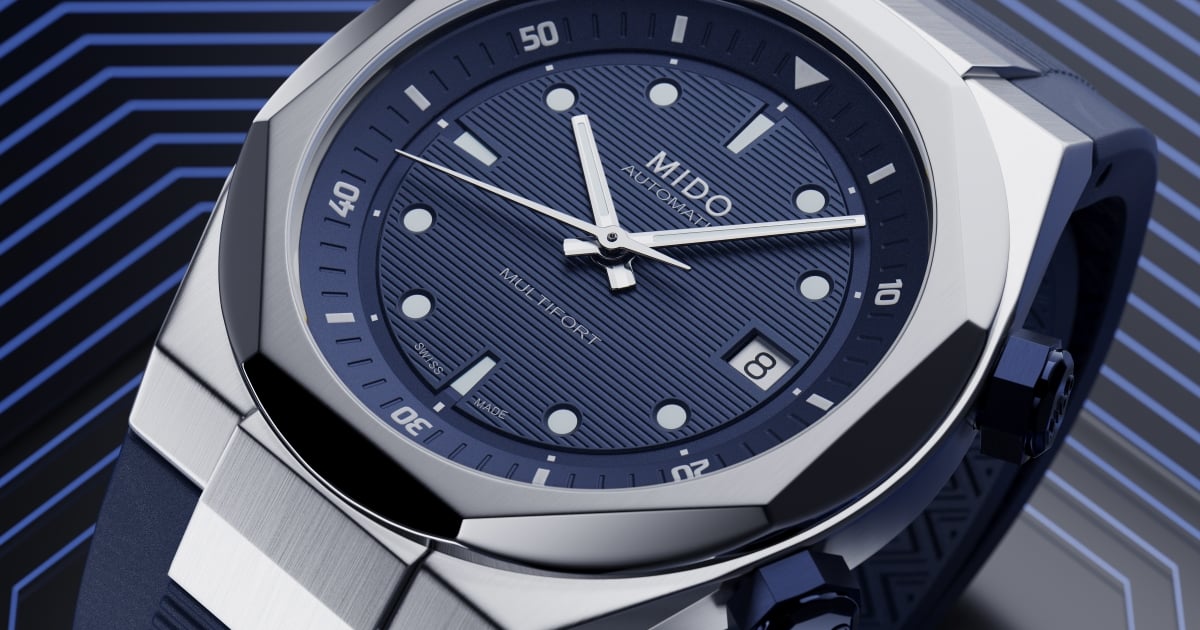
### Mido, 2025: geometric contrast The Mido Multifort 8 Two Crowns makes the design principle almost literal: an eight-sided steel bezel surrounds a circular moving scale. The two external controls, patterned dial and slim 40mm case provide different layers of geometry. Without its hidden timing scale, the prominent octagonal edge would tell a very different story.
### Briston, 2026: compressor-style character The 2026 Briston Clubmaster Legend Compressor combines the archetypal two-crown layout with a 42mm cushion-shaped case. Tortoiseshell-effect acetate variants make the exterior unusually expressive; the inner ring keeps the practical display organised. Its automatic NH35 movement and 200-metre rating anchor the playful design in watchmaking utility.
### Junghans, 2026: machinery in plain sight The Junghans Aquaris Diver is a bigger, tougher interpretation. Its 46.9mm case and protected screw-down crowns enclose a counterclockwise-only inner scale. With 500 metres of stated water resistance, this is a watch where exterior robustness and protected interior measurement are visually connected.

### Usability versus elegance An internal bezel is not inherently better for every purpose. Rotating a crown may be slower than gripping an exposed ring, particularly with wet hands or gloves. Depending on construction, accidental movement and crown sealing may also become concerns. The direction of rotation, legibility, luminous markings and security of the interface matter greatly when measuring safety-critical elapsed time.
### Why the idea lasts Few watch features offer such a direct trade between industrial design and interaction design. The ring is visually protected yet mechanically accessible; the outside is uncluttered yet the inside remains busy with purpose. In a world of watches that often compete by adding visible complexity, the inner rotating bezel makes its case through a subtler pleasure: discovering that the dial itself can move.
Source & attribution
Related perspectives
The field-watch code: ten 2026 watches and the design of military timekeeping ↗
Beyond minimalism: five Scandinavian watches redefining design in 2026 ↗
Cartier strips the Tank Louis back to platinum and a minimalist grey dial ↗