Release Archive
Andreas Strehler’s Trans-Axial Tourbillon regulates force before it fights gravity
A remontoir and tourbillon share one axis in Strehler’s technically concentrated 41mm watch.
- Release date
- Unknown
- Source published
- Not verified
- Added to Chronolume
- 2026-11-08
- Article published
- 2026-11-08
- Research checked
- 2026-11-11
Chronolume · Source-based analysis · Research checked 2026-11-11
Save this watch to revisit later.
Official model documentation checked 11 November 2026. Existing factual core retained with added design analysis and ownership implications. No hands-on tests or undocumented construction claims; existing slugs, source dates, images, credits and variants retained.
The analysis
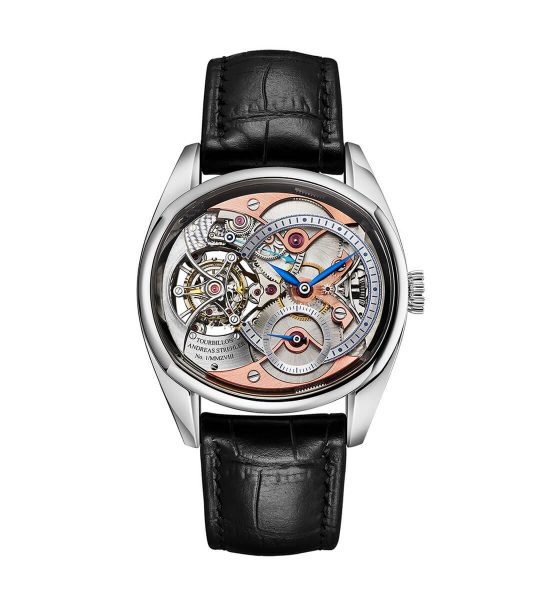
The Trans-Axial Tourbillon combines two regulating ideas in one visible mechanism. Twin mainspring barrels feed a remontoir d’égalité, which releases a consistent quantity of energy every second, before that energy reaches a tourbillon mounted on the same axis. The architecture turns rate stability into the watch’s central visual subject.
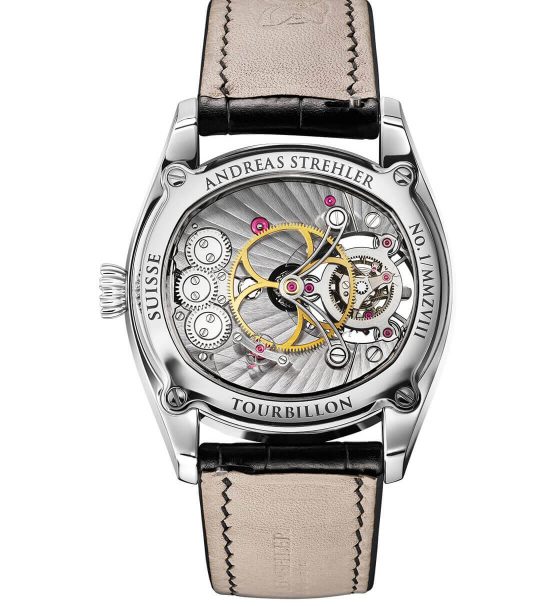
Its manually wound movement runs at 3Hz and provides a stated 78-hour reserve. Strehler lists 250 components and 39 jewels, with a small jumping-seconds display and a differential power-reserve indication. The tonneau-shaped movement sits inside a 41 by 47.2mm case measuring 10mm thick.
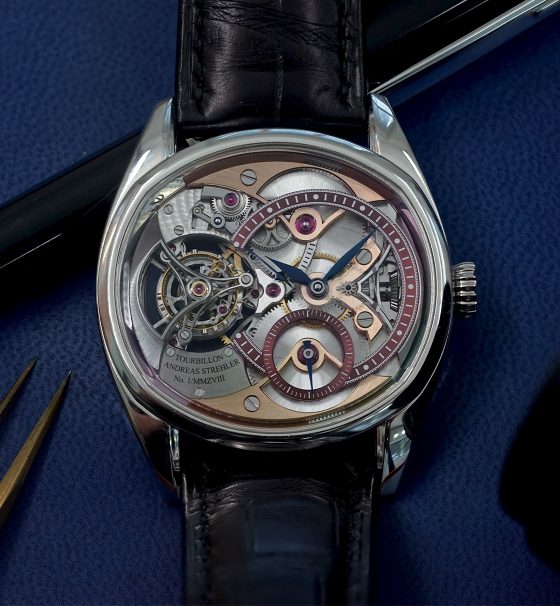
Case choices include rose gold, platinum, steel and titanium. The official page lists CHF 185,000 for precious-metal versions and CHF 175,800 for steel or titanium, excluding tax. This is a desk-based model profile; availability and current delivery timing still require confirmation.
A remontoir and a tourbillon address different parts of the regulation problem. The former interposes a repeated energy delivery between the mainspring supply and the regulating mechanism. The latter makes the regulating assembly rotate. Putting them together does not make their purposes identical, and it should not be summarised as one large accuracy claim. The arrangement is technically interesting even before any measured rate result is considered.
The one-second rhythm also makes the energy-management idea perceptible. Mechanical regulation is often described through components that move too quickly or too subtly for casual observation. A repeating release provides a slower visual event. The small jumping seconds belong within that language, giving the owner a clear cadence rather than a smooth central sweep.
The power-reserve display has a different role. It tells the owner something about the state of winding, not the current rate. A watch can have energy remaining without maintaining exactly the same timekeeping performance under every condition. No published reserve figure should be read as a guarantee of identical behaviour throughout the whole interval. The appropriate conclusion is about the designed architecture, not an unperformed timing test.
Comparison with Lune Exacte helps clarify the choice. Both use manual winding and constant-force ideas, but Lune Exacte directs much of its interest towards a highly precise astronomical indication. The Trans-Axial instead puts regulation itself at the centre. Someone drawn to movement architecture may therefore prefer it without claiming that a moon display is a lesser achievement.
The case dimensions also deserve to be read as a shaped enclosure. A width and a length together say more than calling it a 41mm watch. The movement and case are composed around each other rather than treating the calibre as a small round insert beneath a large dial. That coherence is visible in the documentation, although comfort and the actual balance of different case metals still require handling.
Case material changes price and physical character without changing the core reason to consider the mechanism. Steel or titanium should not be presented as a different technical grade from the precious-metal versions merely because the listed price is lower. A buyer should choose the entire object: material, weight, surface treatment and the way the regulating assembly is framed.
The Trans-Axial is therefore best approached as a watch for studying how mechanical time is maintained. Its complication is not primarily another piece of everyday information. It is a visible proposition about energy and regulation. Official prices exclude taxes and do not establish current delivery terms. This assessment is based on the maker’s documentation, without independent rate measurements, durability testing or firsthand examination of the finishing.