New Release
Albishorn Voisin Aérosport Classic: Art Deco through depth, not decoration
Why Albishorn's three-dimensional Art Deco dial, 180-degree seconds display and specially adapted hand-wound chronometer offer more than period styling.
- Release date
- 2026-11-11
- Source published
- 2026-11-10
- Added to Chronolume
- 2026-11-10
- Article published
- 2026-11-10
- Research checked
- 2026-11-11
Chronolume · Source-based analysis · Research checked 2026-11-11
Save this watch to revisit later.
Expanded desk-based design analysis verified against the manufacturer's Classic product page and cross-checked with dated SJX (10 November), Monochrome and Hodinkee coverage (10–11 November 2026). Physical dimensions, calibre base, dial construction, edition size and original manufacturer price from Albishorn. Optional bracelet price and launch date corroborated by independent coverage. No hands-on measurements, ownership, wear or real-world accuracy test; ergonomic and legibility tradeoffs are analytical questions, not tested findings. Publication date: 10 November 2026 is verified on SJX; manufacturer product page confirms shipping from late November and 11 November 2026 online launch is independently corroborated by Hodinkee, Monochrome and Fratello.
The analysis
Some vintage-inspired watches borrow a dial font, a set of numerals or a fashionable case size. The Albishorn Voisin Aérosport Classic attempts something harder: it imagines the complete logic of a watch that might have been commissioned in the 1930s, then develops the case, dial and movement around that fiction. The question is not whether it looks old. It is whether its unusual construction makes the historical idea feel convincing on its own terms.
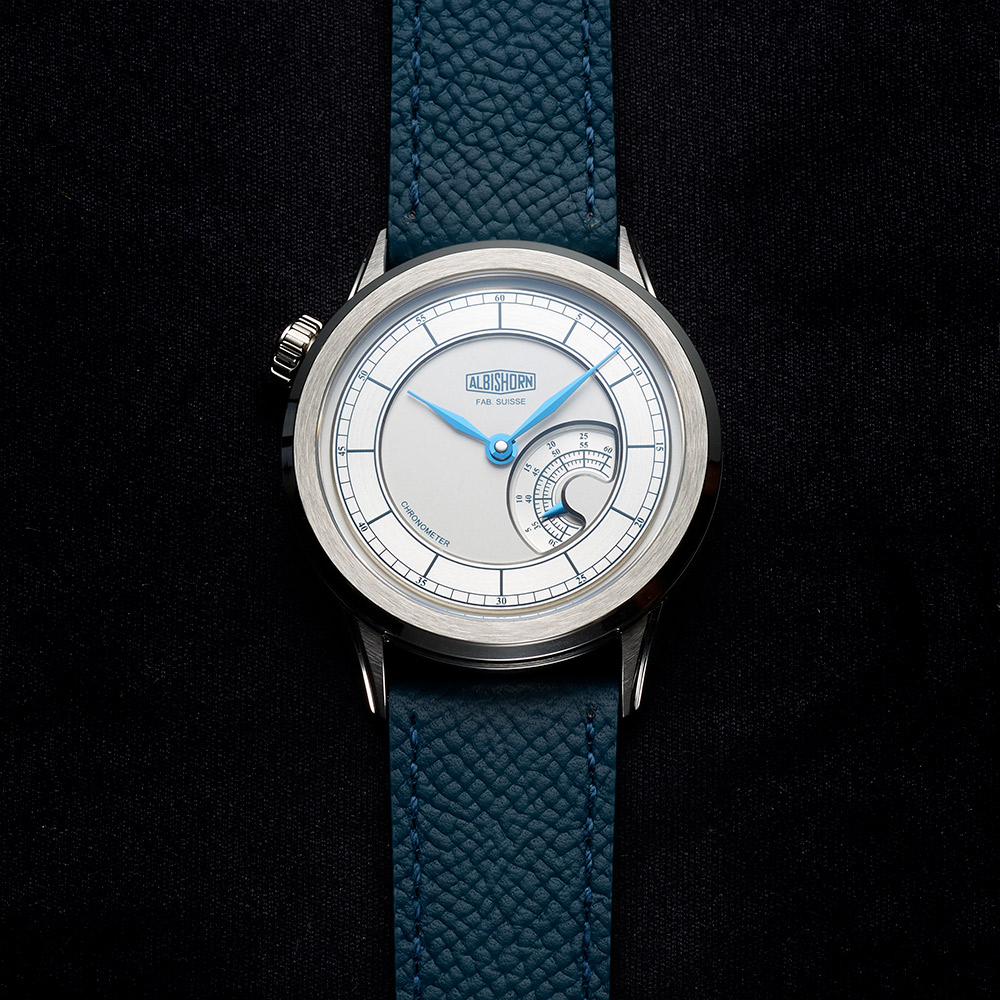
Start with the face. A conventional sector dial uses printed circles and radial markers to divide information into orderly zones. Albishorn turns those graphic zones into physical architecture. An opaline silver centre sits beneath a raised, circular-satin-finished chapter ring, whose polished edges catch the light. Below both lies the recessed running-seconds display near four o'clock. Depth, rather than a busy palette or applied ornament, tells the eye which information belongs together. This is why the Classic's apparent simplicity demands a closer look.
The most unconventional component is the 180-degree small-seconds indication. Instead of a standard subdial with a hand completing a full circle, the scale occupies a half-circle, and opposite ends of an asymmetrical hand mark successive halves of the minute. One end serves the first 30 seconds; the other takes over for the second 30. The dial therefore shows continuous running seconds through a deliberately discontinuous-looking graphic. It is an ingenious solution to a compositional problem: how to retain a visible seconds indication without giving it the visual weight of a full circular register.
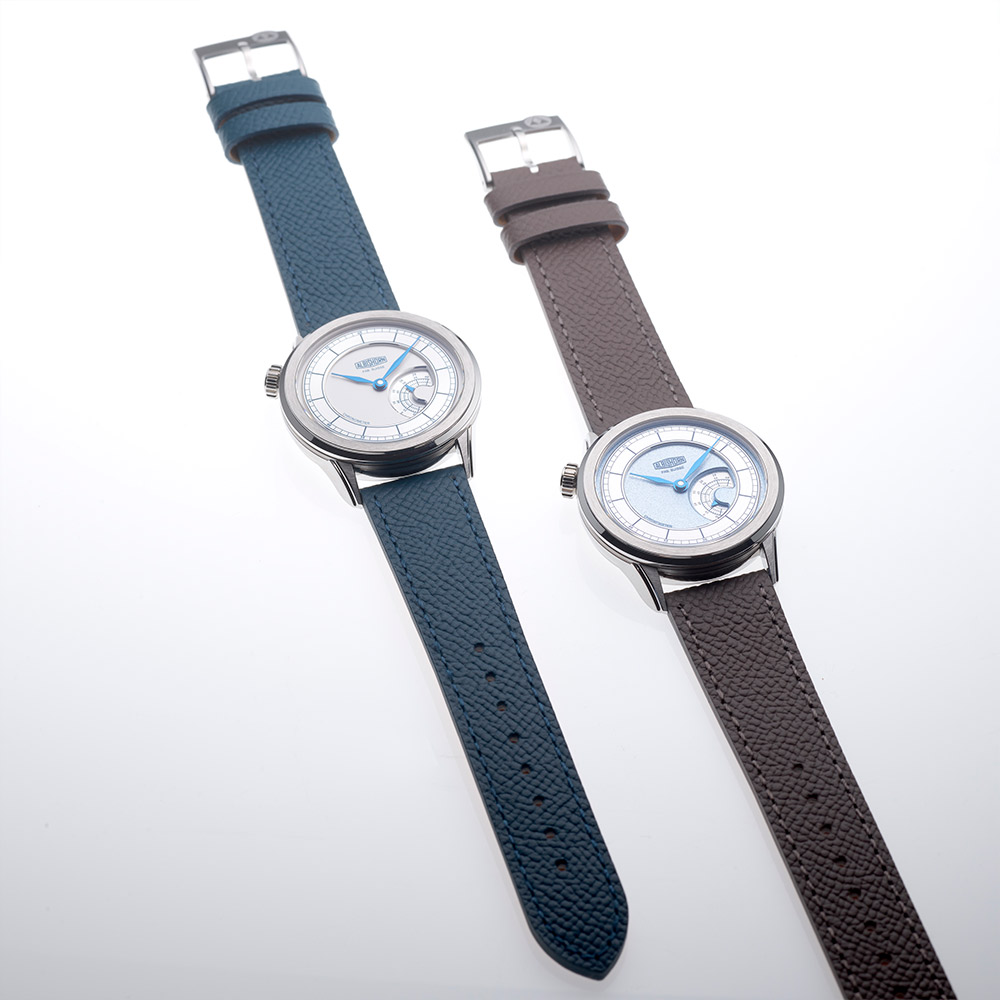
That ingenuity has a cost. A familiar round subdial can generally be understood at a glance; the Albishorn asks its wearer to learn which end of the hand is active and where the scale resumes. In manufacturer photography, the lower-set sector creates a strong sense of depth and balances the otherwise generous empty space. Whether its divided reading is as intuitive during daily use remains an open question. That is a desk-based judgment about the layout, not a claim drawn from wearing the watch.
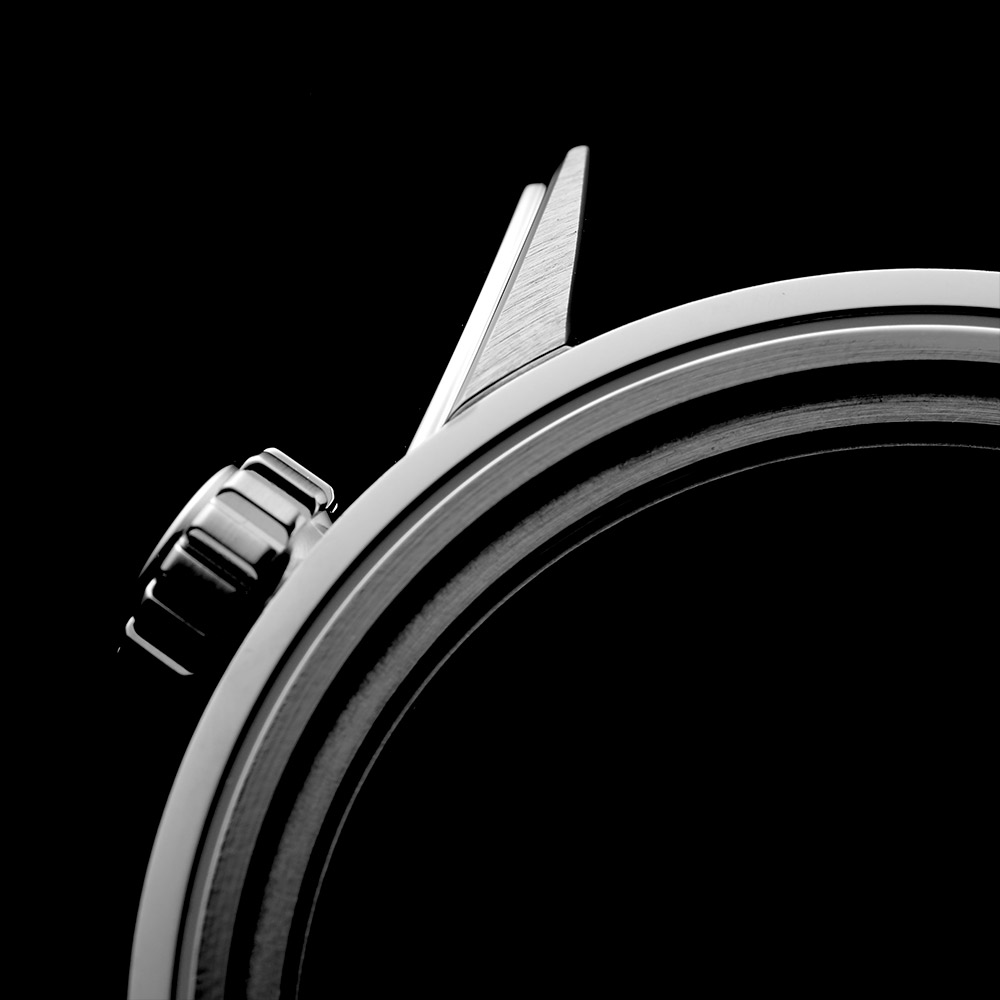
The case continues the same structural language. At 38mm across and 45.2mm from lug to lug, it sits in a restrained size category, but the geometry is more involved than the silhouette suggests. A two-step bezel sets circular satin brushing against a reflective lower facet; an inserted ring articulates the mid-case; and the two-level lugs repeat the design's horizontal layers. The 316L steel case measures 9.6mm thick with its sapphire crystals, or 8.9mm without them. Those figures make the amount of visible dial relief especially noteworthy.
A crown at roughly ten o'clock interrupts the usual right-side symmetry. It also connects the Voisin to Albishorn's established taste for off-centre controls and alternative instrument layouts. The crown has a sculpted recess that divides its profile, making it an object of design rather than a neutral winding knob. Whether that position is more comfortable for daily hand-winding will depend on wrist and handling preferences; the unusual location alone does not establish an ergonomic advantage.
Both the case and the dial depend on their finishes for their effect. The satin-brushed ring, polished borders and opaline field should respond differently as the light moves, while blued hands and blue inscriptions create a controlled accent against the silver. Albishorn specifies a box-shaped sapphire front crystal with multilayer anti-reflective treatment on both faces, plus a sapphire display back. These details are not simply decorative specifications: reducing reflection is particularly relevant when the dial's physical levels are part of what the watch is trying to communicate.
Comparing the Classic with the sibling Ice Blue shows how much the base finish matters. Both share the raised chapter ring and the unusual seconds sector, but the Classic relies on a silver opaline middle field and printed detail, whereas independent launch coverage describes a textured, more emphatically patterned centre on the Ice Blue. The former reads as a disciplined study in circles, edges and negative space; the latter brings more surface texture into the composition. Neither changes the underlying display, so this is a meaningful aesthetic comparison rather than two different technical models.
The mechanism is integral to that design choice. Calibre ALB04 M is an Albishorn-specific, manually wound movement developed from a Manufacture AMT ébauche. It is not accurate to describe the complete calibre as wholly manufactured in-house. Albishorn says its construction was adapted to support separate dial assemblies for the central hours and minutes and the offset seconds sector. The visual arrangement is therefore not merely a decorative plate stacked onto an untouched, generic movement. Mechanical layout and dial architecture were considered together.
The published specifications are substantial for a compact time-only watch: a 30mm-wide, 4mm-high movement with 17 jewels, a 4Hz frequency, hacking seconds and an approximately 60-hour power reserve. It is COSC-certified as a chronometer. That certification supplies a meaningful independent standard for the tested movement, although it should not be mistaken for a guarantee of identical real-world performance in every position and wearing condition. With manual winding and no date, the interaction remains purposefully simple even while the dial's seconds display is not.
The display back reveals a different sort of architecture. Radiating Geneva stripes emphasize the bridge arrangement, while double snailing decorates the winding wheels. Perlage appears on the main plate, including surfaces that are hidden once the dial is fitted; the maker also points to polished screw heads and gold-toned engravings. These are manufacturer-described finishes, not a hands-on assessment of their execution. Their editorial importance is that Albishorn treats the movement as something to be examined, not simply a specification needed to power the dial.
Then there is Gabriel Voisin. He was a real pioneer of French aviation and later an automobile designer whose interwar cars used advanced engineering and unconventional forms. His 1935 C28 Aérosport provides the conceptual setting. The watch, however, is not a documented historical commission, an authenticated Voisin possession or a replica of an original 1930s model. Albishorn explicitly invents the commission. The historical reference functions as a design brief: what sort of precise, mechanically thoughtful personal object might have belonged in that world?
This distinction protects the watch from the usual weakness of automotive collaborations. There is no need for a miniature grille, oversized car emblem or literal dashboard instrument pasted onto the dial. Instead, the designers interpret the more transferable values of Voisin's work: layered construction, disciplined geometry and a willingness to let engineering produce the form. Calling this Art Deco by structure rather than decoration is not just a pleasing phrase; it describes how the separate levels, polished transitions and restrained colour serve the finished object.
It also marks a change within Albishorn's own catalogue. Earlier pieces such as the Maxigraph and Marinagraph develop their imagined histories around timing functions and specialist instruments. The Voisin Aérosport removes the chronograph complication but keeps the brand's enthusiasm for unconventional display architecture. Its identity must therefore survive without an additional timing function to explain its shape. The asymmetric seconds sector, stepped case and ten-o'clock crown do that work. In design terms, this may be a more revealing test of the brand than another complication.
The everyday proposition deserves the same scrutiny as the aesthetic story. Albishorn specifies 50 metres of water resistance, a 20mm lug width and two included quick-release calf-leather straps, one taupe and one petrol blue. An optional steel bracelet is also offered. There is no luminous dial treatment listed in independent specifications, so this should not be assessed as a low-light instrument watch. Its 38mm diameter and moderate thickness are promising on paper, but comfort, winding feel, clasp fit and legibility still require actual wrist time before firm conclusions are possible.
For the Classic, the official product listing gives CHF 3,450, a limit of 99 pieces and deliveries beginning in late November 2026. Independent launch reports specify CHF 3,900 when ordered with the optional steel bracelet, with prices excluding applicable taxes, duties and shipping. They also place the online launch on 11 November 2026; a sales opening is not the same as confirmed dispatch. The model is limited, but its importance is not the numerical scarcity. It is that a small independent has invested an unusual amount of design and movement development in a watch that only tells hours, minutes and seconds.
The Voisin Aérosport Classic succeeds most clearly as a design proposition: a sector dial whose depth is real, a seconds indication that changes how a familiar function is read, and a case whose stepped construction carries the same idea outward. The unresolved questions are practical rather than conceptual: how effortlessly does the semicircular seconds display read on the wrist, and how does the offset crown feel in daily use? Until those are tested, the strongest conclusion is about its coherence. This is not a costume watch for an invented past; it is a contemporary mechanical object designed as though that past had once existed.
At a glance
| Model | Voisin Aérosport Classic |
|---|---|
| Case | 316L stainless steel; 38 mm diameter; 45.2 mm lug to lug |
| Thickness | 9.6 mm including sapphire; 8.9 mm without |
| Crystal | Sapphire front and rear; front with double-sided anti-reflective coating |
| Water resistance | 50 m |
| Dial | Three-level sector dial; opaline silver centre; 180° seconds at 4 o'clock |
| Crown | 10 o'clock |
| Movement | ALB04 M, hand wound, based on a Manufacture AMT ébauche |
| Frequency | 28,800 vph (4 Hz) |
| Jewels | 17 |
| Power reserve | 60 hours (manufacturer typical) |
| Certification | COSC chronometer |
| Straps | Taupe and petrol blue calf leather included; 20 mm lug width |
| Classic edition | 99 pieces |
| Price | CHF 3,450 on two straps; CHF 3,900 with optional bracelet (excl. taxes/duties/shipping) |
| Delivery | Late November 2026, per manufacturer |