New Release
Bell & Ross BR-05 Moonphase: can an instrument watch become romantic?
The BR-05 Moonphase uses an aventurine dial and a luminous moving shadow to turn Bell & Ross’s urban sports watch into a restrained celestial display.
- Release date
- 2026-11-24
- Source published
- 2026-11-26
- Added to Chronolume
- 2026-11-26
- Article published
- 2026-11-26
- Research checked
- 2026-11-26
Chronolume · Release archive · Based on Monochrome Watches
Save this watch to revisit later.
What to know
Bell & Ross has spent years making the rounded-square BR-05 feel like an urban instrument. The new BR-05 Moonphase asks whether that architecture can carry a complication normally associated with romantic dress watches without losing its discipline. Rather than adding a small conventional moon-phase window, the brand gives the Moon the entire lower sector of an aventurine dial. The result is not merely a BR-05 with another function. It is a test of whether a familiar integrated-bracelet sports watch can become expressive without becoming decorative for decoration’s sake.
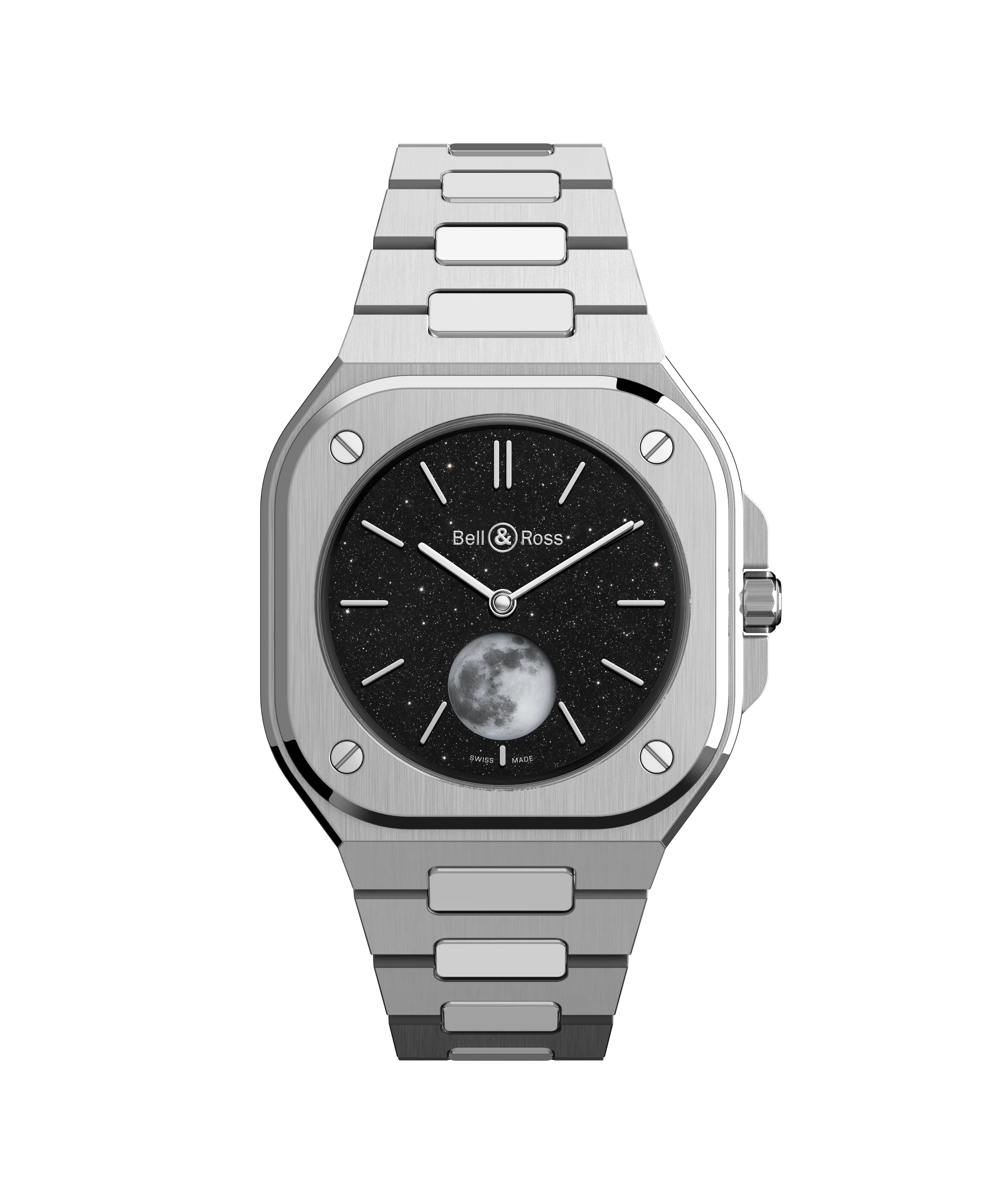
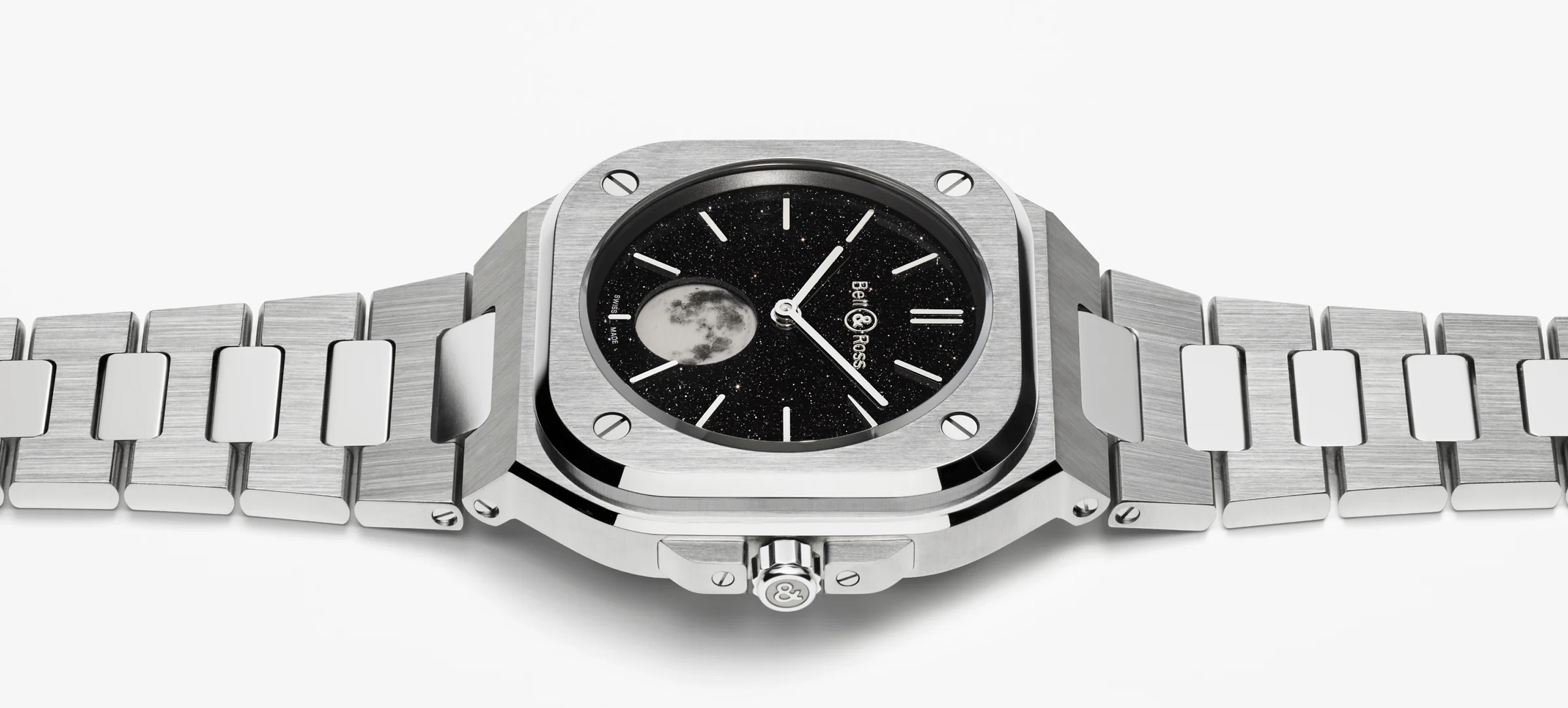
The watch is reference BR05A-MP-ST/SST on the steel bracelet, with BR05A-MP-ST identifying the broader model. Its stainless-steel case measures 40mm across and 11.5mm thick, retains the four functional bezel screws and uses the usual alternation of satin-brushed and polished surfaces. A screw-down crown and 100 metres of water resistance preserve the practical basis of the collection. Bell & Ross has not disclosed a lug-to-lug measurement, which is less straightforward on an integrated design in any case. The bracelet reference is listed at €5,990 in Europe; the black rubber-strap version is €5,500.
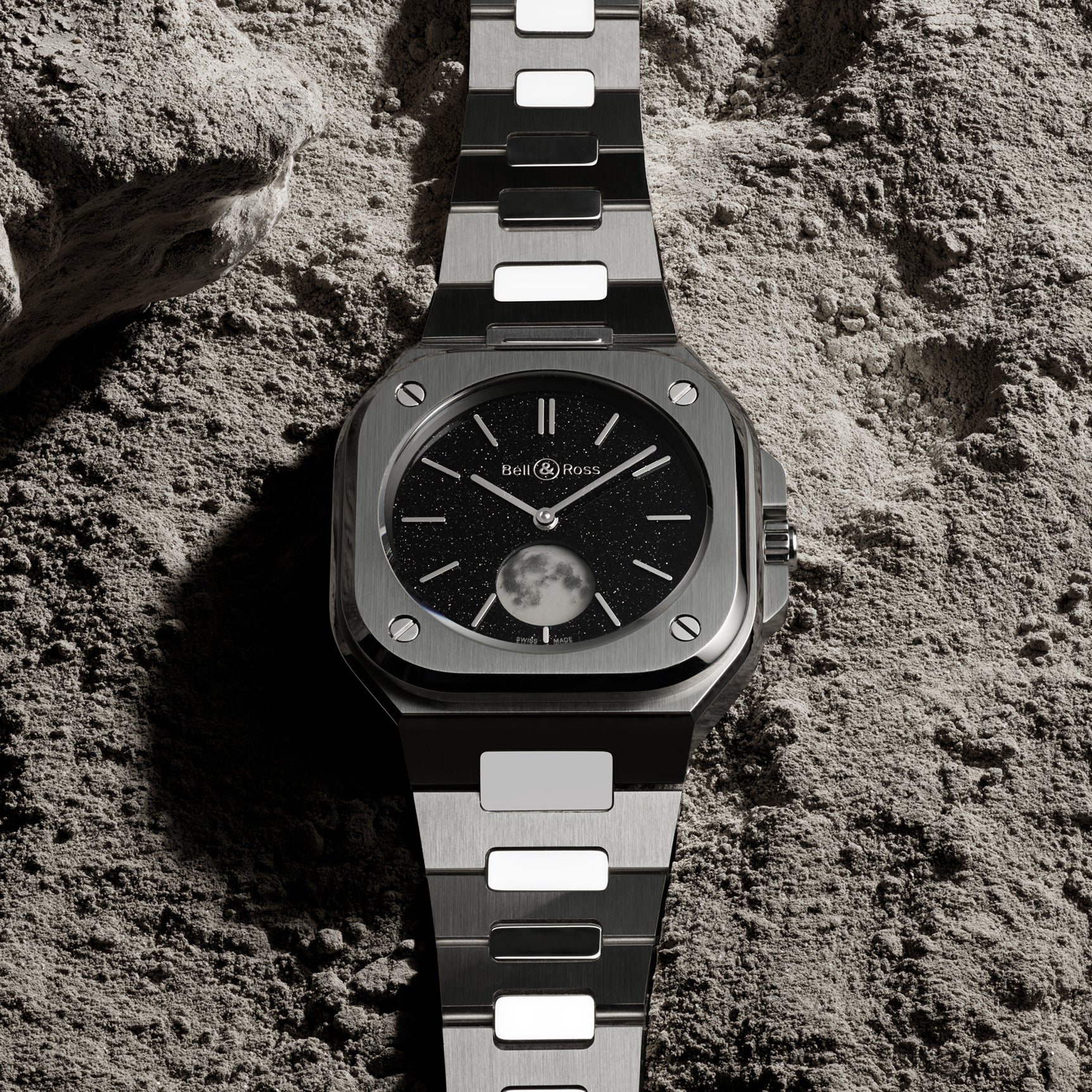
The dial is where the model stops behaving like a standard BR-05. Black aventurine glass supplies a field of metallic flecks, but the complication does not sit in a traditional crescent aperture. A circular display at six o’clock keeps the laser-engraved lunar surface visible while a rotating photoluminescent disc creates the moving shadow that indicates eight phases of the Moon. This reverses the usual visual logic: instead of the Moon travelling through a pair of curved cut-outs, the Moon remains the anchor and the shadow does the work.
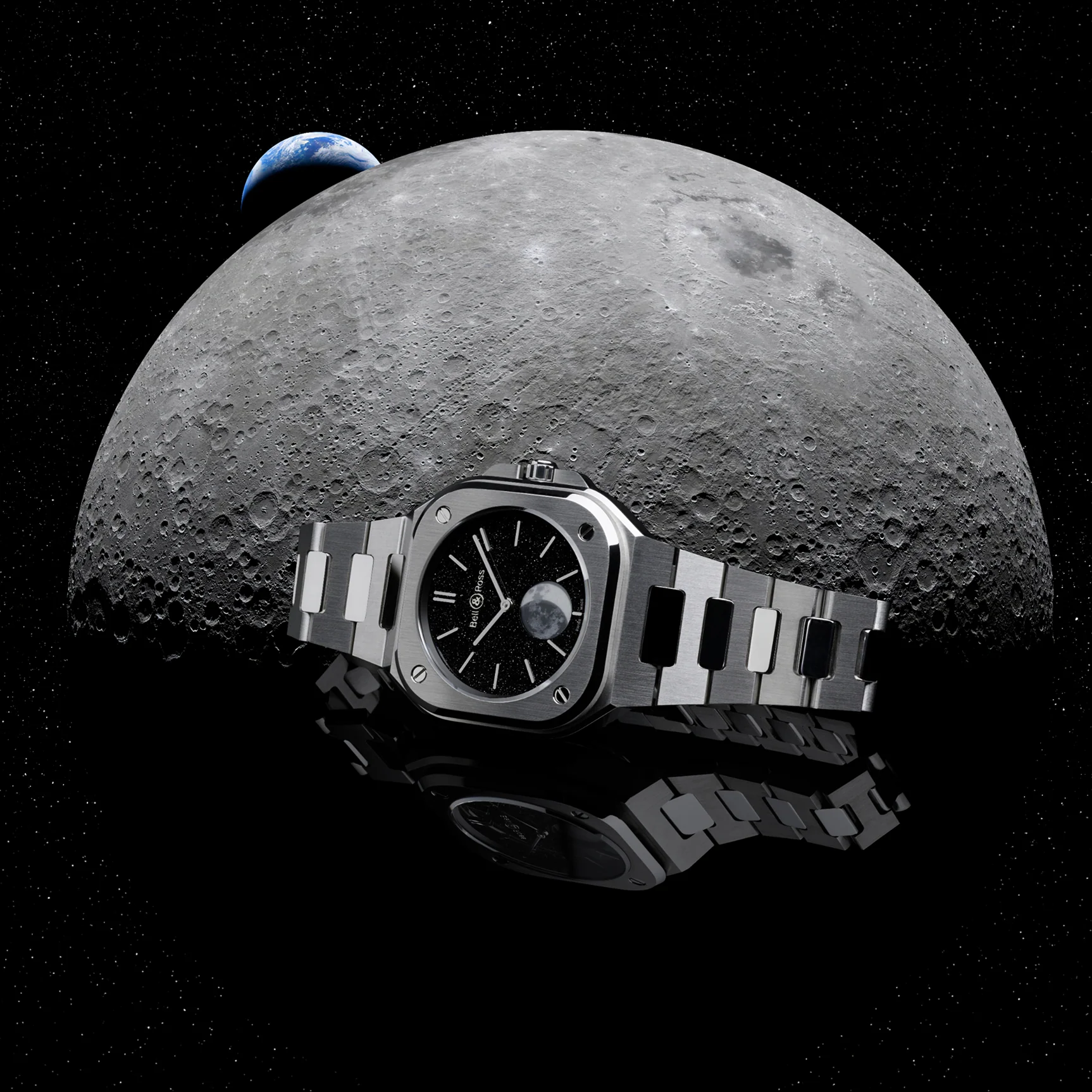
That choice matters to legibility and character. The large lunar display can be understood as an image before it is read as information, giving the watch a clear focal point. Bell & Ross removes both the date and the running seconds hand, leaving hours, minutes and moon phase. That restraint prevents the aventurine background, applied indices and luminous lunar disc from becoming a stack of unrelated effects. It also means the owner must accept a watch that favours atmosphere over everyday data. This is not the BR-05 for someone who wants the date at a glance.
Inside is the automatic BR-CAL.330, identified by independent technical coverage as a La Joux-Perret G101 base. There is a small but meaningful discrepancy in the available evidence: Bell & Ross’s technical specification states approximately 65 hours of power reserve, while the narrative on the same official page says approximately 60 hours; dated launch coverage also reports 60. Chronolume therefore records the range rather than choosing the more flattering number. The movement runs the hours, minutes and moon-phase display; the solid caseback carries a relief image of the full Moon instead of exposing the calibre.
The closest internal comparison is Chronolume’s BR-05 Blue Diamond Eagle profile. Both watches use aventurine to turn the dial into a night sky, but they pursue different ideas. The 36mm Blue Diamond Eagle maps the Aquila constellation with diamonds and keeps the mechanics to a conventional automatic time display with a stated 54-hour reserve. The 40mm Moonphase replaces jewellery-like markers with a functional celestial display and gives the dial more physical depth. One celebrates a fixed constellation; the other makes the changing lunar cycle the mechanism and the image.
That difference is important because it keeps the new model from feeling like a colourway. The case is familiar, but the display reorganises the visual weight of the watch. The circular Moon at six balances the round dial opening inside the rounded-square case, so the complication reinforces the BR-05 geometry rather than floating inside it. The integrated bracelet then pulls the reflective steel surfaces away from the dial, making the black centre appear deeper. This is desk-based interpretation from official and published imagery, not a judgment based on handling the watch.
The BR-05 Moonphase succeeds when viewed as an architectural moon-phase watch, not as a miniature astronomical instrument. It offers no date, seconds or additional calendar information, and Bell & Ross does not claim a specialised high-accuracy lunar cycle. What it does offer is a large, immediately understandable display inside a robust 100-metre steel watch. For a reader attracted to the BR-05 but unconvinced by another three-hander or chronograph, this is the most coherent reason yet to revisit the collection: the complication changes the face, the hierarchy and the mood without asking the case to become something it is not.