New Release
Bremont Supernova Perpetual Calendar GMT: can a high complication be a daily watch?
Bremont combines an Agenhor-developed perpetual calendar and crown-monopusher GMT with the 100-metre Supernova sports-watch architecture. We examine whether its usability matches its ambition.
- Release date
- 2026-11-24
- Source published
- Not verified
- Added to Chronolume
- 2026-11-25
- Article published
- 2026-11-25
- Research checked
- 2026-11-25
Chronolume · Release archive · Based on Bremont
Save this watch to revisit later.
What to know
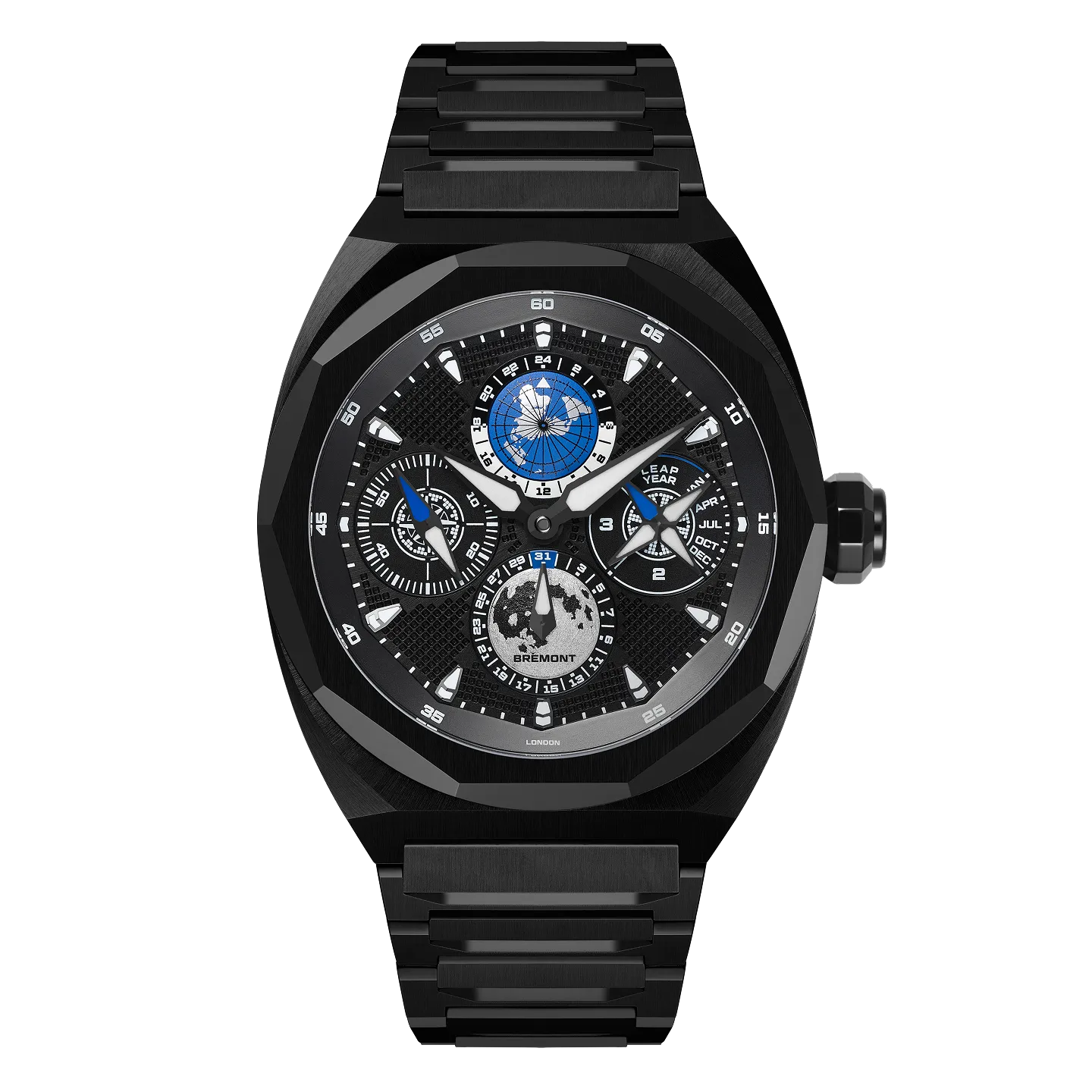
Bremont’s Supernova Perpetual Calendar GMT Monopusher asks an unusually practical question of a very complicated watch: can a perpetual calendar behave like something you might actually wear every day? The answer is not simply in the number of indications. It lies in how the British brand packages a perpetual calendar, a second time zone and a crown-operated corrector inside the established Supernova architecture, then gives the result 100 metres of water resistance and an integrated bracelet. On paper, this is a high complication built with fewer excuses than most.
The watch is reference SN41-PER-DLC-BK-B, a 20-piece edition announced on 24 November 2026. Its 41mm case is made from 904L stainless steel with an Ultra Black DLC treatment, paired with a black ceramic bezel and Bremont’s screwless Supernova construction. The official dimensions are 49.7mm in length and 13.9mm in depth. Those numbers do not make it discreet, but they keep it within the physical territory of a modern sports watch rather than turning the calendar into a display object. The integrated quick-release bracelet and 100-metre rating reinforce that intent.
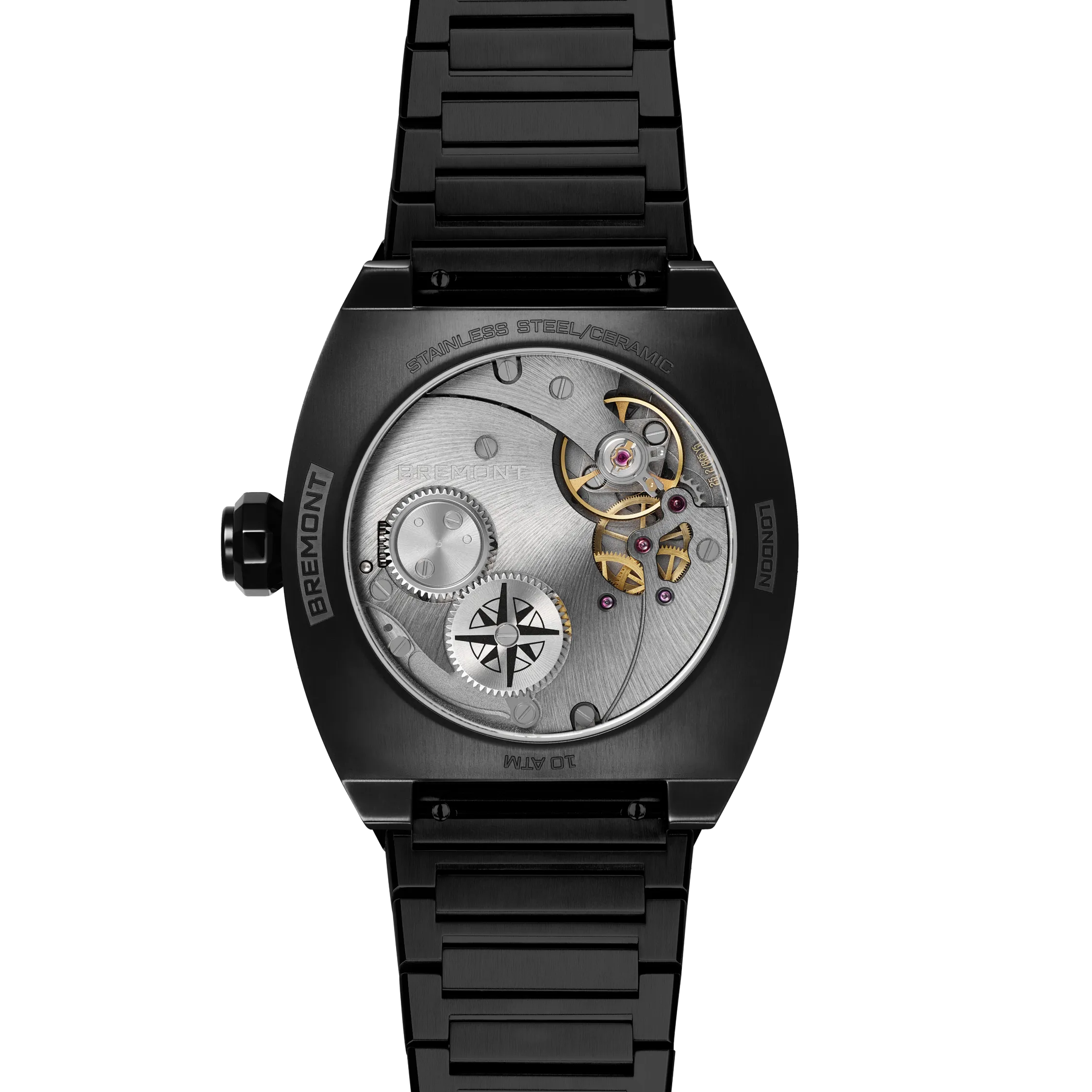
The manually wound BHC9192MH movement is the more consequential part of the proposition. Bremont says its perpetual-calendar and GMT module was developed exclusively with Agenhor, while final assembly takes place at The Wing after Bremont watchmakers trained with the Geneva specialist. The calendar is designed to account for months of different lengths and leap years, and the brand describes 172 micro-jumps across a four-year cycle. That is a manufacturer claim rather than an independently observed endurance test, but it explains the engineering ambition behind the crowded display.
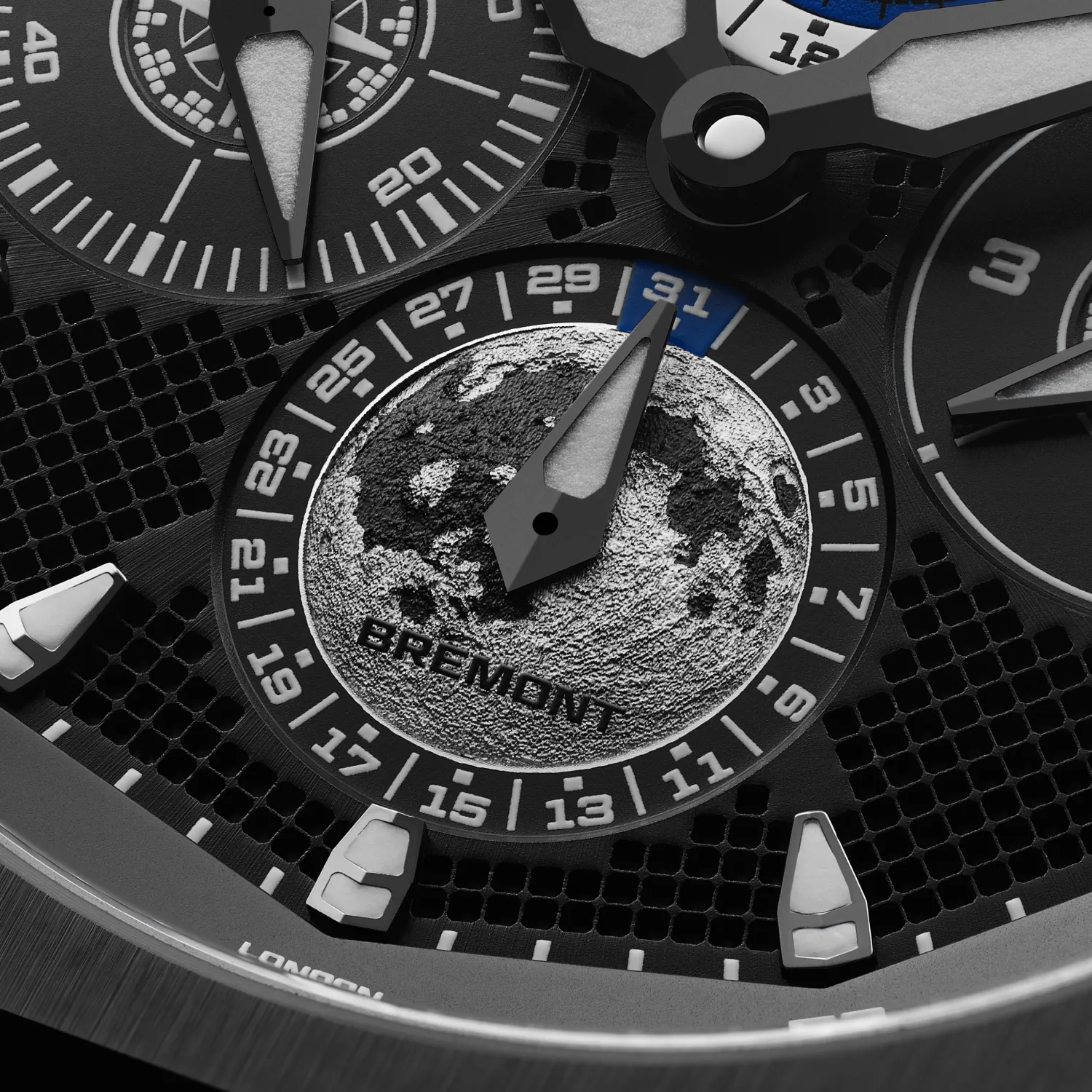
Reading the dial requires a little orientation. Local hours and minutes remain central, while small seconds sits at nine o’clock. The subdial at three combines the month with a leap-year indication; the display at six carries the date and moon phase. At twelve, a blue-and-black globe provides the 24-hour GMT indication. Pressing the monopusher integrated into the crown advances that second time zone in one-hour steps. The benefit is mechanical tidiness: the case does not need an extra corrector protruding from its flank. The cost is that several kinds of information compete on a black galvanic dial patterned like a solar array.
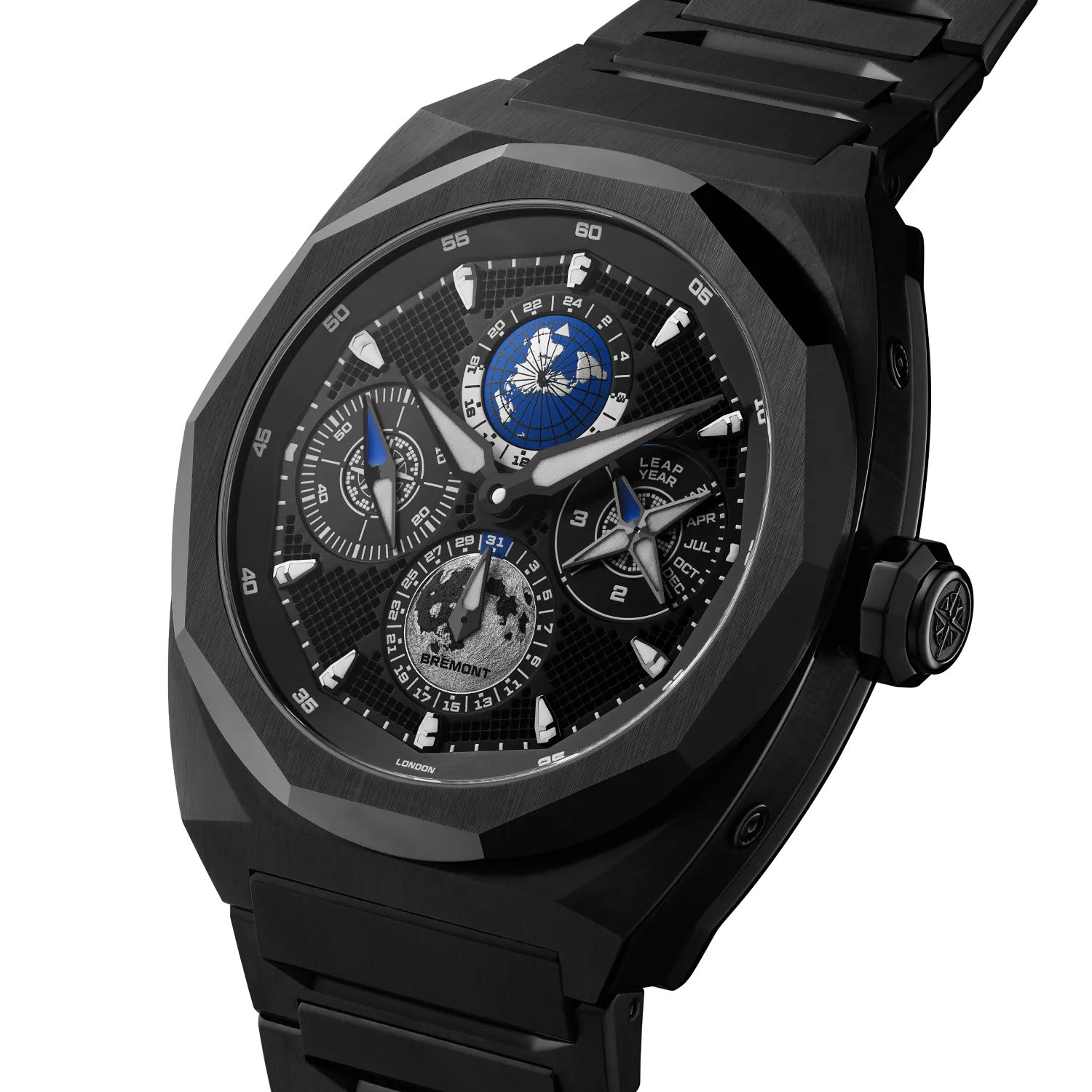
That density is where the design succeeds and struggles at the same time. Blue indications create a hierarchy against the black case and dial, while Super-LumiNova on the hands and markers preserves the basic time display. The globe at twelve is an immediate visual anchor, and the moon phase at six gives the calendar a second celestial counterweight. Yet this is not a minimalist perpetual calendar. The owner must be willing to learn the dial rather than expect every indication to resolve at a glance. The space-age theme is coherent, but coherence is not the same as simplicity.
Chronolume’s closest internal comparison is Bremont’s Supernova Hawking chronograph. Both watches use a 41mm black-DLC 904L Supernova case, an integrated bracelet and 100 metres of water resistance. From there they diverge sharply. The Hawking is an automatic chronograph with a 62-hour power reserve, a 600-piece edition and a price of £7,700. The new perpetual calendar is manual-wind, offers 50 hours, is limited to 20 and costs £29,950. The difference that matters is not simply complication count: the perpetual calendar asks for a much more deliberate relationship with the watch. Winding it and interpreting its displays become part of ownership, while the Hawking behaves more like a conventional sports chronograph.
That comparison also clarifies the price. A near-fourfold increase cannot be justified by case material or water resistance, which are broadly shared. It is tied to the Agenhor-developed calendar/GMT architecture, the much smaller production run and the labour implied by assembling and regulating a complex manual movement in Britain. Buyers should still treat the brand’s assembly and accuracy statements as manufacturer-supplied evidence. Chronolume has not handled the watch, timed the movement or tested the calendar through a leap-year transition.
The practical verdict is therefore conditional. The Supernova Perpetual Calendar GMT Monopusher is convincing if the reader wants a high complication that retains sports-watch robustness, a useful travel indication and a case designed around an integrated bracelet. It is less persuasive for someone seeking instant calendar legibility or the convenience of automatic winding. Bremont has not made the perpetual calendar simple; it has made it physically usable. That distinction is the watch’s strongest original idea—and the reason this limited edition deserves attention beyond its specification sheet.