Design & Culture
A past that never happened: the appeal of imaginary watch history
From Albishorn’s hypothetical commissions to cinema, military styling and personal memory: why an invented backstory can enrich a watch when it remains clearly labelled.
- Release date
- Unknown
- Source published
- 2026-11-11
- Added to Chronolume
- 2026-11-11
- Article published
- 2026-11-11
- Research checked
- 2026-11-11
Chronolume · Source-based analysis · Research checked 2026-11-11
Save this watch to revisit later.
Original cultural interpretation, written 11 November 2026. Official Albishorn Maxigraph description and Hamilton's dated Murph account checked; Voisin hypothetical commission corroborated by dated Fratello reporting after direct official product-page fetch failed. All nine linked Chronolume articles loaded and read against persisted archive. Two previously registered self-hosted Albishorn photographs visually checked and reused with original provenance/owner-directed approval. No new image downloads, interviews, archival discoveries, hands-on tests or market forecasts claimed. Source date is this original essay's publication date, not a manufacturer announcement date.
The analysis
A watch can arrive with more history than its owner will ever have time to investigate. There may be a pilot, a race, a naval specification, a film or a forgotten workshop somewhere in the explanation. Sometimes the connection is documented. Sometimes it is a design reference. Sometimes it is openly invented. The interesting cultural question is not whether we should stop enjoying these stories. It is whether we can learn to enjoy them without asking one kind of story to pass for another.
Consider a watch imagined for an event that really happened, but which never existed at the time. It offers a curious alternative to the familiar anniversary reissue. Instead of retrieving a design from an archive, its maker asks what might have occupied a gap in that archive. The result is closer to historical fiction than restoration: real settings supply constraints, and a contemporary designer supplies the missing object. The honesty of the exercise depends on keeping that missing object imaginary.
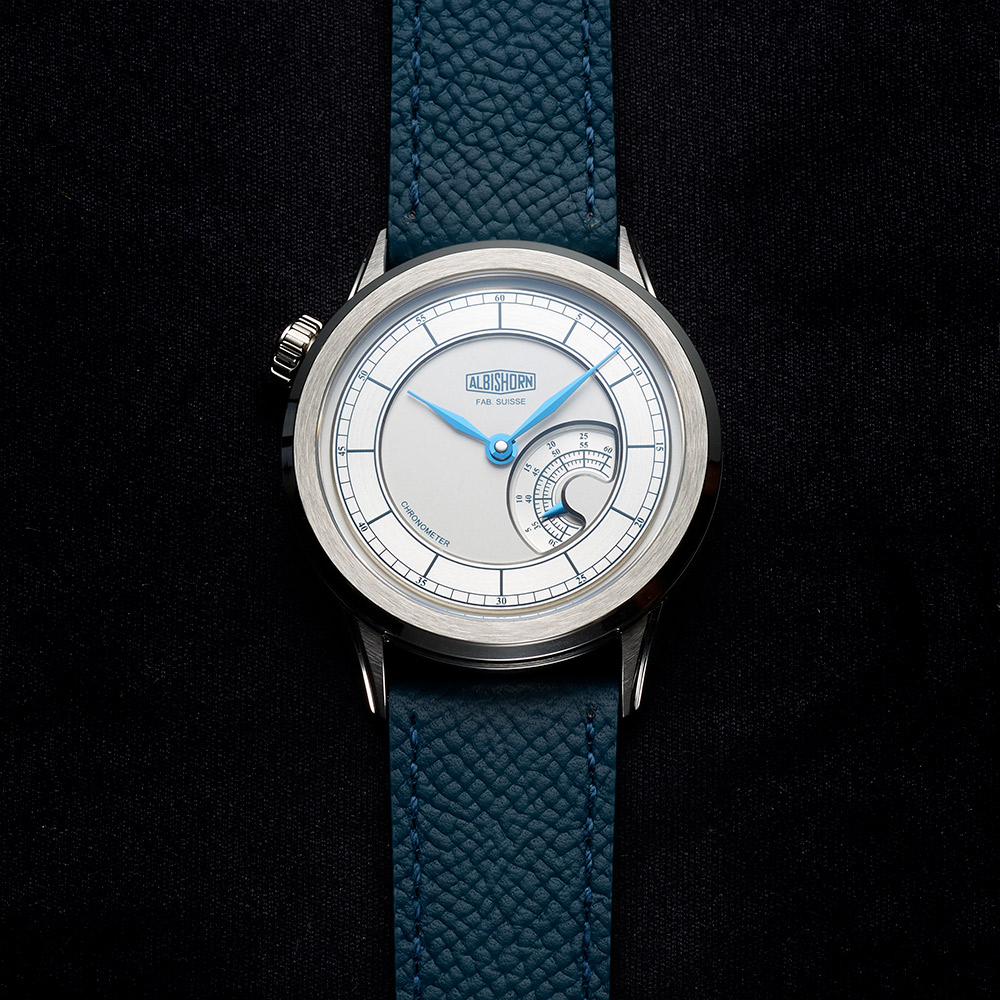
**An archive with a blank page.** Albishorn makes this premise unusually explicit. Its Maxigraph, made with Massena LAB, is presented as an imagined regatta chronograph for the first Bol d’Or in 1939. On its official page, the brand calls the commission hypothetical. The modern watch has a ten-minute retrograde countdown and a separate running indicator. Those are physical features of an actual object; the suggested historical commission is a creative framework.
That separation opens up an interesting freedom. A reissue invites questions about fidelity: which details match the original, which have changed, and whether the changes improve or dilute it. An imaginary period watch invites a different test. Do its choices make sense together? Does the proposed setting help explain the layout, proportions and controls? The story is useful when it imposes discipline on the design. It becomes less useful when it is merely a colourful paragraph that could accompany almost any watch.
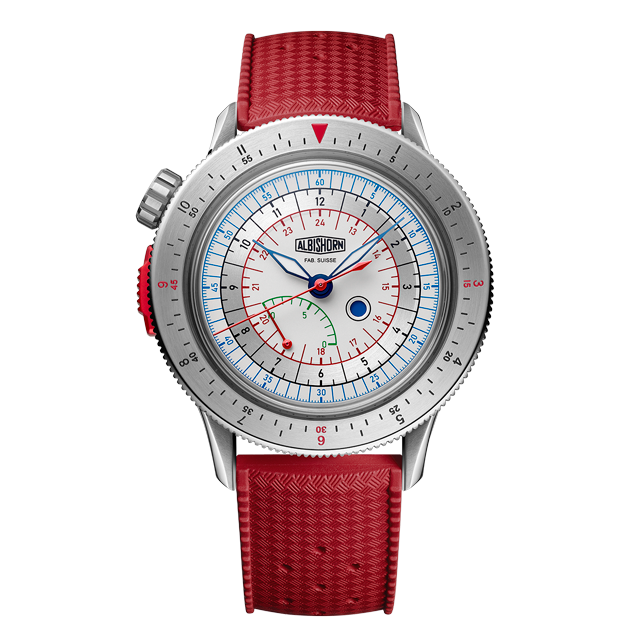
The distinction also protects the pleasure of discovery. A collector can enjoy the feeling of finding a lost instrument without being told that an invented instrument is a historical discovery. Suspended disbelief is not the same as being misled. We make this distinction easily in novels and films, where an invented character can move through a real city. Watch culture becomes more interesting when it grants designers similar imaginative room while retaining clear labels.
**The person was real; the commission was not.** The Voisin Aérosport Classic extends the conversation into a quieter kind of watch. Contemporary coverage describes an imagined commission for Gabriel Voisin, rather than a recovered watch he owned. The appeal lies in considering how an engineering and design world might be translated into an object for the wrist. A stepped dial, distinct scales and blue details have to do the work; a famous name alone cannot make the composition convincing.
This is where an invented past can become a productive design method. Choosing a setting means choosing limits. A designer has to decide what belongs, what feels intrusive and which modern conveniences can be incorporated without dissolving the premise. Viewers need not agree with every choice. They can still evaluate the result as a coherent proposal. The question shifts from ‘Did this exact object exist?’ to ‘What has the proposal taught us to notice?’ Neither question should quietly replace the other.
**A fictional life can create a real history.** Cinema offers a different relationship between invention and evidence. Hamilton says it created a watch for Interstellar and brought the Khaki Field Murph to the public in 2019. The characters and their extraordinary relationship with time belong to the film. The making of the prop and the later commercial watch belong to a documented production history. The watch does not need its fictional events to have happened in order for its cultural significance to be real.
Our broader essay on the watches that became movie stars explores that transfer of meaning. A viewer can develop a strong attachment to an object through someone who never existed. What is being acquired later is not the character’s life, but a tangible route back to the experience of watching. That is a legitimate form of affection. It becomes confused only when an emotional connection is presented as proof of technical superiority or as provenance for a particular physical watch.
The distinction between a design associated with a film and an individual screen-used object is especially important. A retail example can resemble the prop and carry the maker’s official association without having been near the production. That does not make the retail watch a disappointment. It simply changes the claim. One object participates in a shared visual language; another may have a traceable role in making the film. Their stories are related, but the evidence required to establish them is different.
**The point at which imagination needs a label.** Military-inspired watches make that boundary harder to ignore. A dial can borrow the visual clarity of equipment without having been purchased by an armed service. An institutional approval can be real without proving that every retail example was issued. A modern watch can draw on a historical specification while differing substantially from the original equipment. These distinctions change the object’s meaning even when the watches look similar.
Chronolume’s examination of military legitimacy beyond camouflage is useful here because it separates the verbs. Inspired by, approved by and issued to describe different relationships. Fiction is not an adequate substitute for evidence when a seller makes a factual claim about service history. Equally, a plainly labelled interpretation need not be dismissed for lacking an operational past. It should be assessed as an interpretation, including whether its design decisions support the purpose it evokes.
The same discipline helps with partnerships. In our essay on collaborations that leave fingerprints on the design, the most useful question is what the encounter changes in the object. A collaboration can be a real agreement and still produce an uninteresting watch. An imaginative premise can produce a compelling one. Institutional legitimacy, design quality and emotional appeal are separate judgements; a strong answer to one does not automatically settle the others.
**What the story cannot certify.** This matters most when watches change hands. A convincing explanation can make an object easier to understand, but it cannot authenticate its components, document its service history or establish who owned it. An attractive nickname is not an archive. A period-style dial is not evidence of age. A limited edition is not proof that a buyer will later find someone willing to pay more. The culture around an object and the evidence attached to that individual object need separate attention.
The practical counterpart is our discussion of trust in the secondary market. A collector should be able to ask for documentation without being accused of missing the romance. Clear evidence actually makes room for a more relaxed enjoyment of the story: once the factual claims are understood, the owner can decide how much the design, association or imagined setting matters personally. Enthusiasm does not have to do the work of authentication.
There is a simple reading exercise worth trying before the next purchase. Take the description of a watch and identify what refers to the individual object, what refers to the model’s documented history, and what describes a creative idea. Then ask which of those persuaded you. This need not become a joyless audit. It is a way to discover whether you love the watch, the world it evokes, or the promise of belonging to that world. Any of those can be meaningful, provided the distinction remains visible.
**The history that begins after the sale.** Eventually, even the most elaborate brand narrative meets an ordinary day. The watch is worn to work, taken on a journey, left in a drawer or given to someone else. Its owner begins adding a smaller and less polished history. Unlike the hypothetical commission, that history has actually happened. Unlike an auction biography, much of it may be impossible to prove to a stranger. Its importance does not depend on becoming commercially valuable.
That is why scratches, patina and the decision to let a watch age belong in this discussion. A cosmetic mark need not become a heroic anecdote to deserve acceptance. It can simply record use. Manufacturing an appearance of age and acquiring wear over time are different processes, just as wearing a historically inspired watch and owning an historical artefact are different experiences. Both can appeal, but their meanings should not be collapsed.
The most personal counterweight to the elaborate backstory is the watch we remember rather than the most expensive one. An owner’s reasons may have almost nothing to do with the narrative that first made the watch desirable. What began as an imagined regatta instrument can become the watch worn during a mundane but important year. A film connection can become a reminder of the person who gave it. Borrowed meaning provides a beginning, not a permanent script.
An imaginary past can therefore be a generous invitation. It lets a contemporary object converse with a world that never quite produced it, and it gives collectors something more engaging to discuss than a list of dimensions. The condition is candour. Let the hypothetical commission remain hypothetical, the documented association remain documented and the owner’s memory remain their own. The richest watch culture has room for all three—and enough curiosity to tell them apart.