New Release
Hamilton Khaki Pilot GMT Air Zermatt: does rescue work change the aviation GMT?
Forged carbon, a traveller GMT and Air Zermatt colour cues turn Hamilton’s H-14 platform into a rescue-themed travel watch with a distinct information hierarchy.
- Release date
- Unknown
- Source published
- 2026-11-17
- Added to Chronolume
- 2026-11-17
- Article published
- 2026-11-17
- Research checked
- 2026-11-17
Chronolume · Source-based comparison · Research checked 2026-11-17
Save this watch to revisit later.
Official Hamilton product specifications, availability and exact-model gallery checked 17 November 2026. Dated announcement context and traveller-GMT operation checked against MONOCHROME and corroborated where possible by Europe Star’s press-release reproduction. Internal comparison uses Chronolume’s existing H82555330 profile. No hands-on access, interview, independent measurement, accuracy test or fabricated conversion.
The analysis
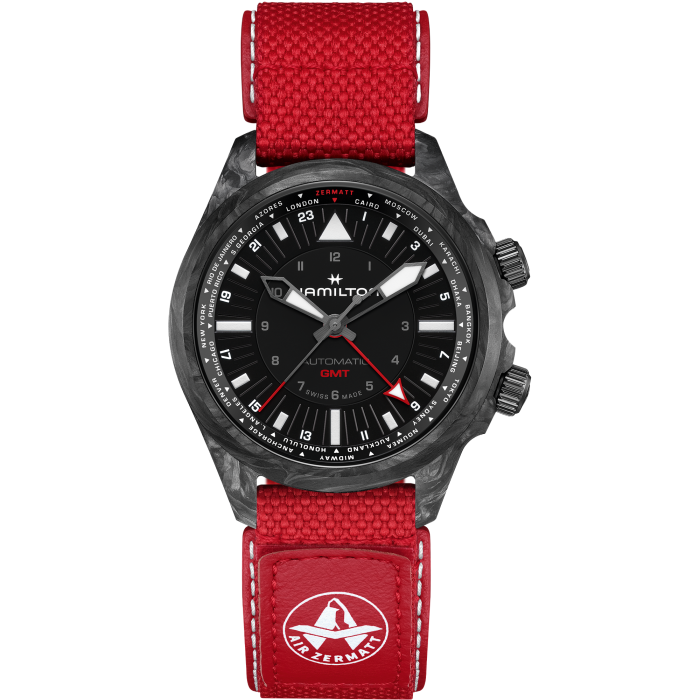
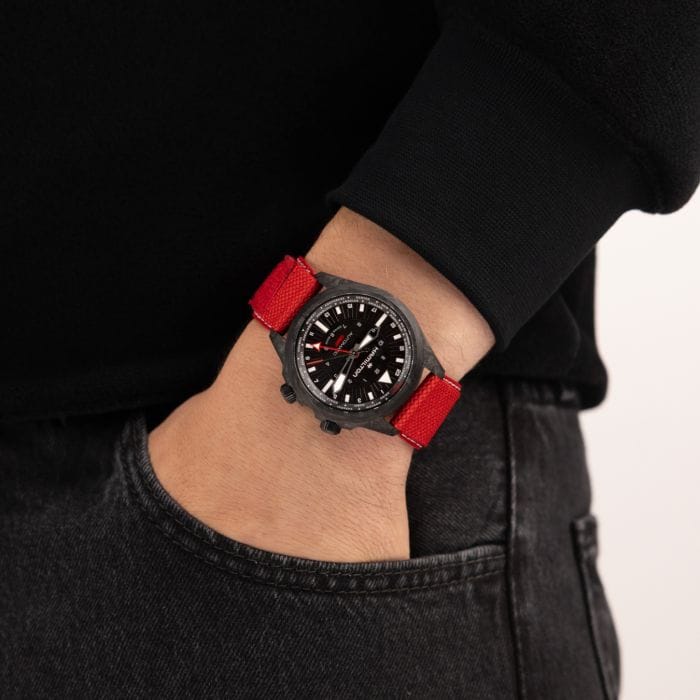
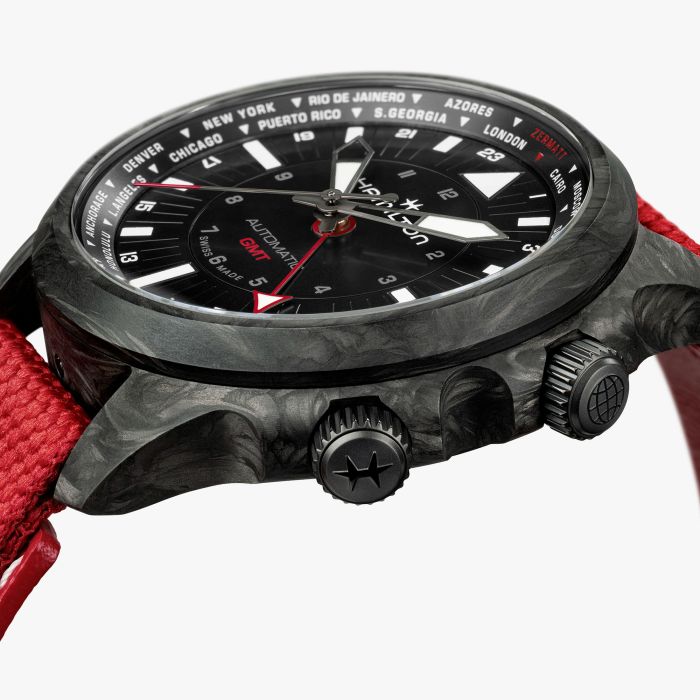
The Hamilton Khaki Aviation Pilot GMT Air Zermatt Special Edition asks a useful question: does a rescue-service collaboration change the function of an aviation GMT, or mainly its appearance? The answer is more interesting than the red strap suggests. Reference H76505930 combines a forged-carbon case, a red GMT hand, an internal city ring and Hamilton’s H-14 automatic calibre. It marks 15 years of Hamilton’s relationship with Swiss air-rescue organisation Air Zermatt, but the important part is how those choices reorganise a familiar travel-watch formula.
Start with the case. Forged carbon does not produce the regular weave associated with laminated carbon fibre; its visible pattern is irregular, so no two case surfaces should look precisely alike. On this watch, that texture keeps the black 42mm enclosure from reading as a flat, anonymous shell. It also provides a visual link to technical equipment without pretending that the material alone turns a consumer watch into rescue gear. Hamilton lists a sapphire crystal with anti-reflective treatment, 100 metres of water resistance, a display back and a Nivachron balance spring.
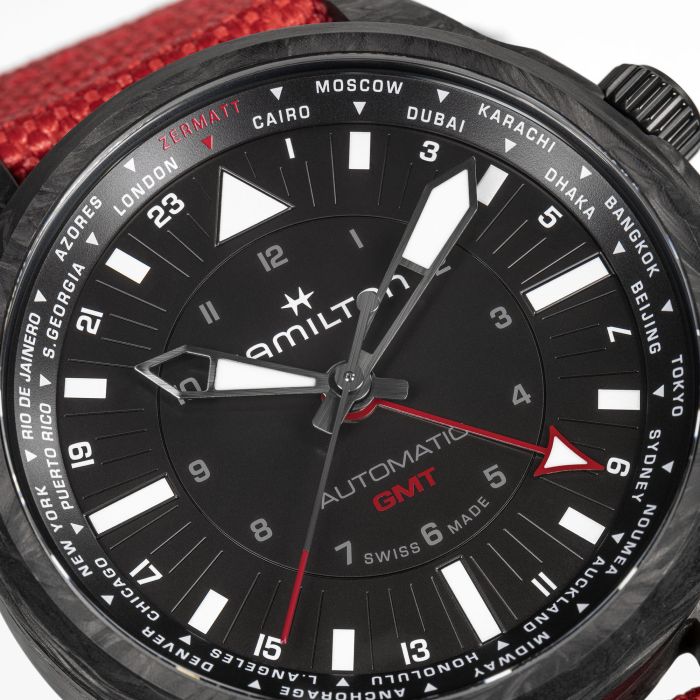
The dial is built around several jobs, and hierarchy matters. Large white Arabic numerals and broad hands carry ordinary time. A red arrow-tipped hand identifies the second time zone, while the outer city ring gives the complication an explicitly international frame. Red is repeated on the textile strap, but the hand remains the more useful application: it lets the eye isolate travel information quickly. From the official photographs, the city names are necessarily smaller and slower to consult. This is therefore not a dashboard where every item deserves equal attention; local time should win the first glance.
The H-14 calibre is the functional centre of the watch. Hamilton states an 80-hour power reserve, and dated launch coverage describes it as a traveller or “flyer” GMT, with the local hour hand adjustable independently. That distinction matters when crossing time zones: the wearer can move local time without disturbing the home-time indication. Chronolume has not handled this watch, timed the setting action or tested calendar behaviour at a date boundary, so the exact operating sequence should be confirmed in Hamilton’s manual. The source-based conclusion is narrower: this is more than a fixed 24-hour pointer added for style.
A useful sibling is the Hamilton Khaki Navy Scuba Auto GMT H82555330, which also uses the H-14 and an 80-hour reserve. The Scuba puts the second-zone mechanism inside a 43mm steel case with a dive-oriented bezel and 300 metres of water resistance. The Air Zermatt version moves the same broad travel idea into a lighter-looking forged-carbon, aviation-and-rescue context, with 100 metres of resistance and a city ring. The difference that matters is interface: the Scuba prioritises elapsed-time and water capability, while the Air Zermatt prioritises place names, low visual mass and rapid local-time changes.
Proportions need one caution. Hamilton’s live Swiss product page lists a thickness of 11.1mm, while dated launch material carried by Europe Star and MONOCHROME reports 13.38mm. Those figures conflict, and neither should be silently substituted for the other. Lug-to-lug length was not disclosed in the checked material. Until Hamilton clarifies the discrepancy or the watch can be measured, a buyer should treat thickness as unresolved and try the complete watch rather than infer fit from the 42mm diameter alone.
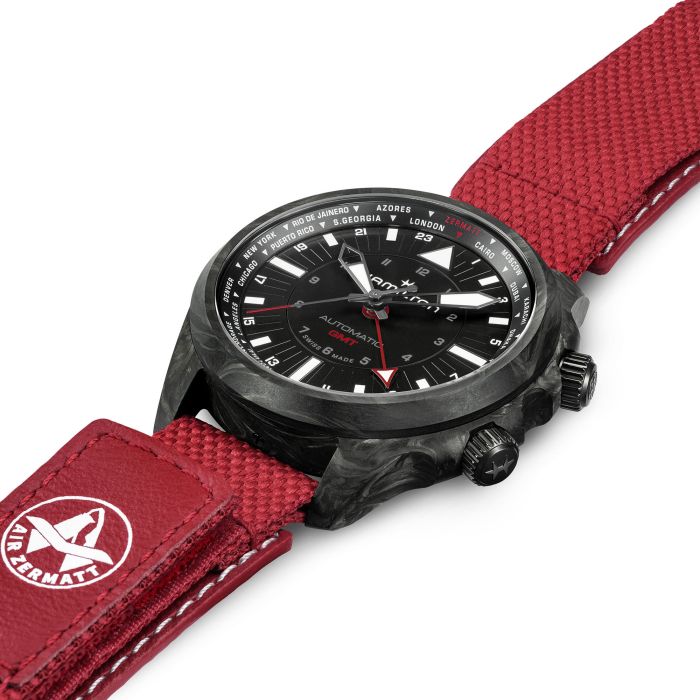
The two supplied straps make the collaboration’s visual character optional rather than permanent. The red textile strap, signed for Air Zermatt, foregrounds the partnership and is the version shown most prominently. A black leather strap is also supplied, allowing the carbon case and GMT accents to do the work more quietly. Both use a black PVD-coated buckle. That second configuration may matter to an owner who appreciates the rescue association but does not want a bright strap to define every use of the watch.
Hamilton’s Swiss store listed H76505930 in stock at CHF 1,445 when checked on 17 November 2026. MONOCHROME’s dated report lists EUR 1,645 and USD 1,725; those are reported market prices, not Chronolume currency conversions. Belgian availability and a Belgian landed price were not independently verified. Hamilton calls this a special edition, but none of the checked sources disclosed a numerical production limit.
The Air Zermatt succeeds when read as a genuine GMT with a collaboration-shaped interface, not as a rescue instrument by association. Its strongest decisions are practical: an independently adjustable local hour, a legible red second-zone hand, useful water resistance and two straps. The forged-carbon case and Air Zermatt colour language give those functions a clear identity. For a traveller choosing between Hamilton siblings, the decisive question is not which story sounds more adventurous; it is whether a city-ring aviation display or a dive-oriented timing bezel better matches the information they will actually use.
Sources and method: specifications and availability were checked against Hamilton’s official product page and Hamilton’s Air Zermatt story. The 17 November announcement context, traveller-GMT operation and multi-market prices were checked against MONOCHROME; the November launch description and 13.38mm figure were corroborated by Europe Star’s press-release reproduction. This is desk-based analysis of published material and official photographs, not a hands-on review, interview, independent measurement or accuracy test.
At a glance
| Brand | Hamilton |
|---|---|
| Model / reference | Khaki Aviation Pilot GMT Air Zermatt Special Edition / H76505930 |
| Case material | Forged carbon |
| Diameter | 42 mm |
| Thickness | 11.1 mm on Hamilton’s live product page; 13.38 mm in dated launch coverage — unresolved |
| Lug-to-lug | Not disclosed in checked sources |
| Crystal | Sapphire with anti-reflective treatment |
| Dial | Black; white Arabic numerals, red GMT hand and city ring |
| Movement type / calibre | Automatic Hamilton H-14 GMT; Nivachron balance spring; 21,600 vph reported by MONOCHROME |
| Functions | Hours, minutes, seconds, date, second time zone; independently adjustable local hour reported in dated launch coverage |
| Power reserve | 80 hours |
| Water resistance | 100 m / 10 bar |
| Strap / bracelet | Red Air Zermatt textile strap plus black leather strap; black PVD-coated buckle |
| Price / currency | CHF 1,445 on Hamilton’s Swiss store; MONOCHROME reports EUR 1,645 and USD 1,725 |
| Availability | Listed in stock on Hamilton’s Swiss store when checked 17 November 2026; Belgian availability not independently verified |
| Edition size | Special edition; numerical limit not disclosed |