New Release
Norqain Independence Skeleton Arctic Blue: is the bracelet the real upgrade?
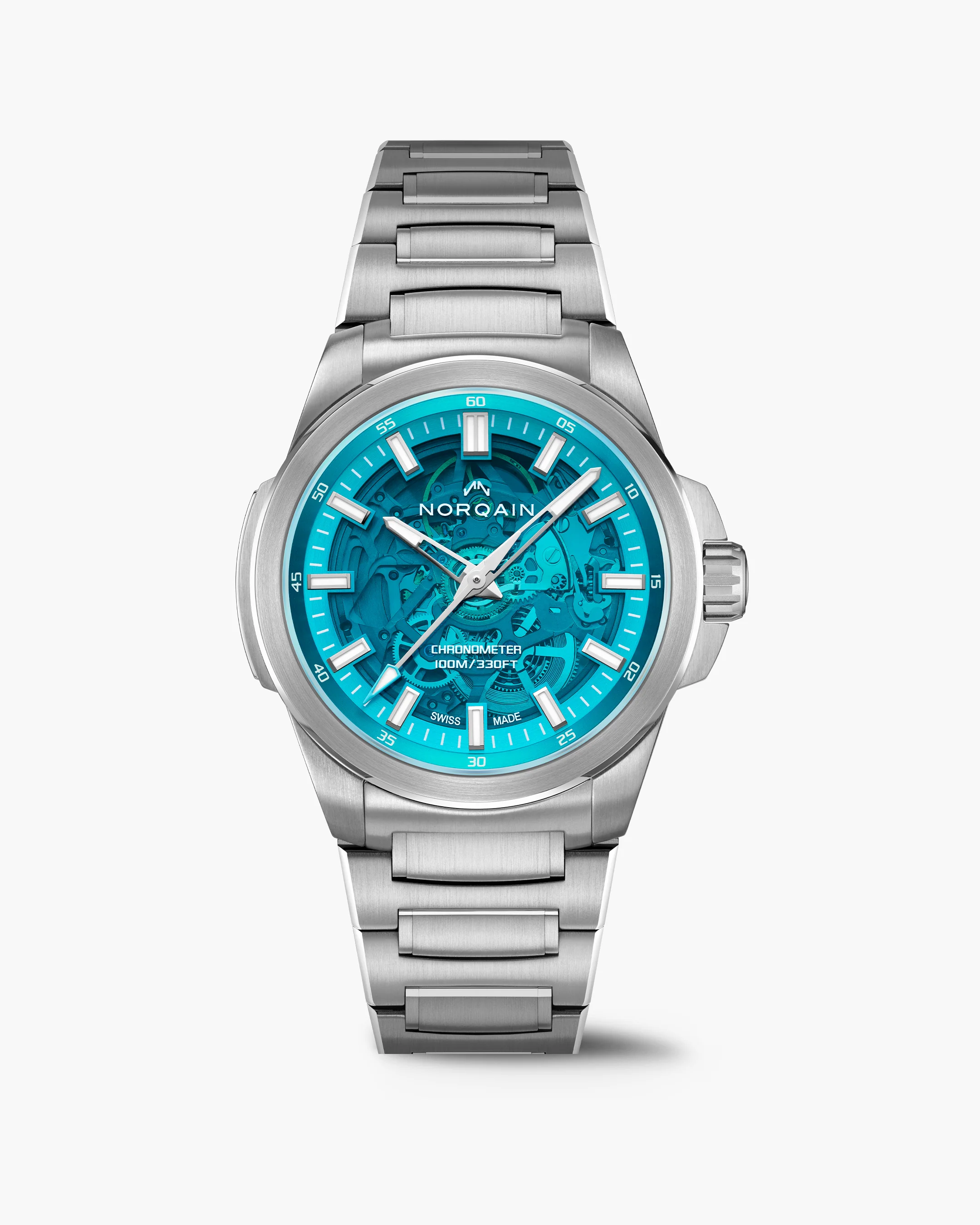
A transparent Arctic Blue dial catches the eye, but Norqain’s redesigned semi-integrated bracelet is what changes the 40mm Independence Skeleton.
- Release date
- 2026-11-19
- Source published
- 2026-11-20
- Added to Chronolume
- 2026-11-22
- Article published
- 2026-11-22
- Research checked
- 2026-11-22
Chronolume · Source-based comparison · Research checked 2026-11-22
Save this watch to revisit later.
Desk-based comparison of official exact-model specifications, product photography and sibling pricing, cross-checked against dated launch reporting.
The analysis
## Is the new bracelet more important than the new colour? Arctic Blue is the first thing the Norqain Independence Skeleton shows in a photograph, but it may not be the most consequential part of this release. Reference N3008.07S01.Q01.S01 keeps the established 40mm steel case and the familiar COSC-certified N08S skeleton movement, then changes the object that connects both to the wrist: a redesigned semi-integrated bracelet. The useful question is therefore not whether another blue sports watch looks attractive. It is whether a better transition from case to bracelet gives this openworked Independence a clearer identity than its siblings on conventional steel or rubber.
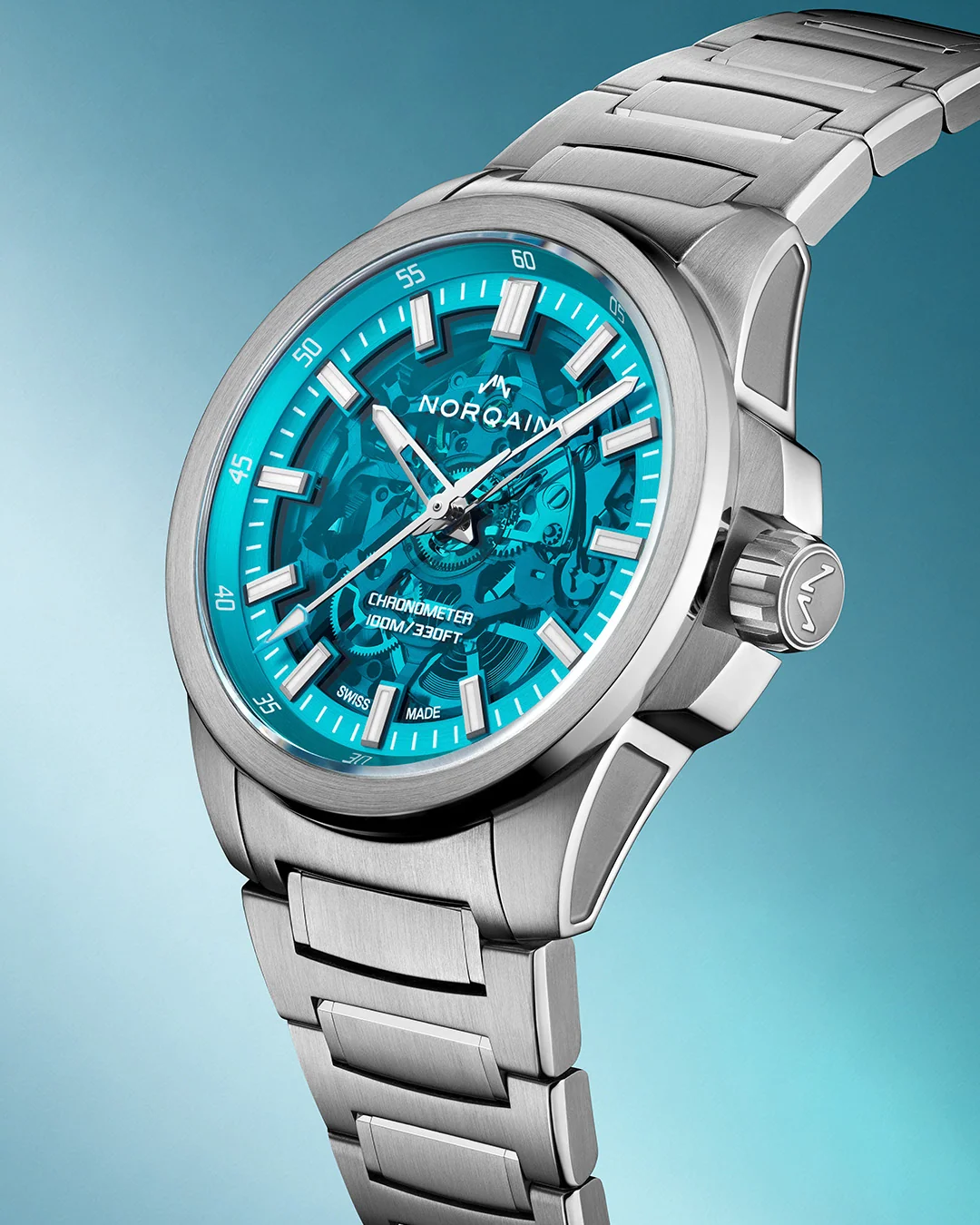
The official photographs make the colour work structurally rather than merely cosmetically. The transparent main plate is tinted Arctic Blue at the centre, allowing bridges, wheels and the balance to remain visible. Toward the perimeter the colour becomes more opaque, creating a calmer ring for the minute track, faceted indexes and hands. That matters on an openworked watch, where visual depth can easily compete with reading the time. White X1 Super-LumiNova on the indexes and white luminous material on the hands provide contrast, while the turquoise tip of the central seconds hand repeats the colder end of the dial’s palette.
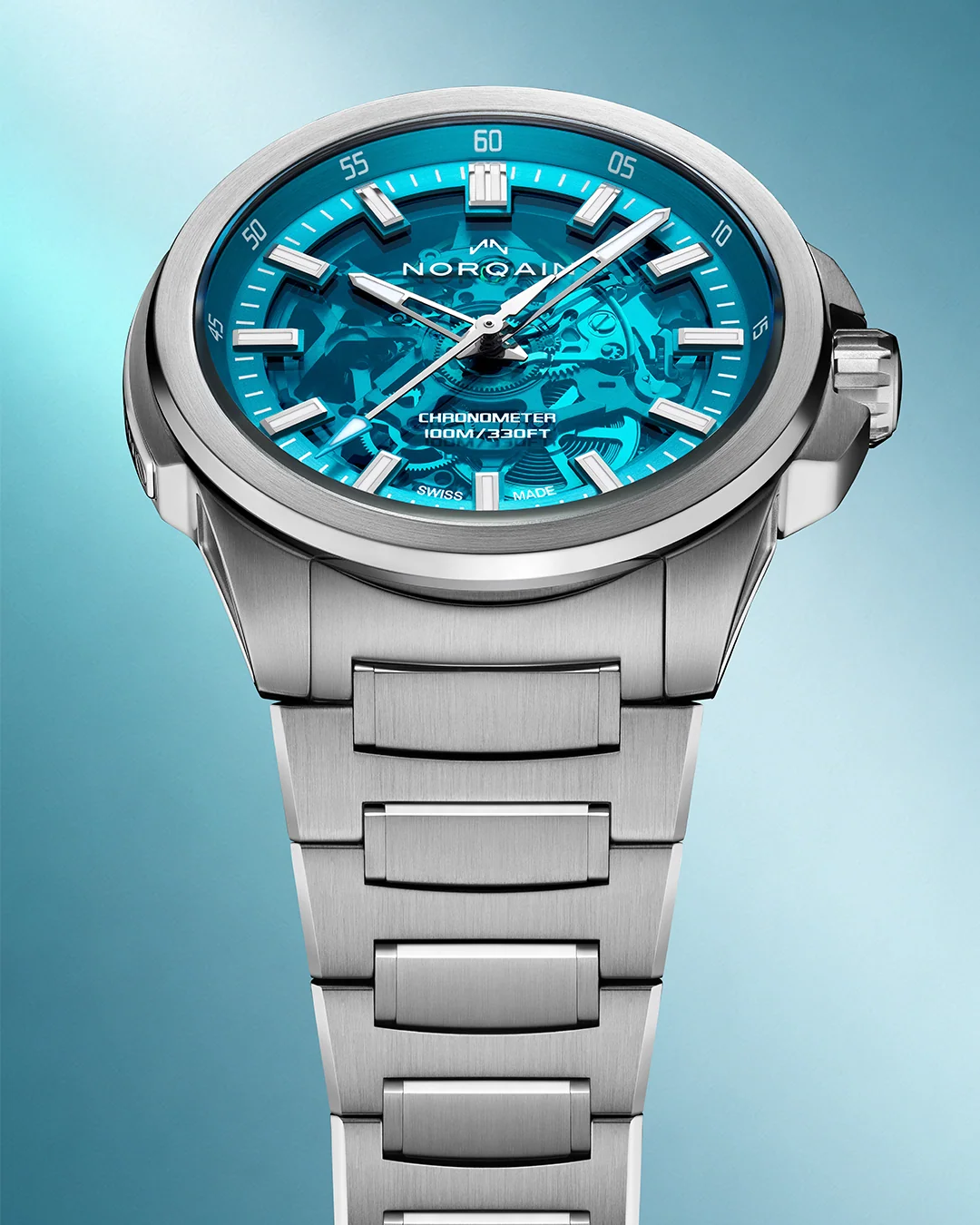
## The bracelet changes the silhouette Norqain describes the bracelet as semi-integrated, a precise distinction. It is attached between identifiable lugs rather than being inseparable from the case architecture, yet its broad first links and narrowed lugs are designed to make the connection read as one continuous form. The asymmetrical central link has a curved lower edge and vertical brushing; polished bevels around the H-shaped links introduce flashes of light without turning the bracelet into jewellery. More important for daily use, the folding clasp contains a micro-adjustment system. That lets the owner accommodate wrist swelling without changing links.
Compare this with the existing 40mm Independence Skeleton reference N3008.07S01.G01. Both use a 40mm steel case, the N08S calibre and 100-metre water resistance. The older sibling is offered on a conventional steel bracelet or patterned rubber and uses a darker anthracite/turquoise treatment. The Arctic Blue model costs more—Norqain’s Swiss store lists CHF 4,300 against CHF 4,250 for the steel G01 sibling—but the difference is not explained by a new calibre or limited production. It is a premium for the new bracelet construction and dial execution. Fifty Swiss francs is small enough that bracelet preference should decide between them, not the headline colour.
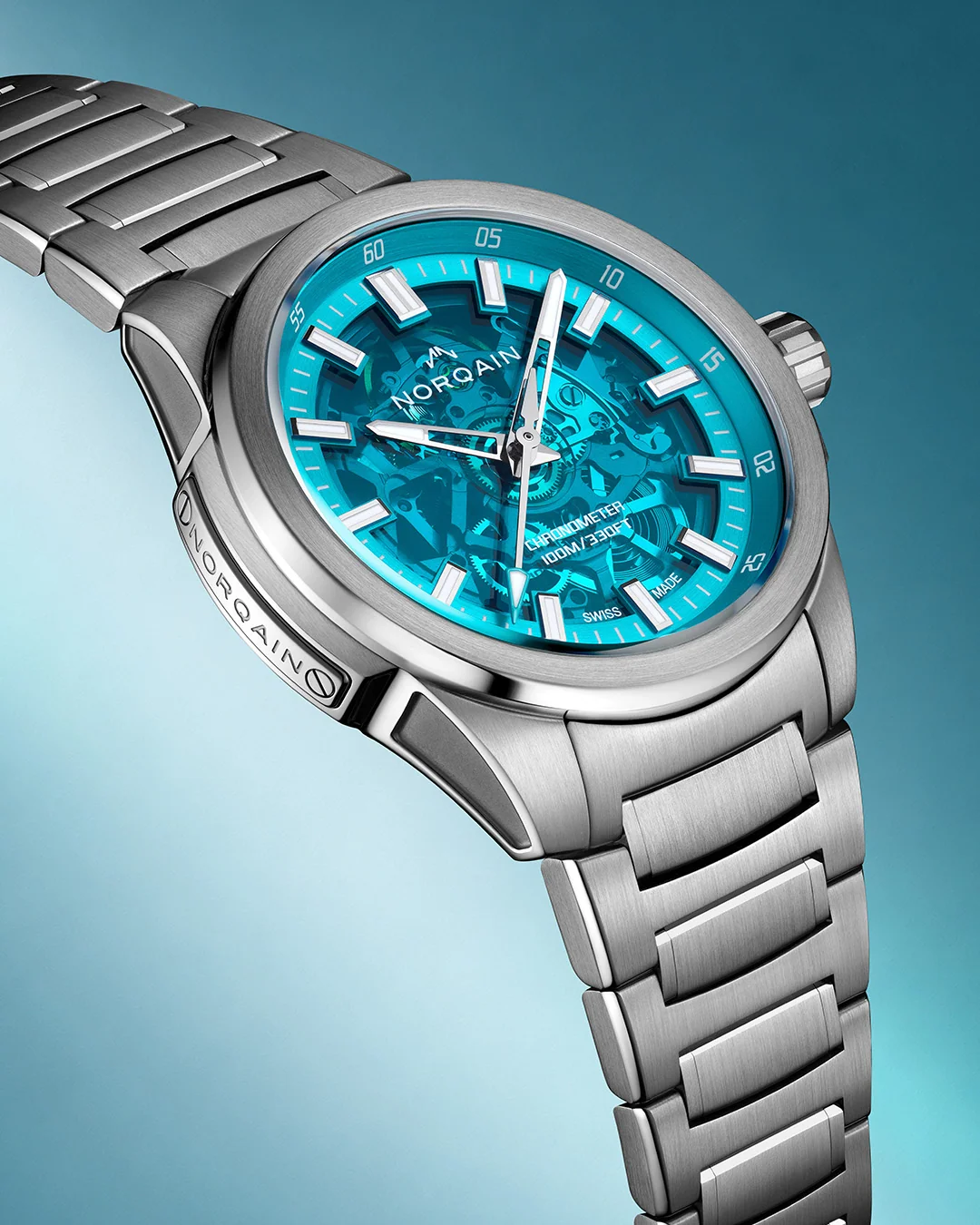
## Familiar dimensions, better visual continuity The case measures 40mm across, 12.05mm thick and 46.3mm from lug to lug, with a 20mm space between the lugs. Those figures place it in the compact end of contemporary skeleton sports watches, but they do not prove comfort. The new bracelet should distribute visual weight more evenly because its first link fills more of the gap below the case. Whether it also improves physical comfort cannot be established from press photographs. Articulation, clasp bulk and the effective first-link span need a wrist test, so this remains a desk-based interpretation.
The watch retains the collection’s engraved steel plate on the case flank, a screw-down crown, a flat sapphire crystal with anti-reflective treatment and a sapphire display back. Water resistance is 100 metres. Together with the bracelet and screw-down crown, those choices support regular wear rather than treating the skeletonised dial as a fragile display piece. Norqain’s combination of brushed surfaces and smaller polished accents also makes practical sense here: the blue transparency supplies enough spectacle without requiring every external surface to compete.
## The movement is known rather than novel The automatic calibre N08S is a skeletonised Sellita SW200-1 S c, personalised with a Norqain oscillating weight. It runs at 28,800 vibrations per hour, has 26 jewels and delivers 41 hours of power reserve. COSC chronometer certification is valuable evidence of rate performance, but it does not transform the movement into an in-house proposition. The architecture is familiar, serviceable and visually exposed from both sides. Buyers choosing between this model and the more expensive Wild ONE Skeleton should notice that the Independence offers 100 metres of water resistance and a conventional steel case, while the Wild ONE family trades toward shock-resistant composite construction and, in some versions, newer manufacture calibres.
That comparison clarifies the Arctic Blue model’s position. It is not the technical flagship of Norqain’s skeleton catalogue, and it does not need to be. Its argument is proportion and cohesion: a 40mm steel watch, a blue openworked dial with an intentionally solid reading track, and a bracelet whose form now appears designed with the case rather than added after it. The CHF 4,300 official price and €4,650 price on Norqain’s Italian store place it above entry-level Sellita skeleton watches, so finishing, chronometer certification and the quality of that bracelet transition carry much of the value case.
## Conclusion The Arctic Blue dial gives this release instant recognition, but the bracelet is the reason to take it seriously as more than a colour update. It addresses the part of a sports watch the wearer handles and sees throughout the day, adds micro-adjustment and makes the established 40mm case look more intentional. Readers already satisfied with the older bracelet gain no new movement and little functional reason to change. New buyers, however, get the most visually resolved steel Independence Skeleton yet. The remaining question is tactile: only a hands-on comparison can establish whether the new first links and clasp feel as coherent as they look.
At a glance
| Brand | NORQAIN |
|---|---|
| Model / reference | Independence Skeleton Arctic Blue; N3008.07S01.Q01.S01 |
| Case material | 316L stainless steel |
| Diameter | 40.00mm |
| Thickness | 12.05mm |
| Lug-to-lug | 46.30mm |
| Crystal | Flat scratch-resistant sapphire crystal with double anti-reflective treatment; sapphire display back |
| Dial | Openworked Arctic Blue dial with transparent main plate and more opaque perimeter; white X1 Super-LumiNova on indexes |
| Movement type / calibre | Automatic skeleton movement; NORQAIN calibre N08S (Sellita SW200-1 S c), COSC-certified |
| Functions | Hours, minutes, central seconds |
| Power reserve | 41 hours |
| Water resistance | 100 metres; screw-down crown |
| Strap / bracelet | Redesigned semi-integrated 316L stainless-steel bracelet with brushed and polished links, folding clasp and micro-adjustment; 20mm lug width |
| Price / currency | CHF 4,300 on NORQAIN’s global store; €4,650 on the Italian store |
| Availability | In stock; permanent collection according to dated launch coverage |
| Edition size | Not limited |