Release Archive
Krayon Anywhere Magnolia: petals that tell you when daylight ends
Magnolia makes painted decoration part of the indication itself, linking its floral composition to the changing length of the day.
- Release date
- Unknown
- Source published
- Not verified
- Added to Chronolume
- 2026-11-11
- Article published
- 2026-11-11
- Research checked
- 2026-11-11
Chronolume · Source-based analysis · Research checked 2026-11-11
Save this watch to revisit later.
Desk-based reading of manufacturer material and visual inspection of official images. No handling, measurements or interviews. Original announcement dates retained; availability and pricing omitted. Expanded on 11 November 2026 after reading the official Magnolia page in the browser (web fetch failed). Interprets petal/scale relation and compares PAC-MAN without claiming a legibility test. Existing photographs, metadata and attribution preserved.
The analysis
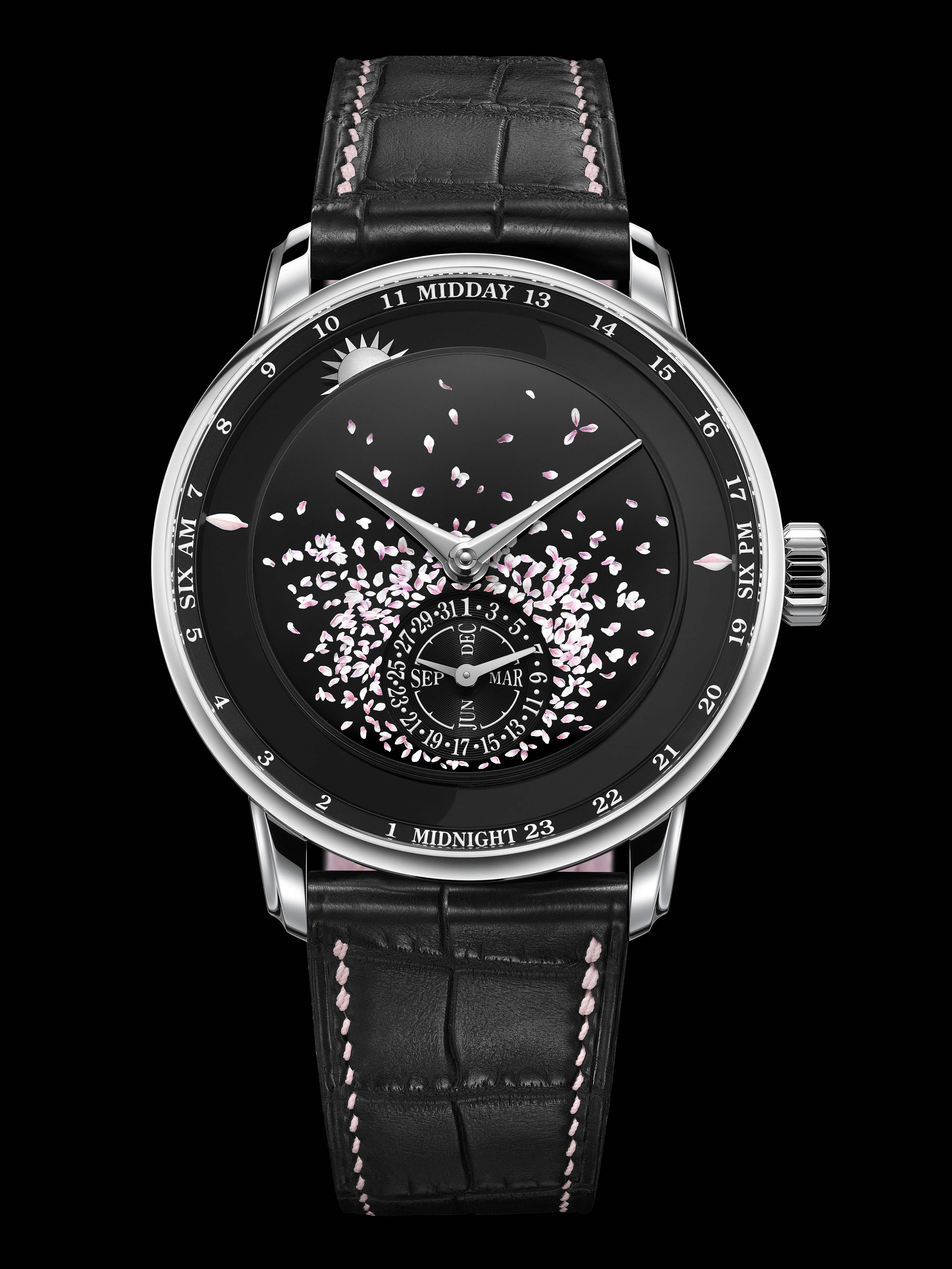
Where does decoration stop and a display begin? Anywhere Magnolia makes that boundary unusually difficult to draw. Two painted petals indicate sunrise and sunset against a 24-hour scale: the upward-facing petal marks dawn and the downward-facing petal marks dusk. Their changing positions give the flower painting a mechanical purpose.

Krayon specifies a series of 15 platinum watches with individually painted black onyx dials. The manually wound C030 provides a stated 72-hour reserve inside a case measuring 39mm across and 9.5mm thick. Date and month sit at six o’clock; conventional central hands retain the familiar time display.

In the official photographs, the dark background allows the pale petals to remain distinct from both the painted branch and the peripheral numerals. That supports a clear design proposition: the motif is not simply placed over the mechanism, but supplies its visual vocabulary. Actual readability in changing light remains untested.
Announced on 11 November 2026, Magnolia is considered here as a distinct artistic interpretation, not a replacement for Chronolume’s existing standard Anywhere coverage. Price and regional availability are not established by the sources used.
The reason this matters is that the painting changes the meaning of an indication without removing its function. A petal can be read as part of a natural scene, then recognised as a boundary on the daylight scale. The wearer moves between those two readings. An ordinary floral dial offers a picture behind the hands; Magnolia asks part of the picture to participate in explaining the day.
Krayon connects the composition to a magnolia tree opposite its manufacture in Neuchâtel. That is the maker’s account of the inspiration, rather than an independently observed visit. It provides a more specific origin for the motif than a general association between flowers and spring. The painted scene is also intentionally varied across the series: the common idea does not require every dial to repeat precisely the same arrangement.
The distinction between central time and daylight information is important. Hours and minutes answer the immediate question of what time it is. Sunrise and sunset describe the relationship between that time and a chosen place. The second reading invites a longer look, especially when the calendar advances through the seasons. The complication is therefore interesting even when its information is not needed for a practical task.
Compare that approach with Krayon’s PAC-MAN interpretation. Both use recognisable imagery to give an unusual indication a vocabulary. PAC-MAN introduces the associations of a game; Magnolia uses growth, falling petals and seasonal change. Neither proves that a pictorial display is faster to read than a plain scale. What changes is the kind of attention the watch asks the owner to bring to it.
The manual-winding specification adds an ownership rhythm of its own. A nominal three-day reserve allows some time away from the wrist, but it does not remove the need to maintain sufficient winding and correct calendar settings. Before commissioning or buying such a watch, an owner should understand how the location is configured and how the display is restored after it stops. The decorative execution does not make those operating questions disappear.
Magnolia’s strongest proposition is the alignment of subject and function: a scene about fleeting natural beauty carries information about the daily availability of light. That is more coherent than an unrelated decorative motif placed over an astronomical mechanism. The judgement is about the design concept and official images, with no claim of measured readability, miniature-painting inspection or hands-on operation.