Release Archive
Krayon Everywhere and Horizon: the difference between a clock and a calculator
A guide to the user-set geographical inputs behind Everywhere’s daylight display, with Horizon kept as a documented family interpretation.
- Release date
- Unknown
- Source published
- Not verified
- Added to Chronolume
- 2026-11-11
- Article published
- 2026-11-11
- Research checked
- 2026-11-11
Chronolume · Source-based analysis · Research checked 2026-11-11

Save this watch to revisit later.
Desk-based reading of manufacturer material and visual inspection of official images. No handling, measurements or interviews. Original announcement dates retained; availability and pricing omitted. Expanded and fact-checked against official documentation on 11 November 2026. Additional discussion distinguishes setting inputs, display interpretation and ownership implications. Existing images, source dates, variant records and attribution preserved.
The analysis
Everywhere is easiest to understand by separating what it displays from what the owner sets. The outer day-and-night sectors show sunrise, sunset and daylight duration. Behind that result sit adjustable latitude, longitude, UTC offset and calendar information. A function selector and crown allow the owner to change those inputs.
References compared
The table highlights differences; shared specifications are covered in the text. Prices retain their stated region and date.
| Reference / configuration | What changes | Source |
|---|---|---|
| Configuration 1 | Shared specifications described above. | Krayon official product information and press archive ↗ 2017-06-21 |
| Configuration 2 | Shared specifications described above. | Krayon official product information and press archive ↗ 2018-06-26 |
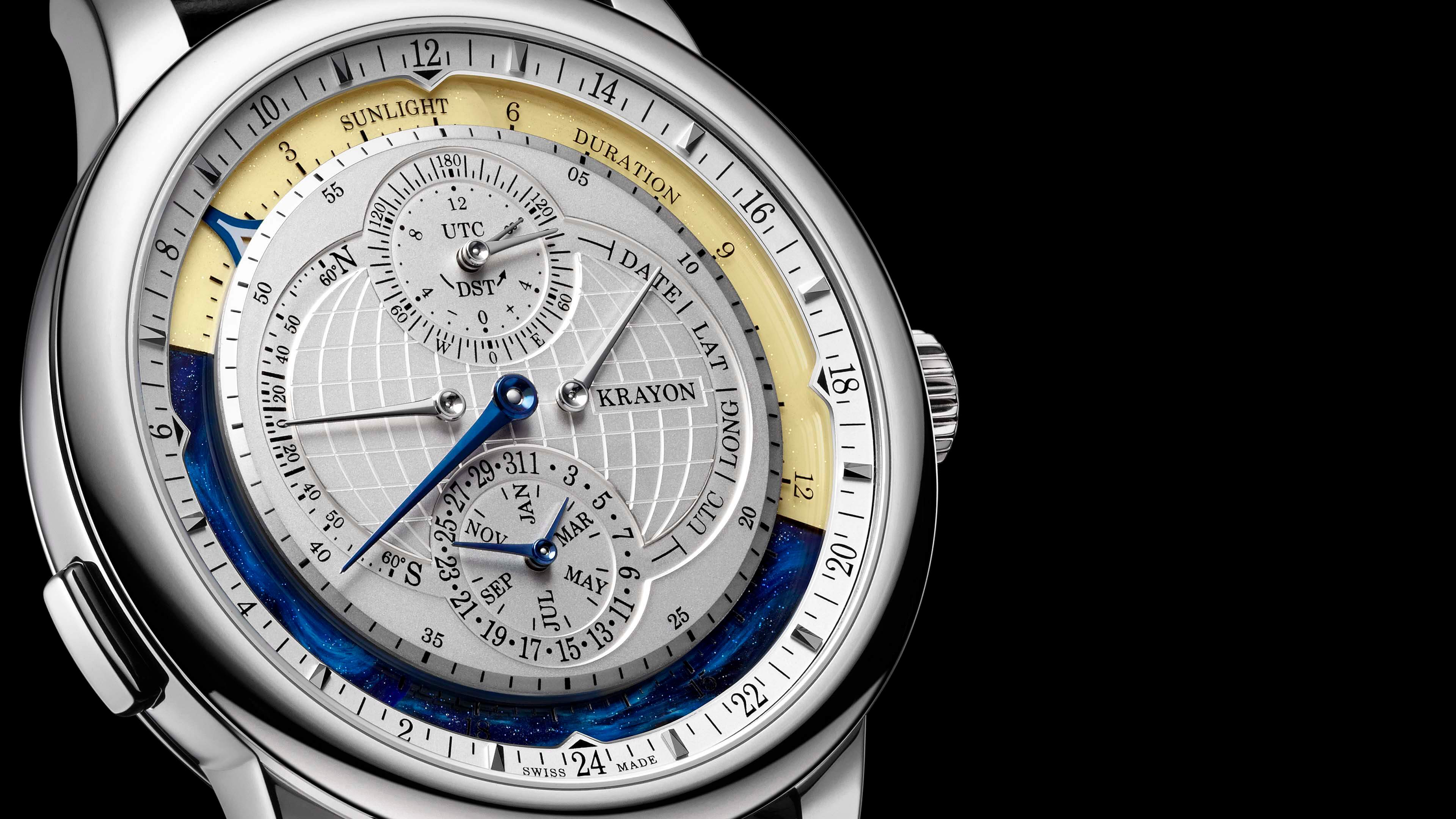
The manufacturer describes the USS as an automatic movement with a micro-rotor and 595 components. Its geographical flexibility comes with an important boundary: the latitude setting runs from 60 degrees south to 60 degrees north. This is not an unrestricted promise of daily sunrise and sunset at the poles.

The useful design distinction is between a destination and a calculation. Reading the daylight boundary is relatively direct; preparing that reading requires understanding geographical inputs. The dial assigns space to both activities rather than concealing setup entirely. This is a desk-based explanation, not an assessment of how quickly the controls can be learned.

Everywhere Horizon, announced on 26 June 2018, is a personalised interpretation within this family. Its 43mm white-gold case combines engraving with a diamond-set bezel and lugs. Krayon lists an 80-hour reserve for Horizon, while the original Everywhere page gives 72 hours; those figures should not be silently treated as interchangeable.

The original Everywhere press archive is dated 21 June 2017. These are historical additions, not November 2026 releases. Horizon’s decoration and separate specifications are retained here rather than creating a second near-identical explanation of the same astronomical display.

The important distinction is between changing the time shown by a watch and changing the place for which daylight is calculated. Moving the hands to match a destination is only part of the problem. Latitude and longitude identify the geographical point, while the time-zone setting translates the result into a civil-time reading. A traveller therefore needs to think about location and local clock time separately. An incorrect input can produce an apparently plausible display for the wrong place.
This explains why the dial gives space to settings that an ordinary watch would not need to show. The extra indicators are not simply decorative evidence of complexity. They let the owner inspect the assumptions behind the result. A clearer-looking face with hidden geographical settings might be more immediately attractive, but it would make this relationship less visible. Everywhere treats the calculation as part of the experience rather than disguising it as an ordinary calendar.
A useful comparison is with Anywhere Magnolia. Magnolia turns the daylight indication into an image, whereas Everywhere places greater visual emphasis on the machinery of choosing the inputs. These are different priorities, even though both direct attention towards sunrise and sunset. Someone considering either should establish which settings are intended for the owner and which require a watchmaker; the name of a model is not a complete operating guide.
Horizon introduces another layer: personalisation changes the frame through which the same underlying idea is encountered. Engraving and gem-setting do not make the calculation more universal. They make the particular object more individual. It is therefore worth separating a preference for decorative treatment from an assessment of whether the astronomical display is useful to its owner.
The attraction is strongest for someone who wants to pay attention to a place over the course of a year. Daylight duration is a slower kind of information than elapsed seconds, and the changing sectors reward repeated observation. This remains an explanation from official documentation rather than a control tutorial or a test of astronomical accuracy. Current pricing, servicing arrangements and the exact specification of a commissioned example should be established directly with Krayon.